Mexican Air Force: A Century of Aviation History
The history of the Fuerza Aérea Mexicana (FAM) is a narrative of rapid evolution, transitioning from a handful of daring pioneers in the early 20th century to a modern force capable of supersonic flight and complex special operations. From its roots in the Mexican Revolution to its role in internal security and international conflict, the FAM has mirrored the political and technological shifts of the nation it serves.
The Dawn of Flight and the Mexican Revolution
The foundation of Mexican military aviation began when President Francisco Madero sent five pioneers—Juan Pablo and Eduardo Aldasoro, Alberto and Gustavo Salinas, and Horacio Ruiz—to New York to master the art of flying. Upon their return in 1913, they served as both pilots and instructors for the next generation.
The official precursor to the Air Force was the Army's Auxiliary Aerial Militia Squadron (Escuadrilla Aérea de la Milicia Auxiliar del Ejército), established in April 1913 by General Manuel Mondragón. Early operations were centered at Campo de Balbuena, Mexico City's first airport, where pilots Miguel Lebrija and Juan Guillermo Villasana conducted bombing tests.
While initially limited to reconnaissance, the force achieved a historic milestone on May 10, 1913, when Didier Masson and Joaquín Bauche Alcalde dropped 15 kilograms of dynamite on rebel boats. This event is recognized as the first instance of air-to-sea bombing. Masson also conducted the first-ever aerial leaflet drops.
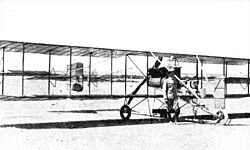
On February 5, 1915, Venustiano Carranza, leader of the Constitutionalist Army, formally founded the Military Aviation Arm (Arma de Aviación Militar), with Lt. Alberto Salinas Carranza serving as its first commander.
Restructuring and Internal Conflicts (1920–1939)
In 1920, the FAM underwent a massive overhaul under the leadership of U.S. Colonel Ralph O'Neill. Finding the existing fleet of 13 national prototypes obsolete or ill-equipped, O'Neill introduced the term "Fuerza Aérea Mexicana" and modernized the fleet with French Farman F.50 night bombers and British Avro 504K and 504J aircraft, the latter of which were eventually produced locally as the Avro Anáhuac.
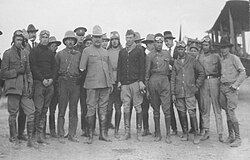
O'Neill implemented the "Gosport System"—an early intercom invented by Robert Smith-Barry—to provide in-air commands, and established specialized squadrons for fighters, bombing, observation, and reconnaissance.
Throughout the 1920s, the FAM was instrumental in suppressing various rebellions:
- The Delahuertista Rebellion (1923): The government utilized de Havilland DH-4B aircraft provided by the United States to defeat a coup led by former President Adolfo de la Huerta.
- The Cristero War (1926–1929): A religious conflict sparked by President Plutarco Elías Calles' attempt to create a national church independent of Rome.
- The Escobar Rebellion (1929): A critical coup led by General José Gonzalo Escobar. The FAM, bolstered by U.S.-supplied OU-2M Corsairs, Douglas O-2Ms, Stearmans, and Wacos, secured a decisive victory at the Battle of Jiménez.
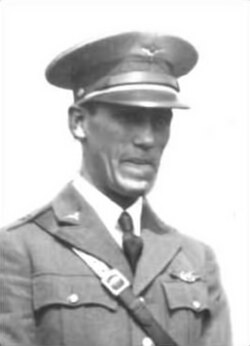
To reduce dependence on foreign imports, Mexico established the National Aviation Workshops (TNCA) in 1925 to design and build domestic aircraft and engines. Later, in 1938, the FAM successfully suppressed the rebellion of General Saturnino Cedillo using a mixed fleet including V-99M Corsairs.
Global Conflict and the Jet Age
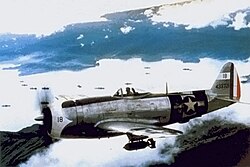
During World War II, Mexico's military aviation reached the global stage with the Escuadrón 201. This P-47D fighter squadron, part of the Mexican Expeditionary Air Force, deployed to the Pacific to fight the Empire of Japan. Comprising 25 aircraft and 300 personnel, the unit flew 96 combat missions over Formosa (Taiwan) and the Philippines during the Battle of Luzon.
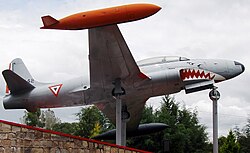
The Cold War brought the transition to jet propulsion. The first jet, the de Havilland Vampire Mk.I, arrived in 1960. Nicknamed "The Flying Avocado" due to its ovoid shape and green camouflage, it was eventually replaced by the Lockheed T-33 Shooting Star in 1961, which became a mainstay for patrol and interception duties for decades.
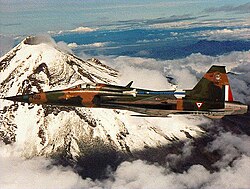
In 1982, the FAM entered the supersonic era with the acquisition of 12 Northrop F-5E/F Tiger II jets. These aircraft became the primary fighter platform, though they have faced challenges with aging and maintenance in recent years.
Modern Operations and Future Outlook
The 1994 Zapatista (EZLN) uprising in Chiapas highlighted a critical need for rotary-wing assets. The FAM deployed Bell 212, MD.530F, and Bell 205/206 helicopters to support ground troops. This conflict led to a significant expansion of the fleet, including the acquisition of UH-60L Black Hawks and MD.530MG "Defender" helicopters for special operations.
Recent years have been marked by a focus on the drug war, emphasizing UAVs (Unmanned Aerial Vehicles), surveillance platforms, and rapid transport. While the F-5 fleet has been largely retired due to costs, efforts began in 2023 to restore at least nine airframes to active service.
Looking forward, the FAM is seeking to modernize its fighter capability. General Román Carmona Landa has indicated plans to procure 12 new fighters by 2028, considering options such as the F-16 Fighting Falcon, Saab JAS 39 Gripen, FA-50 Fighting Eagle, or the M-346 Master.
Key Facts
- First Air-to-Sea Bombing: Occurred on May 10, 1913, using 15kg of dynamite.
- Overseas Combat: Escuadrón 201 is the only Mexican unit to have seen overseas combat (WWII).
- Supersonic Entry: The Northrop F-5 Tiger II provided Mexico's first supersonic capability in 1982.
- The "Flying Avocado": The nickname given to the de Havilland Vampire Mk.I jets.
- Modernization Goal: The FAM aims to acquire 12 new multi-role fighters by 2028.
| Era/Conflict | Key Aircraft | Primary Role |
|---|---|---|
| Mexican Revolution | Curtiss Sonora / Farman F.50 | Observation & Bombing |
| 1920s Rebellions | Avro 504 / DH-4B | Air Superiority & Support |
| World War II | P-47D Thunderbolt | Fighter/Combat (Pacific) |
| Cold War | T-33 Shooting Star / F-5 Tiger II | Interception & Supersonic Patrol |
| Chiapas Conflict | Bell 212 / UH-60L Black Hawk | Special Operations & Transport |
Frequently Asked Questions
Who were the pioneers of the Mexican Air Force?
The foundation was led by Juan Pablo and Eduardo Aldasoro, Alberto and Gustavo Salinas, and Horacio Ruiz, who were trained in New York under the direction of President Francisco Madero.
What was the significance of Escuadrón 201?
Escuadrón 201 was a P-47D fighter squadron that served in the Pacific Theater during World War II, conducting 96 missions over the Philippines and Formosa, making it the only Mexican unit to engage in overseas combat.
Why was the de Havilland Vampire called "The Flying Avocado"?
Mexican crews gave it this nickname because of the aircraft's ovoid fuselage shape and its dark green night camouflage.
How did the FAM support the government during the Chiapas conflict?
The FAM deployed a large fleet of helicopters, including Bell 212s and MD.530Fs, to provide fire support and transport for ground troops fighting the Zapatista Army of National Liberation (EZLN).
What is the future of Mexico's fighter fleet?
The FAM is planning to replace its aging F-5 Tiger IIs with 12 new fighters by 2028, evaluating options like the F-16, Gripen, FA-50, and M-346 for air defense and ground attack roles.