Mestalla Stadium: The Historic Heart of Valencia Football
Located in the vibrant city of Valencia, Spain, the Mestalla Stadium (Estadio de Mestalla) stands as a monument to footballing passion and architectural uniqueness. As the home of Valencia CF, it is not only the largest stadium in the Valencian Community but also holds the distinction of being the oldest stadium currently active in La Liga since January 2020.
The stadium derives its name from the historic Mestalla irrigation canal, a system developed during the Moorish dynasty between the 10th and 11th centuries. Originally, this canal ran outside the south stand, requiring visitors to jump over it to enter the grounds.
Key Facts
- Capacity: 49,430 seats.
- Ranking: 8th-largest stadium in Spain.
- Status: UEFA category four stadium.
- Distinction: Recognized as one of the steepest stadiums in the world, and the steepest in Europe.
- Inauguration: 20 May 1923.
Architectural Design and Atmosphere
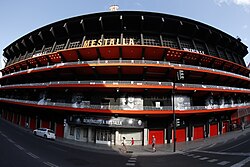
Mestalla is world-renowned for its steep seating arrangements, which create an intimidating and immersive atmosphere. The highest tier reaches an incline of approximately 34–35 degrees, placing it very close to the legal safety limit of 37 degrees set by FIFA and UEFA. This verticality, combined with the close proximity of the spectators to the pitch, distinguishes it from other iconic venues like the San Siro, Maracanã, and Signal Iduna Park.
A Century of History
Designed by architect Francisco Almenar Quinzá, the stadium opened on 20 May 1923 with a friendly match between Valencia and Levante. While it began with a capacity of 17,000, it grew to 25,000 by 1927 and eventually reached 60,000 following renovations in the 1950s.
War and Natural Disaster
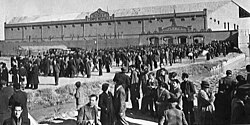
The stadium's history has not been without hardship. During the Spanish Civil War, the site was utilized as a storage warehouse and a concentration camp, leaving the grandstand damaged and the terraces empty. Later, in October 1957, the Turia River broke its banks, causing severe flood damage. The stadium was restored and reopened during the 1959 Fallas festivities, featuring new artificial lighting.
Naming and Evolution
From 1969 to 1994, the venue was known as the Estadio Luis Casanova in honor of the club president. However, in 1994, Casanova requested that the original name, Mestalla, be restored. Other significant updates include the 1972 opening of the avant-garde club head office and the 1973 removal of fourteen rows of standing terraces to make room for goal seats.
International Prestige and Major Events
Mestalla has long been a preferred venue for high-stakes international football. It has hosted the Spain national football team since 1925 and served as a key venue for the 1982 FIFA World Cup. During the 1992 Summer Olympics in Barcelona, Mestalla hosted all of Spain's matches leading up to the final, culminating in a Gold medal victory.
The stadium has also hosted ten Copa del Rey finals, including four legendary El Clásico finals between Real Madrid and Barcelona in 1936, 1990, 2011, and 2014. Most recently, it hosted the second leg of the UEFA Nations League quarter-finals in 2025.
1982 FIFA World Cup Matches
| Date | Match | Result | Round | Attendance |
|---|---|---|---|---|
| 16 June 1982 | Spain vs. Honduras | 1–1 | Group 5 | 49,562 |
| 20 June 1982 | Spain vs. Yugoslavia | 2–1 | Group 5 | 48,000 |
| 25 June 1982 | Spain vs. Northern Ireland | 0–1 | Group 5 | 49,562 |
The Future: Nou Mestalla
While the historic Mestalla continues to serve the club, plans for a replacement, the Nou Mestalla, began in 2007. Construction was delayed for years due to a financial crisis, but work resumed on 10 January 2025. The new stadium is designed for a capacity of 61,500 and is estimated for completion before the 2027-28 season.
Transport and Access
The stadium is easily accessible via Valencia's public transit network. The primary metro access is through the Aragó station, serving Lines 5 and 7.
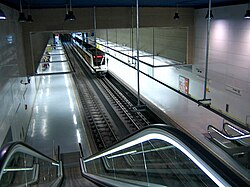
Visitors can also use the Facultats-Manuel Broseta station (Lines 3 and 9) or various bus lines, including line 32 via Amadeo of Savoia street and line 71 via Reyes Prosper street.
Frequently Asked Questions
Why is Mestalla Stadium considered one of the steepest in the world?
The stadium's highest tier has an incline of approximately 34–35 degrees, which is very close to the FIFA and UEFA safety limit of 37 degrees, creating a vertical wall of spectators.
What is the capacity of the current Mestalla Stadium?
The stadium currently has a capacity of 49,430 seats.
When was the stadium inaugurated?
Mestalla was inaugurated on 20 May 1923, with a friendly match between Valencia and Levante.
What is the Nou Mestalla?
The Nou Mestalla is the planned replacement stadium for Valencia CF. It is designed to hold 61,500 spectators and is expected to be completed before the 2027-28 season.
Has the stadium ever changed its name?
Yes, between 1969 and 1994, it was named Estadio Luis Casanova to honor the club's president before reverting to its original name.