Mercer County Community College
Mercer County Community College (MCCC) is a public community college dedicated to providing accessible, high-quality education to a diverse student population. With an open admission policy, the institution serves as a vital educational hub in New Jersey, offering a blend of transfer-focused associate degrees and career-preparatory programs designed to launch students into professional fields or four-year universities.
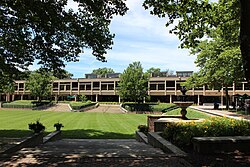
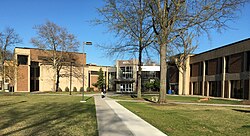
The college operates across multiple sites, including the expansive 292-acre West Windsor Campus, which opened in 1972, and the James Kerney Campus located in downtown Trenton. Additionally, MCCC manages the Mercer County Fire Academy at the Dempster Fire Training Center in Lawrenceville.
Key Facts
- Established: 1966
- Accreditation: Middle States Commission on Higher Education
- Student Population: Approximately 9,000 students
- Campuses: West Windsor and James Kerney (Trenton)
- Mascot: Maverick the Mustang
- Colors: Green and gold
History and Evolution
While MCCC was formally founded in 1966, its roots in Trenton date back to at least 1890 with a drawing school. This evolved into the Trenton School of Technical Science and Art in 1898, which later became the School of Industrial Arts in 1901.
By 1947, the institution became the Trenton Junior College and School of Industrial Arts (TJC). After gaining authorization to confer Associate of Arts and Science degrees in the 1950s and receiving full accreditation from the Middle States Association in 1962, TJC merged with MCCC in 1966 to create the modern institution known today.
Academic Excellence and Specialized Programs
MCCC provides a wide array of academic pathways. The University Center, which broke ground in 2018, allows students to pursue bachelor's and master's degrees through partnerships with institutions such as Rutgers, Felician University, Fairleigh Dickinson University, William Paterson, and Wilmington University.
The Honors Program
Established in 2006, the Mercer Honors Program offers a rigorous pathway for matriculated students. These smaller, discussion-based courses are designed to challenge students and prepare them for upper-division coursework at four-year institutions. The program also hosts an annual student-led conference, such as the 2019 event focusing on millennial challenges.
The DREAM Program
In 2005, MCCC and The College of New Jersey utilized a $300,000 grant from Laura and Steve Riggio to develop the DREAM Program. This initiative provides inclusive special-needs education specifically for students with cognitive disabilities.
Transfer Success
MCCC is recognized as a strong pipeline for prestigious universities. Notably, in 2020, two students transferred from MCCC to Princeton University. Princeton has since launched initiatives to attract qualified community college transfers, citing MCCC as a targeted example of a successful partner institution.
Accredited Professional Programs
Beyond general education, MCCC maintains specialized accreditations for several career-focused programs to ensure industry standards are met.
| Program | Accrediting Body |
|---|---|
| Nursing | Accreditation Commission for Education in Nursing |
| Funeral Service | American Board of Funeral Service Education |
| Physical Therapist Assistant | American Physical Therapy Association |
| Radiography | Joint Review Committee on Education in Radiologic Technology |
| Montessori Teacher Education | Montessori Accreditation Council for Teacher Education |
| Medical Laboratory Technician | National Accrediting Agency for Clinical Laboratory Sciences |
| Paralegal | American Bar Association |
| Aviation Flight Technology | Aviation Accreditation Board International |
Campus Life and Student Media
The student experience at MCCC is enriched by a variety of media outlets and performing arts venues. The Kelsey Theatre, a 385-seat venue at the West Windsor Campus, hosts numerous productions and is home to ten different theatre companies as of 2026.
Student Journalism and Broadcasting
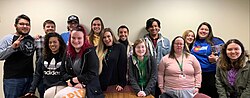
Founded in 1968, The College Voice is the student newspaper. After being revived in 2008, it has won over 100 New Jersey Press Association awards and transitioned to a "digital-first" model in 2023.
![Students from The College Voice won 18 awards from the New Jersey Press Foundation in 2019[41]](/images/aa/50/aa5063d2465cd667a2b3a6a81fdd2970db17a767013e9d151afdb733f62ef950.jpg)
Broadcasting is also a cornerstone of campus life. Mercer County Television (MCTV 26) provides real-world experience for television students, while WWFM: The Classical Network broadcasts classical music on HD1 and jazz (JazzOn2) on HD2. WWFM received the Deems Taylor/Virgil Thomson Radio Broadcast Award in 2014.
Athletics and Alumni
The MCCC Mustangs compete in the NJCAA Region 19 and the Garden State Athletic Conference. The college has seen significant success in baseball, softball, men's soccer, and men's lacrosse, with several sports winning Region 19 championships during the 2017–2018 and 2018–2019 seasons.
The college's athletic legacy includes sending players to Major League Baseball, such as Dave Gallagher, Dan Gakeler, and Heath Fillmyer.

Notable alumni span various fields, including musician Trey Anastasio (Phish), Top Fuel champion Antron Brown, and New York Times reporter Kenneth R. Rosen.
Frequently Asked Questions
What is the admission policy at Mercer County Community College?
MCCC maintains an open admission policy, meaning it is accessible to all students seeking to enroll in its programs.
Where are MCCC's campuses located?
The college has a main 292-acre campus in West Windsor and the James Kerney Campus in downtown Trenton, as well as the Mercer County Fire Academy in Lawrenceville.
Can students earn a bachelor's degree at MCCC?
Yes, through the University Center, MCCC partners with institutions like Rutgers and Fairleigh Dickinson University to offer bachelor's and master's programs on campus.
What is the student-to-faculty ratio?
The student-faculty ratio at MCCC is 16:1.
Does MCCC have programs for students with disabilities?
Yes, the DREAM Program was specifically developed to provide inclusive education for students with cognitive disabilities.