Mental Workload: Theories, Modeling, and Cognitive Resource Management
In the fields of human factors and system design, mental workload (MWL) is a critical metric used to ensure safety and efficiency. While there is no single universally agreed-upon definition, it is generally understood as the relationship between the mental processing resources a person possesses and the demands imposed by a specific task. More technically, MWL represents the activation of a finite pool of limited cognitive resources used to process a primary task over time, influenced by both external environmental factors and the internal characteristics of the operator.
The primary goal of workload modeling—the analytical technique used to measure and predict these demands—is to maintain a manageable balance. By avoiding both overload (too much demand) and underload (too little demand), designers can create safety-critical systems that minimize human error and optimize performance.
Key Facts
- Resource Limitation: Human cognitive capacity is finite; exceeding this limit leads to performance decrements or errors.
- The Underload Risk: Performance does not only drop when workload is too high; sustained low workload can cause boredom and a loss of situational awareness.
- Parallel Processing: Humans can perform multiple tasks simultaneously if those tasks draw from different cognitive resource pools.
- Workload Debt: High cognitive demand can lead to "workload debt," where low-priority tasks are postponed, potentially leading to a "cascade" of failures.
Theoretical Frameworks of Cognitive Workload
Wickens' Multiple Resource Theory (MRT)
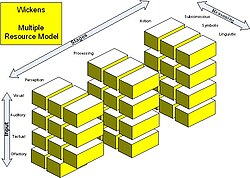
Proposed by Wickens in 1984, the Multiple Resource Theory (MRT) suggests that humans do not rely on a single central pool of information processing. Instead, we possess several distinct resource pools. If two tasks require the same resource, they must be processed sequentially, which can lead to bottlenecks. However, if tasks utilize different resources, they can be processed in parallel.
According to this theory, performance drops occur when there is a shortage of a specific resource. For example, a simple task like dialing a phone creates little demand. However, if a second task is introduced that requires the same cognitive components, the resulting excess workload can cause slower performance or errors.
The VCAP Model
Building on similar logic, McCracken and Aldrich (1984) decomposed all tasks into four specific processing resources, known as VCAP:
- Visual: External visual stimuli that require attention.
- Cognitive: The level of internal information processing required.
- Auditory: External sound-based stimuli that require attention.
- Psychomotor: The physical actions required to complete the task.
Training and Resource Integration
Joseph Hopkins proposed that complex skills are essentially the result of resolving resource conflicts. Through training, conflicting workload demands are reduced via higher-level processing or predictive time sequencing. For instance, a novice driver may struggle to steer and change gears simultaneously because both tasks compete for the same resources. An experienced driver integrates these into a single skill, allowing them to change gears early (predictive sequencing) to free up resources for steering.
Creating and Applying Workload Models
Developing a workload model begins with a detailed task analysis. This process defines the sequence of tasks, the timing involved, and the background scenario. Each task is broken down into its VCAP components and assigned numerical values based on established rating scales.
These values are then summed across concurrent tasks to identify critical points of high demand. This allows designers to compare a new system's impact against a baseline. Advanced models, such as those developed by K. Tara Smith (2007), integrate the theories of Wickens, McCracken, Aldrich, and Hopkins to predict how workload changes based on an operator's experience and training level.
| Assessment Goal | Key Question |
|---|---|
| Capability | Does the operator have the capacity to perform the required tasks? |
| Spare Capacity | Is there enough remaining capacity to handle emergencies or additional tasks? |
| Optimization | Can equipment be altered to increase or decrease the mental workload? |
| Comparison | How does the workload of a new system compare to the legacy system? |
Cognitive Workload in Time-Critical Decision Making
The medium through which information is presented significantly impacts cognitive load. In high-pressure situations, relying on a single mode of communication (e.g., only visual alerts) can become a limiting factor. Balancing information across different channels—such as visual, auditory, and haptic (touch)—is essential to prevent human error or delayed decision-making.
K. Tara Smith identified two critical phenomena in these environments:
- Workload Debt: This occurs when the workload is too high to complete all tasks in the available time, leading the operator to consciously or subconsciously postpone low-priority tasks.
- Workload Debt Cascade: This happens when postponed tasks accumulate to the point where the operator can no longer catch up, resulting in a failure of subsequent activities.
Frequently Asked Questions
What happens if mental workload is too low?
Low workload, known as underload, is not necessarily ideal. It can lead to boredom, reduced alertness, and a loss of situational awareness, which can be just as dangerous as overload in safety-critical environments.
How does training reduce cognitive workload?
Training allows different task functions to be integrated into a single new skill. This reduces resource conflicts through higher-level processing or predictive time sequencing, meaning the operator no longer needs to consciously manage each individual component of the task.
What is the difference between workload debt and a workload debt cascade?
Workload debt is the initial act of postponing low-priority tasks because the current demand exceeds capacity. A workload debt cascade is the cumulative effect where those postponed tasks pile up, eventually causing the operator to fail in their subsequent duties.
Can humans process multiple tasks at once?
Yes, according to Multiple Resource Theory, humans can process tasks in parallel as long as the tasks utilize different resource pools (e.g., one visual task and one auditory task). If tasks share the same resource, they must be processed sequentially, increasing the risk of overload.