Mediterranean Games: A Legacy of Regional Sporting Excellence
The Mediterranean Games are a premier multi-sport event designed to foster athletic competition and cultural exchange among nations bordering the Mediterranean Sea. Organized by the International Committee of Mediterranean Games (CIJM), the event brings together athletes from three continents—Africa, Asia, and Europe—every four years to compete in a wide array of disciplines.
From its inception in the mid-20th century to its modern iterations, the Games serve as a vital bridge between diverse cultures, utilizing the spirit of sport to unite the Mediterranean basin.

Key Facts
- Frequency: Held every four years.
- Inaugural Event: 1951 in Alexandria, Egypt.
- Most Recent Event: 2022 in Oran, Algeria.
- Upcoming Event: 2026 in Taranto, Italy.
- Governing Body: International Committee of Mediterranean Games (CIJM), headquartered in Athens.
- Participation: Currently 26 participating countries.
History and Evolution
The concept for the Games was proposed during the 1948 Summer Olympics by Muhammed Taher Pasha, then chairman of the Egyptian Olympic Committee and vice-president of the International Olympic Committee (IOC), with support from IOC member Ioannis Ketseas. The event was preceded by smaller regional competitions, including the Mediterranean Athletics Championships (1947–1949) and the Mediterranean Cup football competition (1949–1950).
The first official Games opened in October 1951 in Alexandria, Egypt. This landmark event featured 734 athletes from 10 countries competing across 13 sports. By 1955, during the second Games in Barcelona, a supervisory body was created to manage the event, which eventually became the International Committee for the Mediterranean Games (ICMG/CIJM) on June 16, 1961.
Over the decades, the Games have been hosted by twelve different countries: Egypt, Tunisia, Algeria, and Morocco in Africa; Spain, Italy, Turkey, Yugoslavia, Greece, and France in Europe; and Lebanon and Syria in Asia.
![Cities that have hosted the Mediterranean Games [needs update]](/images/60/a7/60a7a07de188f7058ecdf7da405ba17837dbbce1faca5d31cb10d59520c798fb.png)
Scheduling and Timing
The timing of the Games has shifted over time. For the first eleven editions, the event took place one year before the Summer Olympics. Starting in 1993, the schedule moved to the year following the Olympics. However, this has seen exceptions; in 1993, the Games were held only two years after the 1991 edition, and in 2018, the calendar was reset to a mid-even year.
Participation and Membership
Currently, 26 nations participate in the Games. While the primary criteria for membership is bordering the Mediterranean Sea, several countries participate despite not meeting this geographic requirement, including Portugal, Andorra, Kosovo, San Marino, Serbia, and North Macedonia.
- Africa: Algeria, Egypt, Libya, Morocco, and Tunisia.
- Asia: Lebanon and Syria.
- Europe: Albania, Andorra, Bosnia and Herzegovina, Croatia, Cyprus, France, Greece, Italy, Kosovo, Malta, Monaco, Montenegro, North Macedonia, Portugal, San Marino, Serbia, Slovenia, Spain, and Turkey.
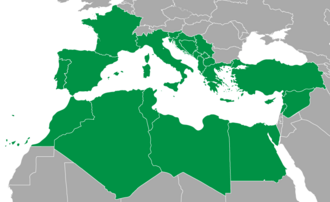
Membership has evolved, with Kosovo joining in 2015 and debuting in 2018. Notably, Israel and Palestine have not participated, and Great Britain (representing Gibraltar and Akrotiri and Dhekelia) does not compete. In 2023, calls were made by the European Olympic Committees president to discuss the admission of both Israel and Palestine.
Symbols and Organization
The official symbol of the Games consists of three rings representing the three continents involved: Asia, Africa, and Europe. The rings are designed with wavy lower edges, symbolizing their immersion in the Mediterranean Sea. A tradition of the closing ceremony involves transferring the flag to the next host city.
The CIJM maintains its permanent seat in Athens, Greece, as a tribute to the country's leading role in the institution. While most host cities have been coastal, the 2030 Games in Pristina will mark the first time the event is hosted in a non-coastal city.
Competitive Overview
Throughout its history, the Mediterranean Games have featured 39 different sports. While staples like athletics, swimming, and football have been present since 1951, newer additions include 3x3 basketball (2018) and upcoming 2026 sports such as Padel and Skateboarding.
Italy has historically dominated the medal table, consistently ranking as the top country across most editions.
| Metric | Details |
|---|---|
| First Edition | 1951 (Alexandria, Egypt) |
| Most Successful Nation | Italy (Rank 1 All-time) |
| Total Participating Nations | 26 |
| Total Sports Featured | 39 |
| Next Host City | Taranto, Italy (2026) |
Frequently Asked Questions
Which country has won the most medals in the Mediterranean Games?
Italy is the most successful nation in the history of the Games, ranking first on the all-time medal table with 2,462 total medals.
Who organizes the Mediterranean Games?
The event is organized by the International Committee of Mediterranean Games (CIJM), which is headquartered in Athens, Greece.
Can countries that do not border the Mediterranean Sea participate?
Yes. Several countries that do not border the sea participate, including Portugal, Andorra, Kosovo, San Marino, Serbia, and North Macedonia.
When and where will the next Mediterranean Games be held?
The next edition is scheduled for 2026 and will take place in Taranto, Italy.
What is the significance of the three rings on the Games' flag?
The three rings represent the three continents involved in the competition: Africa, Asia, and Europe.