Massachusetts Wind Energy Infrastructure and Policy
Massachusetts has established a comprehensive framework of policy and physical infrastructure to aggressively reduce greenhouse gas emissions. A primary pillar of this strategy is the promotion of both on-shore and off-shore wind power, leveraging the state's coastal geography and legislative willpower to transition toward a sustainable energy economy.
Key Facts
- Net Zero Goal: The state aims for net zero greenhouse gas emissions by 2050.
- Legislative Mandates: The Global Warming Solutions Act requires a 25% reduction in 1990 emission levels by 2020 and at least 80% by 2050.
- Infrastructure Hubs: The New Bedford Marine Commerce Terminal serves as the first U.S. hub specifically designed for offshore wind deployment.
- Testing Capabilities: The Wind Technology Testing Center can test turbine blades up to 90 meters in length.
- Capacity Targets: Legislation signed in 2016 required the procurement of 1,600 megawatts of offshore wind and 1,200 megawatts of hydropower.
Legislative Foundations for Clean Energy
The state's transition began with a series of landmark acts in 2008 designed to align economic growth with environmental sustainability.
The Green Communities Act (2008)
This act established a commission dedicated to providing the financial and technical support necessary to lower energy costs, bolster local economies, and advance renewable energy initiatives.
The Green Jobs Act (2008)
To drive economic development, this act created the Massachusetts Clean Energy Center (MassCEC), a state authority focused on job creation within the clean energy sector. It also established the Alternative and Clean Energy Investment Trust Fund to finance these development goals.
The Global Warming Solutions Act (2008)
This legislation set strict benchmarks for emission reductions, mandating a 25% decrease from 1990 levels by 2020 and a minimum 80% reduction by 2050.
Specialized Wind Energy Infrastructure
To move from policy to practice, Massachusetts invested in specialized facilities managed by the MassCEC to support the lifecycle of wind turbine production and deployment.
New Bedford Marine Commerce Terminal
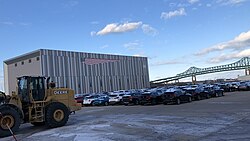
The New Bedford Marine Commerce Terminal is the first facility in the United States designed specifically for the deployment of offshore wind farms. It provides 26 acres of storage space to support the fabrication, implementation, and transportation of large-scale marine cargo. The terminal is strategically located with access to I-195, I-495, and I-95, as well as other regional ports.
Massachusetts Wind Technology Testing Center (WTTC)
Located in Charlestown, the WTTC provides critical prototyping and testing services. The center can test blades up to 90 meters long, a process required for turbines to achieve international qualifications and official certification for use in land and offshore environments.
Implementation and Project Milestones
Under the administration of Governor Charlie Baker (2015–2023), the state accelerated its procurement of renewable energy. In August 2016, legislation was signed requiring the state to procure 1,600 megawatts of offshore wind and 1,200 megawatts of hydropower.
This legislative push led to several key industry milestones:
- Industry Adoption: In September 2016, companies including Deepwater Wind, DONG Energy, and OffshoreMW agreed to use the New Bedford Marine Commerce Terminal as a staging area.
- Vineyard Wind: In May 2018, the administration selected Vineyard Wind to build an 800-megawatt offshore wind farm off the southern coast of Martha's Vineyard. The project received final federal approval from the U.S. Department of the Interior in May 2021.
- Federal Lease Sales: In December 2018, the Bureau of Ocean Energy Management sold 390,000 acres of ocean south of Nantucket and Martha's Vineyard to Equinor Wind, Mayflower Wind, and Vineyard Wind for a record $405 million, with an estimated potential of 4,100 megawatts.
Looking forward, a 2020 Offshore Wind Study analyzed the procurement of an additional 1.6 GW of capacity. Furthermore, the 2020 Decarbonization Roadmap outlines the path to net zero emissions by 2050 through significant investments in solar and offshore wind energy.
Summary of Massachusetts Energy Initiatives
| Initiative/Facility | Primary Purpose | Key Detail/Metric |
|---|---|---|
| Global Warming Solutions Act | Emission Reductions | 80% reduction by 2050 |
| MassCEC | Economic Development | Clean energy job growth |
| New Bedford Terminal | Offshore Wind Logistics | 26 acres of storage |
| WTTC | Turbine Certification | Blades up to 90 meters |
| Vineyard Wind | Energy Production | 800-megawatt capacity |
Frequently Asked Questions
What is the role of the Massachusetts Clean Energy Center (MassCEC)?
The MassCEC is a state authority created by the Green Jobs Act of 2008 to promote job and economic development within the clean energy sector. It manages key infrastructure like the New Bedford Marine Commerce Terminal and the Wind Technology Testing Center.
What are the emission reduction targets for Massachusetts?
Under the Global Warming Solutions Act of 2008, the state is required to reduce greenhouse gas emissions to 25% below 1990 levels by 2020, and at least 80% below those levels by 2050.
Why is the New Bedford Marine Commerce Terminal significant?
It is the first hub in the United States specifically designed for the deployment of offshore wind farms, providing essential staging, fabrication, and transportation support for large-scale marine cargo.
What is the purpose of the Wind Technology Testing Center?
The center allows for the prototyping and testing of wind turbine blades up to 90 meters long. This testing is mandatory for turbines to meet international qualifications and receive certification for use.
What is the Decarbonization Roadmap?
Released in late 2020, the Decarbonization Roadmap is a strategic plan aiming for net zero greenhouse gas emissions by 2050, emphasizing major investments in solar and offshore wind energy.