Mark Burke: A Career in Australian Federal Politics
Mark Burke is a prominent figure within the Labor Right faction of the Australian Labor Party (ALP). Since entering the House of Representatives at the 2004 federal election, Burke has maintained a rare trajectory in Australian politics; alongside Linda Burney, he is one of the only members of the Federal Parliament to have served exclusively as either a minister or a shadow minister throughout his entire tenure.
Representing the safe Labor seat of Watson after replacing Leo McLeay, Burke's ascent began immediately under Mark Latham as the Shadow Minister for Small Business. His early career saw a rapid expansion of responsibilities, moving to the Immigration portfolio in 2005 under Kim Beazley, and later expanding to include Integration and Citizenship under Kevin Rudd following the 2006 leadership spill.
Ministerial Roles under Rudd and Gillard
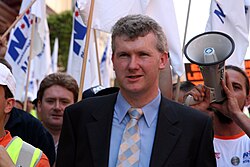
Following the 2007 federal election, Burke transitioned into government as the Minister for Agriculture, Fisheries and Forestry. During this period, he managed two critical national issues: the eradication of horse flu following the 2007 equine influenza outbreak and the abolition of the Australian bulk wheat export monopoly triggered by the AWB oil-for-wheat scandal.
Population and Sustainability
In April 2010, Burke was appointed Minister for Population. This role was created in response to the Government's Intergenerational Report, which projected that Australia's population would grow from 22 million in 2010 to 35 million by 2050—a vision Prime Minister Rudd described as a "big Australia." Burke was tasked with coordinating the services and infrastructure necessary to support this growth.
His portfolio later expanded to include Sustainability, Environment, Water, Population and Communities. In this capacity, Burke achieved several landmark environmental milestones:
- Commonwealth Marine Reserve Network: Established the world's largest network of marine protected areas.
- Species Protection: Added koalas to the threatened species list in New South Wales, Queensland, and the ACT.
- Fisheries Regulation: Banned a controversial Dutch "super trawler" from operating in Tasmanian waters.
- World Heritage: Successfully pushed for the Ningaloo Reef and large areas of the Tasmanian Wilderness to be listed as UNESCO World Heritage Sites.
Burke also served as a mediator in the conflict between the Tasmanian forestry industry and environmental groups, leading to the 2011 Tasmanian Forests Intergovernmental Agreement. However, his tenure also included the 2011 approval of the Bell Bay Pulp Mill in the Tamar Valley, which he granted to Gunns Limited after imposing stricter environmental conditions.
Water Management and the Arts
One of Burke's most enduring legacies is the Murray Darling Basin Plan, which he negotiated and signed into law on November 22, 2012. This plan was the result of over a century of effort and extensive consultation with state governments, environmentalists, and irrigators.
In March 2013, Burke added the Arts portfolio to his responsibilities, implementing the Creative Australia policy. Despite being a supporter of Julia Gillard, Burke remained in the ministry when Kevin Rudd returned to the prime ministership in June 2013. In the Second Rudd Ministry, he served as Minister for Immigration, Multicultural Affairs and Citizenship, where he managed resettlement plans with Nauru and Papua New Guinea and sought the release of unaccompanied minors from immigration detention.
Opposition and the Albanese Government
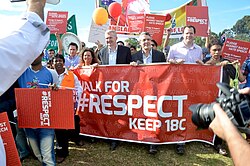
After Labor's defeat in 2013, Burke served in various shadow capacities, including Shadow Finance Minister and Manager of Opposition Business. Between 2016 and 2019, he held shadow portfolios for the Arts, Citizenship, Multicultural Australia, Environment, and Water, before shifting his focus to Industrial Relations in 2019.
With the election of the Albanese government in 2022, Burke returned to the ministry as Leader of the House, Minister for the Arts, and Minister for Employment and Workplace Relations. His role expanded significantly on July 28, 2024, when he was appointed Minister for Home Affairs, Minister for Cyber Security, and Minister for Immigration, Citizenship and Multicultural Affairs.
Following the 2025 federal election, Burke retained the Arts and Home Affairs portfolios and assumed responsibility for the Australian Security Intelligence Organisation (ASIO) and the Australian Federal Police. His tenure has not been without controversy; notably, on March 20, 2026, Burke and Prime Minister Anthony Albanese were heckled at a Lakemba Mosque Eid event, where some attendees accused them of being "genocide supporters."
Key Facts
- Political Affiliation: Labor Right.
- Unique Record: One of only two MPs to have always served as a minister or shadow minister.
- Environmental Legacy: Created the world's largest marine protected area network.
- Legislative Milestone: Signed the Murray Darling Basin Plan in 2012.
- Current Major Portfolios: Home Affairs, Arts, and oversight of ASIO and the Australian Federal Police.
| Period | Government/Role | Key Portfolios/Achievements |
|---|---|---|
| 2004–2007 | Opposition | Shadow Minister for Small Business; Immigration |
| 2007–2010 | Rudd Government | Agriculture, Fisheries and Forestry; Population |
| 2010–2013 | Gillard/Rudd Government | Sustainability, Environment, Water, Population and Communities; Arts |
| 2013–2022 | Opposition | Shadow Finance; Environment and Water; Industrial Relations |
| 2022–Present | Albanese Government | Employment; Arts; Home Affairs; Cyber Security; Immigration |
Frequently Asked Questions
What is the significance of the Commonwealth Marine Reserve Network?
Established by Mark Burke, it is the largest network of marine protected areas in the world and represents the second largest conservation determination globally, surpassed only by the preservation of Antarctica.
What was the "big Australia" policy?
This was a policy direction under Kevin Rudd, implemented by Mark Burke as Minister for Population, to plan for a projected population increase from 22 million in 2010 to 35 million by 2050.
What was the Murray Darling Basin Plan?
Signed into law by Burke in November 2012, it was a long-term water management strategy developed after more than 100 years of planning and consultation with state governments and stakeholders.
Which security agencies does Mark Burke currently oversee?
Following the 2025 federal election, Burke took responsibility for both the Australian Federal Police and the Australian Security Intelligence Organisation (ASIO).
How did Burke contribute to wildlife conservation?
Burke added koalas to the threatened species list in the ACT, New South Wales, and Queensland, and successfully sought UNESCO World Heritage listing for the Ningaloo Reef and the Tasmanian Wilderness.