Marañón River Basin Pre-Inca Languages
The Marañón River basin serves as a critical low point in the Andes mountains, a geographical feature that historically transformed the region into a vital trade hub between the Inca Empire and the Amazon basin. This strategic location fostered a rich tapestry of linguistic diversity, though many of the languages once spoken here remain poorly attested or entirely undocumented.
Over time, the linguistic landscape shifted. In the middle reaches of the river, above the Amazon basin, original languages were replaced by Aguaruna, a Jivaroan language originating from the Amazon that persists in the region today. During the Spanish Conquest, the area remained multilingual; however, unlike other regions that transitioned to Quechua, many inhabitants here switched directly to Spanish, although Quechua did expand during the Colonial era.
Key Facts
- The Marañón River basin was a primary trade link between the Inca Empire and the Amazon.
- Many ancient languages of the region are unrecorded or lack sufficient data for classification.
- The middle river reaches saw the replacement of local tongues by the Jivaroan language, Aguaruna.
- In the Colonial period, Spanish became a dominant replacement language over Quechua in this specific region.
- Linguistic evidence suggests a strong presence of Barbacoan and Jivaroan language families in the northern Andes.
Linguistic Diversity in Ecuador
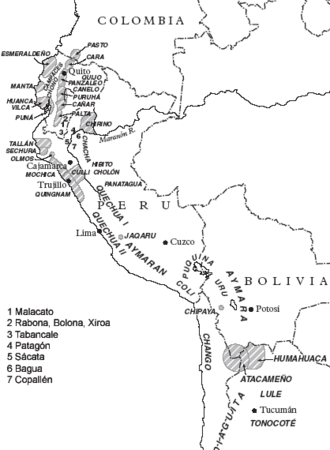
In the province of Loja, Ecuador, several distinct languages were present, including Palta, Malacato, Rabona, Bolona, and Xiroa. Historical records indicate these languages were closely related. Specifically, there is evidence suggesting that Palta was a Jivaroan language (a family of languages native to the upper Amazon), and the name Xiroa may be a variant of Jivaro.
The classification of other local tongues remains elusive. Rabona is known through a few words; while some appear Jivaroan, others resemble Candoshí. Because these surviving words are plant names, they provide little help in classification, leading linguists like Adelaar (2004) to leave Rabona unclassified. Bolona remains essentially unattested.
Northern Basin Languages
Further north, the region hosted languages such as Puruhá, Cañari, Panzaleo, Caranqui, and Pasto. While Puruhá is scarcely attested and Cañari is known primarily through place names, others provide more clues. Caranqui (spoken until the 18th century) and Pasto are identified as Barbacoan languages (a language family found in the border regions of Colombia and Ecuador).
Except for Panzaleo—which is sometimes classified as Paezan—these languages share common linguistic markers, such as the final syllable -pud and onsets like mwe-, pwe-, and bwe-. These similarities suggest they may have all belonged to the Barbacoan family, a theory Adelaar (2004) considers more likely than the proposal that Puruhá and Cañari were Chimuan languages.
Ancient Languages of Peru
The Andean highlands of Peru also harbored a vast array of languages. While Mochica and Cholón are well-known, most languages of northern Peru went unrecorded. However, several specific Marañón languages have been identified through historical fragments.
These attested languages include:
- Patagón (specifically Patagón de Perico and Patagón de Bagua)
- Chacha (associated with the Chachapoya)
- Copallén
- Tabancale (also known as Aconipa)
- Chirino
- Sácata
Summary of Regional Languages
| Region | Attested Languages | Likely Classification/Notes |
|---|---|---|
| Loja, Ecuador | Palta, Malacato, Rabona, Bolona, Xiroa | Likely Jivaroan (Palta, Xiroa); others unclassified |
| Northern Ecuador | Caranqui, Pasto, Puruhá, Cañari, Panzaleo | Likely Barbacoan (except possibly Panzaleo) |
| Northern Peru | Patagón, Chacha, Copallén, Tabancale, Chirino, Sácata | Largely unrecorded/poorly attested |
| Middle Marañón | Aguaruna | Jivaroan (replaced earlier languages) |
Frequently Asked Questions
Why are so many Marañón languages unclassified?
Many of these languages are poorly attested or not attested at all, meaning there is a severe lack of written records or surviving vocabulary to allow linguists to categorize them accurately.
What is the relationship between the languages of northern Ecuador?
Languages like Caranqui, Pasto, Puruhá, and Cañari share specific phonetic markers (such as the -pud syllable), suggesting they were likely part of the Barbacoan language family.
Did the people of the Marañón basin speak Quechua?
While Quechua expanded during the Colonial period, many people in the Marañón basin switched directly to Spanish following the Conquest rather than adopting Quechua.
Which language currently dominates the middle reaches of the river?
The middle reaches are currently home to Aguaruna, a Jivaroan language from the Amazon that replaced the historical languages of that specific area.
What evidence exists for the language Rabona?
Rabona is known only through a few words, specifically plant names. Because these terms are often borrowed or shared between groups, they do not provide enough evidence to definitively classify the language as Jivaroan or Candoshí.