Manuelito: The Rise of a Navajo Leader Before the Long Walk
Before becoming one of the most pivotal figures in Navajo history, Manuelito emerged as a formidable warrior and a strategic diplomat. His journey from a teenage combatant to a recognized official chief reflects the turbulent mid-19th century struggle for Navajo sovereignty amidst encroaching Mexican and American interests.
Early Life and the Path to Leadership
Manuelito's ascent began in 1835 during the Battle of Washington Pass. At just seventeen years old, he fought alongside Narbona's victorious party, defeating a raiding force led by Captain Blas de Hinojos at what is now known as Narbona Pass. It was during this conflict that he earned the name Hashkeh Naabaah, meaning "Angry Warrior."
Over the following decade, Manuelito transitioned from a warrior to a political representative. In November 1846, he was one of the signatories of the Lava Springs Treaty. By 1849, he witnessed a turning point in Navajo leadership when his father-in-law, Chief Narbona, was killed during a meeting with Colonel John M. Washington in the Chuska Mountains.
By July 1853, following the retirement of Chief Sarcillos Largos, Manuelito was elected to speak for the Navajos. This leadership role was critical as the Navajo people faced proposed treaties regarding the separation of grazing lands between Navajo, Mexican, and American interests.
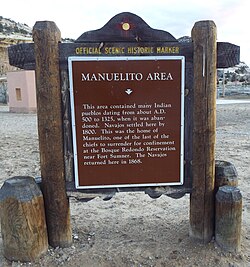
Diplomacy and Conflict with the U.S. Military
In July 1855, Manuelito and Zarcillos Largos signed the Meriwether Treaty at Laguna Negra. This agreement was significant as the United States officially recognized Manuelito as an "official chief," and he was awarded a peace medal to signify his status.
Despite this official recognition, tensions remained high regarding land and livestock. Manuelito frequently acted as a mediator, such as in 1856 when he dealt with Major Kendrick at Fort Defiance regarding stolen stock. However, disputes over pastures often led to violence. In 1858, Manuelito advocated for the use of Ewell's Hay Camp for Navajo livestock; when his band moved their stock closer to the area, a skirmish ensued, resulting in the loss of over 100 cattle and other livestock.
Cultural clashes also fueled instability. In 1858, after a servant of Major Brooks molested a Navajo woman, the Navajos killed the offender according to their customs. This led to a brief military campaign, which eventually concluded with a signed treaty.
Resistance and the Road to Bosque Redondo
The turn of the decade saw an increase in raids. In July 1860, Manuelito and Sarcillos Largos successfully ambushed 50 Mexican/American raiders from Cubero, New Mexico, at Whiskey Lake in the Chuska Mountains, resulting in 40 raider deaths. By December 1860, 400 volunteer citizens launched a campaign against the Navajo people.
As the Long Walk—the forced relocation of the Navajo people—began in 1864, Manuelito's band remained in Dinetah, likely southwest of the Little Colorado River. Despite efforts by the military to bring him in, including messengers sent by Major Eaton and others from Fort Sumner, Manuelito resisted for several years.
The pressure mounted in 1866 when Zunis and Utes attacked his band south of Sierra Escudilla. By September 1866, Manuelito and his followers finally arrived at Fort Wingate and were moved to Bosque Redondo.
The Treaty of Bosque Redondo
Even while held at Bosque Redondo, Manuelito remained a leader of action. In September 1867, after Comanches and Utes raided the Navajo at the camp, Manuelito led a band to raid the Utes before returning to the reservation.
His leadership culminated in 1868 when he became one of the primary signers of the Treaty of Bosque Redondo. This landmark agreement officially ended the Long Walk and allowed the Navajo people to return to their ancestral lands.
Key Facts
- Warrior Name: Earned the name Hashkeh Naabaah ("Angry Warrior") at age 17.
- Official Status: Recognized as an "official chief" by the U.S. government in the 1855 Meriwether Treaty.
- Military Conflict: Led a successful ambush at Whiskey Lake in 1860, killing 40 raiders.
- Resistance: Remained in Dinetah during the start of the Long Walk (1864) before surrendering in 1866.
- Diplomacy: Co-signed the 1868 Treaty of Bosque Redondo, ending the forced relocation.
| Year | Event | Outcome |
|---|---|---|
| 1835 | Battle of Washington Pass | Victory; earned name "Angry Warrior" |
| 1846 | Lava Springs Treaty | Signed as a representative |
| 1855 | Meriwether Treaty | Recognized as official chief; received peace medal |
| 1860 | Whiskey Lake Ambush | Defeated 50 raiders from Cubero |
| 1866 | Surrender to Ft. Wingate | Relocated to Bosque Redondo |
| 1868 | Treaty of Bosque Redondo | Ended the Long Walk |
Frequently Asked Questions
What does the name Hashkeh Naabaah mean?
Hashkeh Naabaah means "Angry Warrior," a name Manuelito earned at the age of seventeen after participating in the victorious battle at Narbona Pass in 1835.
When was Manuelito recognized as an official chief?
He was recognized as an "official chief" by the Americans on July 18, 1855, upon the signing of the Meriwether Treaty at Laguna Negra.
Why did Manuelito resist the Long Walk initially?
Manuelito and his band remained in Dinetah for several years after the Long Walk began in 1864, resisting calls to surrender from military officials until attacks by Zunis and Utes in 1866 forced their movement to Fort Wingate.
What was the significance of the Treaty of Bosque Redondo?
Signed in 1868, this treaty was the legal instrument that ended the Long Walk, allowing the Navajo people to leave the Bosque Redondo reservation and return to their homeland.
How did Manuelito handle disputes over livestock?
Manuelito often acted as a diplomatic liaison between the Navajo and the U.S. Army, though these negotiations were sometimes fraught, such as the 1858 skirmish over Ewell's Hay Camp which resulted in the loss of over 100 cattle.