Manifold Immersions: Classification, Existence, and Codimension
In the field of differential topology, an immersion is a differentiable map between manifolds where the derivative is injective at every point. Unlike embeddings, immersions allow the manifold to intersect itself, provided it does not create "sharp" corners or cusps. The study of how manifolds can be immersed into Euclidean spaces involves a complex interplay between algebraic topology and geometry.
The Classification of Immersions
The systematic study of immersions and regular homotopies—deformations between immersions that remain immersions throughout the process—was pioneered by Hassler Whitney in the 1940s. Whitney established two foundational results: the Whitney immersion theorem and the Whitney embedding theorem. He proved that for an m-dimensional manifold M and an n-dimensional manifold N, any map is homotopic to an immersion if 2m < n + 1, and to an embedding if 2m < n.
Building on this, Stephen Smale discovered that the regular homotopy classes of immersions from a manifold M into Rn could be expressed as the homotopy groups of a specific Stiefel manifold (a space of orthonormal frames). One of the most famous and counterintuitive results of Smale's work was the proof that a sphere can be everted—turned inside out—through a regular homotopy.
This framework was further expanded by Morris Hirsch, who generalized Smale's findings to describe the regular homotopy classes of immersions for any m-dimensional manifold M into any n-dimensional manifold N. This combined approach is known as the Hirsch-Smale classification, which was later generalized by Mikhail Gromov.
Existence and Obstructions
Determining whether an immersion exists depends largely on the stable normal bundle of the manifold. In a codimension k immersion (where k = n - m), the tangent bundle of the manifold and the normal bundle (the vectors perpendicular to the manifold) must sum to a trivial bundle, because the target space Rn is parallelizable (meaning it has a globally defined set of linearly independent tangent vectors).
The primary obstructions to these immersions are detected by characteristic classes, specifically the Stiefel–Whitney classes. If the cohomology dimension of the stable normal bundle is k, the manifold cannot be immersed in a dimension lower than k. This obstruction can be stated intrinsically using the manifold's tangent bundle and cohomology algebra.
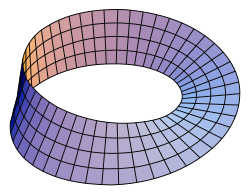
For example, the Möbius strip possesses a non-trivial tangent bundle. Consequently, it cannot be immersed in codimension 0 (within R2), although it can be embedded in codimension 1 (within R3).
In 1960, William S. Massey demonstrated that these characteristic classes vanish above degree n − α(n), where α(n) represents the number of "1" digits in the binary representation of n. This led to the immersion conjecture, which proposed that every n-manifold could be immersed in R2n−α(n). This conjecture was formally proven by Ralph Cohen in 1985.
Codimension 0 Immersions
Immersions of codimension 0 (where the dimensions of the source and target manifolds are equal) behave differently than those of higher codimension. These are essentially submersions—maps where the derivative is surjective. For a closed manifold, a codimension 0 immersion is equivalent to a covering map, which is a fiber bundle with discrete 0-dimensional fibers.
Unlike higher codimension immersions, which are governed by the stable normal bundle, codimension 0 immersions are constrained by the fundamental class and cover spaces. For instance, there is no codimension 0 immersion from a circle (S1) to a line (R1), despite the circle being parallelizable. This is due to the invariance of domain or the fact that the line lacks a fundamental class.
Similarly, while both the 3-sphere (S3) and the 3-torus (T3) are parallelizable, the 3-torus cannot be immersed into the 3-sphere. Any such covering map would require ramification at certain points because the sphere is simply connected.
| Contributor | Key Contribution | Core Concept |
|---|---|---|
| Hassler Whitney | Immersion & Embedding Theorems | Dimensional bounds for existence (2m < n+1) |
| Stephen Smale | Regular Homotopy Classes | Stiefel manifolds and sphere eversion |
| Morris Hirsch | Generalization of Smale's work | Immersions between any two manifolds M and N |
| Ralph Cohen | Proof of Immersion Conjecture | Immersion in R2n−α(n) |
Key Facts
- Whitney's Bound: A map from an m-dimensional manifold to an n-dimensional manifold is homotopic to an immersion if 2m < n + 1.
- Sphere Eversion: A striking result of Smale's work showing a sphere can be turned inside out via regular homotopy.
- Primary Obstruction: The stable normal bundle and its Stiefel–Whitney classes determine if an immersion is possible.
- The Immersion Conjecture: Proven by Ralph Cohen, stating n-manifolds can be immersed in R2n−α(n).
- Codimension 0: These immersions act as covering maps for closed manifolds and are subject to different constraints than higher codimension immersions.
Frequently Asked Questions
What is the difference between an immersion and an embedding?
An immersion is a map where the derivative is injective at every point, allowing the manifold to self-intersect. An embedding is an immersion that is also a homeomorphism onto its image, meaning it does not self-intersect.
What is a regular homotopy?
A regular homotopy is a continuous deformation between two immersions such that every intermediate map in the deformation is also an immersion.
Why can't the Möbius strip immerse in codimension 0?
The Möbius strip has a non-trivial tangent bundle, which creates a topological obstruction that prevents it from being immersed in a space of the same dimension (R2).
What is the significance of α(n) in the immersion conjecture?
The term α(n) refers to the number of ones in the binary expansion of the dimension n. It provides a sharp bound for the vanishing of Stiefel–Whitney classes, determining the minimum Euclidean space required for an immersion.
How do codimension 0 immersions differ from others?
While most immersions are determined by the stable normal bundle, codimension 0 immersions are essentially covering maps. They are constrained by properties like the fundamental class and the simple connectivity of the target space.