Madame Tussauds: The History and Evolution of the World's Most Famous Wax Museum
For nearly two centuries, Madame Tussauds has stood as a global icon of entertainment and artistry. What began as a personal passion for wax sculpting in 18th-century France evolved into a worldwide empire of museums, blending history, celebrity culture, and the macabre. Today, it is more than just a gallery; it is a cornerstone of London's tourism industry.
Key Facts
- Founded: May 22, 1835, by Marie Tussaud.
- Current London Location: Marylebone Road, City of Westminster.
- Famous Feature: The Chamber of Horrors, featuring models of murderers.
- Global Reach: Locations across Europe, North America, Asia, and Oceania.
- Current Operator: Merlin Entertainments.
The Origins of Marie Tussaud
The story of the museum begins with Marie Grosholtz, born in 1761 in Strasbourg, France. Marie learned the art of wax modelling—the process of creating lifelike sculptures using heated wax—from Philippe Curtius, a physician skilled in the craft. By 1777, she had created her first sculpture of the philosopher Voltaire.
Marie's talent led her to become an art tutor to Madame Elizabeth, the sister of King Louis XVI. However, her life took a dramatic turn during the French Revolution. Although imprisoned for three months, she was eventually released and used her skills to create models of the Revolution's most prominent victims.
Following Curtius' death in 1794, Marie inherited his vast collection. She spent the next 33 years touring Europe with her show. After marrying François Tussaud in 1795, she adopted his name and rebranded her exhibition as "Madame Tussaud's." In 1802, she brought her collection of death masks and busts to London, initially partnering with Paul Philidor at the Lyceum Theatre before deciding to venture out on her own.
Establishing a London Institution
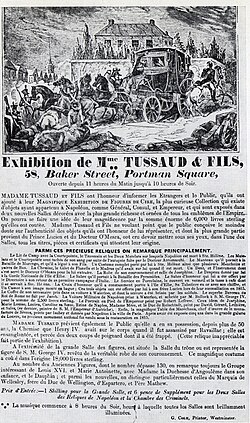
Unable to return to France due to the Napoleonic Wars, Marie settled in London. In 1835, she opened her permanent museum on Baker Street. The attraction quickly became a sensation, particularly the Chamber of Horrors, which displayed wax models of notorious murderers. This section was so popular that it appeared in advertising as early as 1843.
The museum attracted a wide array of figures, from royalty like Queen Victoria and Henry VIII to national heroes like the Duke of Wellington. By 1860, the author Charles Dickens described the museum as an "institution," and a waxwork of Dickens himself was added in 1873.
Relocation and Growth
As the Baker Street site became too small and expensive, Marie's grandson, Joseph Randall, commissioned a new building on Marylebone Road. These galleries opened on July 14, 1884, providing the space needed for the museum to flourish. In 1889, the business was sold to a group of businessmen led by Edwin Josiah Poyser, though the Tussaud family continued to provide artistic leadership.
Expansion and Modern Era
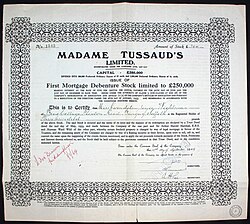
Throughout the 20th century, the museum transitioned into a corporate entity. It became a limited company in 1926 and began international expansion in 1970 with its first exhibition in Amsterdam. Over the following decades, the brand expanded into the United States, opening sites in Las Vegas (1999) and New York (2000).
The ownership of the group shifted several times, passing through Pearson plc and Charterhouse Development Capital before being sold to Dubai International Capital in 2005 for £800 million. In 2007, The Blackstone Group acquired the group and merged it with Merlin Entertainments, which continues to operate the museums today under a lease agreement with investor Nick Leslau.
Contemporary Attractions
Modern Madame Tussauds incorporates immersive technology and diverse exhibits. In 1993, the museum introduced "The Spirit of London," an animated dark ride, and in 2006, it integrated the London Planetarium into its west wing. The museum continues to push boundaries, such as the 2009 unveiling of a 14 cm waxwork of Tinker Bell, the smallest figure in the museum's history.
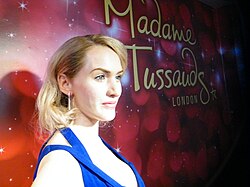
Summary of Museum Evolution
| Era/Year | Key Milestone | Significance |
|---|---|---|
| 1835 | Baker Street Opening | First permanent London home established. |
| 1884 | Move to Marylebone Road | Relocation to current larger premises. |
| 1970 | Amsterdam Opening | Start of international expansion. |
| 2007 | Merlin Entertainments Merger | Integration into a global attractions giant. |
| 2017 | New Delhi Opening | Expansion into the Indian market. |
Frequently Asked Questions
Who was the founder of Madame Tussauds?
The museum was founded by Marie Tussaud (born Marie Grosholtz), a French wax sculptor who learned the craft from Philippe Curtius in Switzerland.
What is the Chamber of Horrors?
The Chamber of Horrors is one of the museum's most famous attractions, featuring wax models of notorious murderers and criminals.
Where is the original London museum located?
While it began on Baker Street, the museum has been located on Marylebone Road in the City of Westminster since 1884.
How did the museum handle the Hitler waxwork?
The Hitler figure was frequently vandalized, including a 2008 incident in Berlin where it was decapitated. In January 2016, the statue was removed from the London museum's Chamber of Horrors following public requests.
Who currently operates Madame Tussauds?
The museums are operated by Merlin Entertainments, although the freehold of the London site is owned by private investor Nick Leslau's firm, Prestbury.