Luxembourgish Art of the 20th Century: Masters of Impressionism and Expressionism
The first half of the 20th century marked a vibrant era for the arts in Luxembourg. This period saw a transition from traditional realism toward more emotive and light-filled styles, as local artists engaged with broader European movements. From the bold distortions of Expressionism—an art style that prioritizes emotional experience over physical reality—to the luminous captures of Impressionism, Luxembourgish creators developed a unique visual language that reflected both their surroundings and their inner worlds.
Key Facts
- Joseph Kutter is regarded as Luxembourg's most successful painter, known for his distinctive Expressionist style.
- Frantz Seimetz was the first Luxembourgish artist to live solely from his art and a pioneer of open-air painting.
- Sosthène Weis was a prolific artist and architect who produced over 5,000 watercolours.
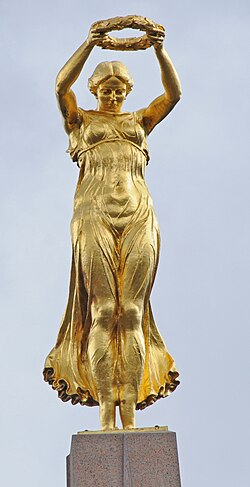
- Claus Cito created the iconic Gëlle Fra (Golden Woman) sculpture in 1923.
- The era was characterized by a strong influence from French and Belgian artistic trends.
The Expressionist Vision of Joseph Kutter
Joseph Kutter (1894–1941) stands as a pivotal figure in the nation's art history. While influenced by the Impressionists, Kutter evolved a powerful Expressionist approach. His portraits are noted for their strong brushstrokes and exaggerated features, such as oversized noses, often giving his subjects the appearance of despairing clowns.
By 1918, Kutter's landscapes and floral works shifted toward intense lines and vivid colors. A prime example of this is his painting of "Luxembourg," commissioned for the 1937 World Exposition in Paris. In this piece, he utilized cubic forms and exaggerated fortifications, creating a stacked architectural perspective that contrasted sharply with the softer representations of the same scene by J. M. W. Turner. A founder of the Luxembourg secessionist movement, Kutter's work was deeply shaped by trends in France and Belgium.
The Luminous World of Impressionism
While Kutter explored emotion through distortion, other artists sought to capture the fleeting beauty of light and nature.
Dominique Lang
Dominique Lang (1874–1919) embraced an uplifting Impressionist style characterized by bright light and a palette rich in blues and greens. Influenced by masters like Monet, Renoir, and Pissarro, Lang often depicted young women in white and scenes along the River Alzette. His 1917 painting of Dudelange is particularly telling; it presents an idyllic countryside, intentionally omitting the factories and workmen's housing of the industrial era.
: Dominique Lang: Banks of the Alzette (1915)
Nico Klopp
Nico Klopp (1894–1930) is best remembered for his Post-Impressionist works—a style that extended Impressionism by emphasizing more structured forms and symbolic content. Living in Remich, Klopp focused heavily on the River Moselle and the local bridge. His landscapes and still lifes are distinguished by solid strokes and bright, bold coloring.
: Nico Klopp: The Bridge at Remich (1925)
: Nico Klopp: Still Life with Fruit (1930)
Frantz Seimetz
Frantz Seimetz (1858–1934) was a dominant force in the Luxembourgish art scene. A prolific painter of portraits and landscapes, Seimetz was the first in the country to delve into Impressionism and the first, following Nicolas Liez, to paint en plein air (in the open air). His work in Echternach and the Mullerthal region evolved after 1900 to become brighter and more romantic, reflecting a sense of happiness and beauty.
: Frantz Seimetz: Pavilion at Echternach (c. 1904)
The Dual Legacy of Sosthène Weis
Sosthène Weis (1872–1941) balanced a career as both a renowned architect and a prolific painter. As an architect, he designed landmark structures including the Arbed building and the central post office. This professional background initially influenced his art, with his pre-1900 works exhibiting a rigid, precise architectural accuracy.
However, between 1915 and 1945, Weis transitioned into a romantic Post-Impressionist style. Using a palette of violets, blues, and ochres, he mastered the depiction of atmospheric light, from early morning mist to sunset haze. Over time, his work moved away from precise reality toward suggestive, dream-like imagery, focusing on the essential spirit of the scene rather than literal detail.
Sculptural Landmarks: Claus Cito
The sculptural arts of the period were headlined by Claus Cito (1882–1965). He is most famous for the Gëlle Fra (Golden Woman), the sculpture that crowns the Monument of Remembrance obelisk created in 1923 to honor Luxembourgish soldiers who died in the First World War.
Beyond this public monument, Cito's technical mastery is evident in his 1939 marble bust of Grand Duchess Charlotte, which currently resides in the former town hall in Differdange.
Summary of Key 20th Century Luxembourgish Artists
| Artist | Primary Style | Notable Focus/Work |
|---|---|---|
| Joseph Kutter | Expressionism | "Luxembourg" (1937); distorted portraits |
| Dominique Lang | Impressionism | River Alzette; idyllic rural scenes |
| Nico Klopp | Post-Impressionism | River Moselle and Remich bridge |
| Frantz Seimetz | Impressionism | Echternach and Mullerthal landscapes |
| Sosthène Weis | Post-Impressionism | 5,000+ watercolours; architecture |
| Claus Cito | Sculpture | Gëlle Fra; Bust of Grand Duchess Charlotte |
Frequently Asked Questions
Who is considered the most successful painter in Luxembourg?
Joseph Kutter is regarded as the most successful painter of this period, known for his transition from Impressionism to a distinctive Expressionist style.
What is the significance of the Gëlle Fra?
The Gëlle Fra (Golden Woman) is a sculpture by Claus Cito that crowns the Monument of Remembrance, created in 1923 to commemorate Luxembourgish soldiers who died during World War I.
Which artist was the first to live solely from their art in Luxembourg?
Frantz Seimetz was the first Luxembourgish artist to manage to live from his art alone.
How did Sosthène Weis's architectural background affect his painting?
His early paintings (up to 1900) were characterized by a boring precision and architectural accuracy. Later, he evolved into a more romantic, suggestive Post-Impressionist style.
How did Dominique Lang view industrialization in his art?
Lang had a characteristic aversion to industrialization; for example, his 1917 painting of Dudelange completely omits factories and workmen's housing in favor of an idyllic countryside.