Lumber and Timber: A Comprehensive Guide to Wood Processing and Standards
Lumber—referred to as timber or fine wood in the United Kingdom, Australia, and New Zealand—is wood that has been processed into uniform, useful sizes. These processed forms, known as dimensional lumber, include beams, planks, and boards. While primarily used for construction framing and finishing (such as floors, wall panels, and window frames), lumber serves a vast array of purposes beyond residential building.
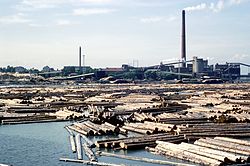
In North America, specifically the United States and Canada, a linguistic distinction exists: "timber" often refers to unprocessed wood fiber, such as standing trees or cut logs, whereas "lumber" refers to the processed material.
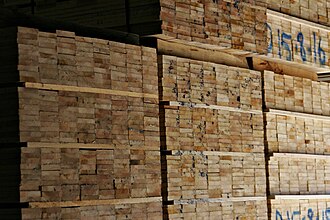
Types of Lumber and Material Sources
Lumber is generally categorized by the type of tree it originates from and the level of processing it has undergone. Approximately 80% of all lumber is derived from softwoods, which come from coniferous species. Common softwoods include pine, fir, spruce (often grouped as spruce-pine-fir), cedar, and hemlock.
Hardwoods are typically reserved for high-grade flooring, cabinetry, and furniture. Depending on the intended use, lumber is supplied in two primary states:
- Rough-sawn: Raw material used for furniture-making and items requiring custom cutting and shaping.
- Finished (Surfaced): Wood that has been planed on one or more faces to meet standard construction sizes.
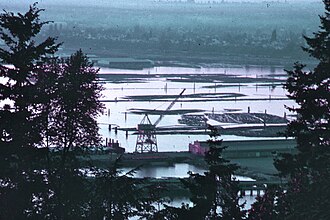
Dimensional Lumber and the Nominal vs. Actual Gap
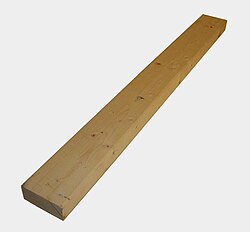
Dimensional lumber is cut to standardized widths and depths. In modern construction, "two-bys" (such as 2×4, 2×6, and 2×12) and 4×4s are the fundamental building blocks for platform-frame and balloon-frame housing.
A critical concept for builders is the difference between nominal dimensions and actual dimensions. Historically, nominal dimensions represented the size of the green, rough board. After the wood was dried and planed (smoothed), it shrank. Today, mills cut wood to a size that ensures the final finished product meets the minimum standard.
For example, a nominal 2×4 board does not actually measure 2 inches by 4 inches; its actual finished size is 1½×3½ inches (38×89 mm).
Common Dimensional Sizes
| Nominal Size (in) | Actual Size (in) | Actual Size (mm) |
|---|---|---|
| 1 × 2 | ¾ × 1½ | 19 × 38 |
| 2 × 2 | 1½ × 1½ | 38 × 38 |
| 2 × 4 | 1½ × 3½ | 38 × 89 |
| 2 × 6 | 1½ × 5½ | 38 × 140 |
| 4 × 4 | 3½ × 3½ | 89 × 89 |
| 4 × 6 | 3½ × 5½ | 89 × 140 |
Engineered Lumber
When standard dimensional lumber is insufficient for the load or span required, engineered lumber is used. These products are manufactured by bonding wood fibers or veneers with adhesives.
- Laminated Veneer Lumber (LVL): Created by layering veneers; these function as high-strength beams for large spans, such as garage door openings.
- Finger-jointed Lumber: Small pieces of solid wood (18 to 24 inches) are joined using interlocking "fingers" and glue. This allows for lengths up to 36 feet, exceeding the typical 22-to-24-foot limit of solid lumber.
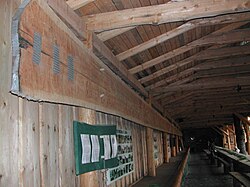
- Glulam Beams: Made by gluing the faces of 2×4 or 2×6 stock together. This creates massive beams (e.g., 6×16) without needing to harvest ancient, oversized trees.
Grades, Standards, and Defects
In Europe, strength grading follows EN-14081 and EN-338. Softwoods are categorized into classes like C16, C18, C24, and C30, where the number represents the 5th percentile bending strength in newtons per square millimetre. Hardwoods use D-classes (D24 through D70).
Lumber quality can be compromised by various defects:
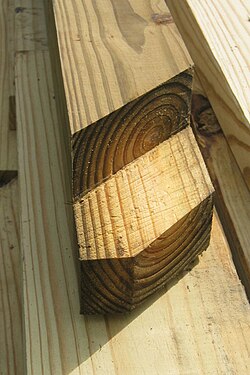
- Conversion Defects: These include wane (presence of the original rounded log surface), chip marks, diagonal grain (from improper sawing), and torn grain.
- Biological Decay: Fungi attack wood when moisture content exceeds 25%, oxygen is present, and the environment is warm. This leads to blue stain, brown rot, dry rot, and white rot.
- Pests: Termites, carpenter ants, woodboring beetles, and marine borers (such as Teredo navalis) can cause significant structural decay.
Key Facts
- Softwood Dominance: 80% of all lumber is produced from softwood species.
- Nominal vs. Actual: A standard "2×4" actually measures 1½×3½ inches.
- Engineered Lengths: Finger-jointing can extend lumber lengths up to 36 feet.
- Fungal Threshold: Wood is susceptible to fungal attack when moisture content is above 25%.
- Waste Stream: In the US (2018 data), 67% of wood waste went to landfills, 17% was recycled, and 16% was incinerated for energy.
Frequently Asked Questions
What is the difference between lumber and timber?
In most contexts, they are synonyms for processed wood. However, in the US and Canada, "timber" specifically refers to unprocessed logs or standing trees, while "lumber" refers to wood processed into boards.
Why is a 2x4 not actually 2 inches by 4 inches?
The 2×4 measurement is the nominal size, which historically referred to the rough-cut green board. The actual size is smaller because the wood is dried and planed to create a smooth, standardized surface.
What is the "quarter system" in hardwood lumber?
The quarter system is a North American nomenclature for rough-sawn hardwood thickness. For example, 4/4 (four quarter) indicates a 1-inch thick board, and 8/4 (eight quarter) indicates a 2-inch thick board.
How does Glulam benefit the environment?
Glulam beams are created by gluing smaller pieces of stock (like 2×4s) together. This allows for the creation of large structural beams without the need to harvest very old, large-diameter trees.
What causes wood rot?
Wood rot is caused by fungi that thrive when three conditions are met: moisture content above 25%, a warm environment, and the presence of oxygen.