Luciana Aymar: The Legendary 'Magician' of Field Hockey
In the world of international sports, few athletes achieve a level of dominance that transcends their era. Luciana Paula Aymar is one such figure. A retired midfielder and former captain of the Argentine national team, Aymar is widely regarded as the greatest female field hockey player of all time. Known for her breathtaking pace and an uncanny ability to weave through defenses, she brought a level of artistry to the game that earned her the nickname "La Maga" (The Magician).
Her impact on the sport was so profound that she is often called the "Maradona of Field Hockey," drawing parallels to the legendary Argentine footballer Diego Maradona due to her exceptional dribbling skills and influence on the pitch.
Key Facts
- FIH Player of the Year: The only player in history to win this award eight times.
- Olympic Success: Won four Olympic medals (two silver, two bronze).
- World Cup Glory: Two-time World Cup champion (2002 and 2010).
- National Icon: Served as the flag bearer for Argentina at the 2012 Summer Olympics.
- Career Caps: Earned 376 caps for the senior Argentine national team, scoring 162 goals.
Early Life and Rise to Prominence
Born on August 10, 1977, in Rosario, Argentina, Luciana Aymar began her journey in field hockey at the age of seven with Club Atlético Fisherton. Her talent was evident early on, leading her to move to Jockey Club de Rosario six years later. Her dedication was unmatched; as a youth player, she traveled daily to Buenos Aires to train with the junior national team.
Aymar's international ascent was rapid. In 1997, she helped the Argentina junior team secure a gold medal at the Pan American Games Junior Championship and a bronze at the Hockey Junior World Cup. By 1998, at just 16 years old, she became the youngest player ever accepted into the Argentine senior squad, debuting at the Hockey World Cup where the team finished fourth.
A Career of Unparalleled Achievement
Aymar was the cornerstone of a golden generation of Argentine hockey. Throughout her senior career, she played for prestigious clubs including Rot-Weiss Köln in Germany, Real Club de Polo in Spain, and domestic powerhouses Quilmes Atlético Club and GEBA. With GEBA, she captured both the Liga Nacional (National League) and the Torneo Metropolitano.
On the global stage, her trophy cabinet is among the most decorated in sports history. She led Argentina to victory in the 2002 and 2010 World Cups, with the 2010 triumph occurring in her hometown of Rosario. Her consistency was legendary, evidenced by her nine Player of the Tournament awards at the Champions Trophy.
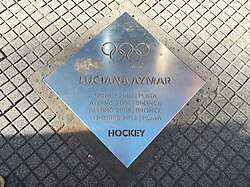
Career Summary Table
| Competition | Gold | Silver | Bronze |
|---|---|---|---|
| Olympic Games | 0 | 2 (2000, 2012) | 2 (2004, 2008) |
| World Cup | 2 (2002, 2010) | 0 | 2 (2006, 2014) |
| Champions Trophy | 6 | 3 | 1 |
| Pan American Games | 3 | 1 | 0 |
Legacy and Public Image
Beyond the medals, Aymar's legacy is cemented in the culture of Argentina. In 2010, she received the Platinum Konex Award, recognizing her as the best hockey player of the decade in her country. Her hometown of Rosario honors her with the Estadio Mundialista Luciana Aymar, a 12,000-seat stadium built specifically for the 2010 Women's Field Hockey World Cup.
Her life and struggles were chronicled in the 2016 documentary "Lucha: Playing the Impossible." The title uses her nickname, "Lucha," which also translates to "fight" in Spanish, symbolizing her resilience and determination.
Personal Life
Following her retirement from professional sports, Aymar moved to Chile. Since 2017, she has been in a relationship with former Chilean professional tennis player Fernando González. The couple has two children: a son born in 2019 and a daughter born in 2021.
Frequently Asked Questions
How many times was Luciana Aymar named FIH Player of the Year?
Luciana Aymar is the only player in history to receive the FIH Player of the Year Award eight times (2001, 2004, 2005, 2007, 2008, 2009, 2010, and 2013).
Why is she called "La Maga"?
She earned the nickname "La Maga" (The Magician) because of her extraordinary pace and dribbling skills, which allowed her to beat opposing players with ease.
Which Olympic medals did Luciana Aymar win?
Aymar won a total of four Olympic medals: silver medals at the 2000 Sydney and 2012 London Games, and bronze medals at the 2004 Athens and 2008 Beijing Games.
What is the significance of the Estadio Mundialista Luciana Aymar?
It is a field hockey stadium in her hometown of Rosario, Argentina, with a capacity of 12,000 spectators, built to host the 2010 Women's Field Hockey World Cup.
Who is Luciana Aymar's partner?
Luciana Aymar is in a relationship with Fernando González, a former professional tennis player from Chile.