Löwenmensch: The Ancient Mystery of the Lion-Man Figurine
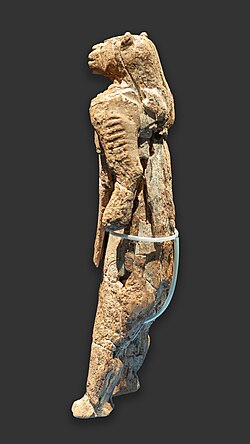
Deep within the Swabian Jura of Germany lies one of the most enigmatic artifacts of the prehistoric world: the Löwenmensch, or Lion-man. This anthropomorphic figurine—combining a human body with the head of a cave lion (Panthera spelaea)—serves as a profound window into the cognitive and spiritual lives of early humans. As the oldest confirmed statue ever discovered, it challenges our understanding of when humans first began to imagine things that do not exist in nature.
Key Facts
- Age: Approximately 35,000 to 41,000 years old.
- Material: Carved from mammoth ivory using flint stone tools.
- Culture: Associated with the Aurignacian culture of the Upper Paleolithic.
- Dimensions: 31.1 cm tall, 5.6 cm wide, and 5.9 cm thick.
- Location: Discovered in Hohlenstein-Stadel cave; currently housed in Museum Ulm.
Discovery and Painstaking Restoration
The journey of the Lion-man from the earth to the museum was a long and fragmented one. Systematic excavations at the Hohlenstein-Stadel cave began in 1937, but it was geologist Otto Völzing who discovered the ivory fragments on August 25, 1939. The outbreak of World War II just a week later halted the fieldwork, leaving the fragments forgotten at Museum Ulm for nearly thirty years.
The process of bringing the figure back to life required decades of expertise. Archaeologist Joachim Hahn first began assembling the 200+ fragments, followed by paleontologist Elisabeth Schmid in 1982, who added critical details to the nose and mouth. A major restoration in 1987 by Ute Wolf and Schmid revealed that the figure was only two-thirds complete, necessitating the use of a reversible mixture of beeswax, artificial wax, and chalk to fill gaps.
Modern technology eventually refined the reconstruction. In 2008, systematic sifting of cave layers yielded minute new fragments. These were first simulated virtually before a second physical restoration took place between 2012 and 2013. Led by Nicole Ebinger-Rist, this final phase removed the artificial fillers and added new fragments, increasing the figurine's height from 296 mm to 311 mm.
The Art of Manufacture
Creating the Löwenmensch was an immense technical challenge. The artist used a flint stone knife to carve the hard mammoth tusk. Evidence from other tusks found in the cave suggests a process of cutting through the skin and bone to expose the tooth, which was then detached using a hammer and splitting wedges.
Experimental replications by Wulf Hein and Kurt Wehrberger highlight the sheer labor involved. Using authentic stone tools, the team found that removing the tusk base took ten hours, while the basic shaping required roughly 200 hours. In total, the recreation took over 370 hours. This suggests that the original artist may have been a specialist, excused from daily subsistence tasks by their community to focus on this masterpiece.
One notable detail is the presence of seven parallel, transverse, carved gouges on the left arm.
Interpretation and Symbolic Meaning
The Lion-man is a prime example of zoomorphic art (art that takes animal forms) and specifically therianthropic imagery, which depicts a hybrid of human and animal. The figurine was found in a chamber 30 meters from the cave entrance, surrounded by bone tools, worked antlers, and jewelry made of beads and perforated teeth. This suggests the area may have served as a storehouse or a site for cultic rituals.
The identity of the figure has been a subject of intense debate. Early researchers like Joachim Hahn believed the figure was male, while Elisabeth Schmid later proposed it represented a woman with the head of a female cave lion. Recent restorations showed that a triangular platelet in the genital area was separate from the body; some argue this was originally a square shape, which would typically be interpreted as a stylized male organ.
The discovery of a similar, smaller lion-headed figure in Hohle Fels suggests that these communities shared a common belief system. Archaeologist Nicholas Conard suggests this points toward the practice of shamanism among Aurignacian people, creating a spiritual connection to the vital forces of nature.
| Attribute | Detail |
|---|---|
| Material | Mammoth Ivory |
| Estimated Age | 35,000 – 41,000 years |
| Height | 31.1 cm |
| Discovery Date | August 25, 1939 |
| Culture | Aurignacian (Upper Paleolithic) |
| Current Location | Museum Ulm, Germany |
Frequently Asked Questions
What is the Löwenmensch?
The Löwenmensch, or Lion-man, is a prehistoric ivory sculpture from Germany that depicts a human-like body with the head of a cave lion. It is one of the oldest known examples of figurative art.
How old is the Lion-man figurine?
Based on carbon dating of the sediment layer where it was found, the figurine is estimated to be between 35,000 and 41,000 years old.
What tools were used to create the sculpture?
The sculpture was carved from a mammoth tusk using flint stone knives, scrapers, and burins.
Is the figurine male or female?
The sex of the figurine is a subject of ongoing academic debate. While some researchers have argued it is female, others suggest the genital area represents a stylized male organ.
Why is this figurine significant to archaeology?
It is the oldest confirmed statue ever discovered and provides evidence that early humans possessed the capacity for symbolic thought and the creation of hybrid, imaginary beings.