Lluís Companys Olympic Stadium: A Landmark of Barcelona's Sporting History
Perched atop the scenic Montjuïc hill overlooking the harbor, the Lluís Companys Olympic Stadium (Estadi Olímpic Lluís Companys) stands as a testament to Barcelona's enduring passion for sport and culture. From its origins as a centerpiece for the 1929 International Exposition to its global spotlight during the 1992 Summer Olympics, this venue has evolved through nearly a century of history to become one of Spain's most iconic arenas.
The stadium is named in honor of Lluís Companys, the 123rd president of the Generalitat de Catalunya (the Government of Catalonia), who was executed by the Franco regime at the nearby Montjuïc Castle in 1940.
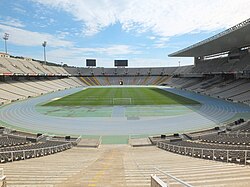
Key Facts
- Location: Montjuïc, Barcelona, Catalonia, Spain.
- Current Capacity: 55,926 seats.
- Opened: May 20, 1929.
- Major Events: 1992 Summer Olympics and Paralympics.
- Notable Tenants: FC Barcelona (2023–2025), Espanyol (1997–2009), and the Barcelona Dragons (1991–2002).
- Ownership: Barcelona City Council, operated by Barcelona de Serveis Municipals (B:SM).
A Century of Evolution
Foundations and Early Years
Designed by architect Pere Domènech i Roura, the stadium first opened its doors on May 20, 1929. Its early years were marked by diverse sporting milestones, including Spain's first official rugby international against Italy and a historic 4–0 victory by the Catalan national football team over Bolton Wanderers.
The venue was intended to host the 1936 People's Olympiad—a protest event against the Berlin Olympics—but the outbreak of the Spanish Civil War forced its cancellation. By the 1950s, it became the center of the 1955 Mediterranean Games and hosted a rare national football cup final between local rivals Barcelona and Espanyol in 1957.
Decline and Olympic Rebirth
During the 1970s, the stadium fell into disuse and the stands deteriorated. During this period, it served as a paddock for teams competing on the Montjuïc racing circuit, though safety concerns nearly led to a driver boycott of the 1975 Formula 1 race.
The stadium's fortunes changed with Barcelona's successful bid for the 1992 Summer Olympics. Under the guidance of Italian architect Vittorio Gregotti, the venue underwent a total renovation. While the original facades were partially preserved, the interior was gutted to make way for modern grandstands. Re-inaugurated in 1989 for the World Cup in Athletics, it eventually hosted the opening and closing ceremonies and all athletics competitions for both the 1992 Olympic and Paralympic Games, reaching a peak capacity of 67,007.
Sporting Legacy and Tenants
Beyond the Olympics, the stadium has been a versatile home for various professional teams. It served as the home ground for Espanyol from 1997 to 2009 and hosted the Barcelona Dragons American football team from 1991 to 2002. Interestingly, the Dragons initially played with seven-yard end zones because the field was shorter than NFL regulations, a layout that was later corrected to the standard ten yards.
In recent years, the stadium has once again become central to the city's football culture. From 2023 to 2025, FC Barcelona utilized the venue as their home ground while the Camp Nou underwent extensive redevelopment. The club is expected to return briefly in late 2027 to complete the installation of a new roof at Camp Nou.
A Global Stage for Music and Culture
The Lluís Companys Olympic Stadium is as famous for its concerts as it is for its sports. It has hosted a legendary roster of global superstars, including Michael Jackson, Madonna, U2, The Rolling Stones, and Beyoncé. In 2023, Coldplay set a massive attendance record during their Music of the Spheres World Tour, drawing 224,761 fans across multiple dates.
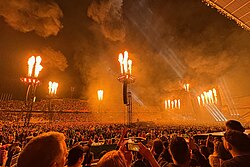
The venue's cultural significance extends beyond music; in June 2026, Pope Leo XIV led a vigil here for over 40,000 people during his visit to Spain.
Stadium Overview
| Feature | Detail |
|---|---|
| Architect | Pere Domènech i Roura (Original), Vittorio Gregotti (Renovation) |
| Structural Engineer | Arup |
| Construction Cost | 288 million pesetas (Renovation) |
| Capacity | 55,926 (Current) / 67,007 (1992 Olympics) |
| Coordinates | 41°21′53″N 2°9′20″E |
Frequently Asked Questions
Who is the stadium named after?
The stadium is named after Lluís Companys, the 123rd president of the Generalitat de Catalunya, who was executed by the Franco regime in 1940.
Why did FC Barcelona play here recently?
FC Barcelona used the stadium as their temporary home ground from 2023 to 2025 while their primary stadium, the Camp Nou, underwent major redevelopment.
What was the stadium's role in the 1992 Olympics?
It served as the main stadium for the 1992 Summer Olympics and Paralympics, hosting the opening and closing ceremonies as well as all athletics competitions.
Has the stadium hosted American football?
Yes, it was the home of the Barcelona Dragons from 1991 to 2002 and hosted the NFL's American Bowl in 1993 and 1994.
Which music artists have performed at the venue?
The stadium has hosted numerous global icons, including The Rolling Stones, Bruce Springsteen, Beyoncé, Coldplay, and U2, among many others.