Understanding Lianas: The Woody Vines of the Forest Canopy
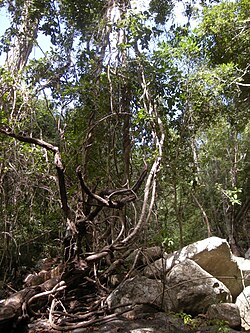
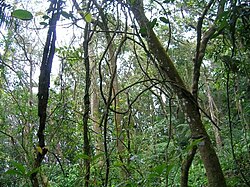
In the dense, sun-drenched layers of a forest, you may notice long, woody stems winding their way from the ground toward the sky. These are lianas. A liana is a long-stemmed woody vine that is rooted in the soil at ground level and utilizes trees or other vertical structures to climb toward the forest canopy in search of direct sunlight. It is important to note that "liana" does not refer to a specific taxonomic grouping (a biological classification); rather, it describes a specific growth habit, much like the terms "tree" or "shrub." The word itself originates from the standard French liane, derived from an Antilles French dialect word meaning "to sheave."
Ecological Roles and Habitats
Lianas are most commonly associated with tropical moist broadleaf forests, particularly seasonal forests. However, they are not exclusive to the tropics; they can also be found in temperate rainforests and temperate deciduous forests. Even in temperate regions, certain genera like Clematis or Vitis (wild grape) function as lianas. These plants play a vital role in the architecture of the forest, often forming "bridges" across the canopy.
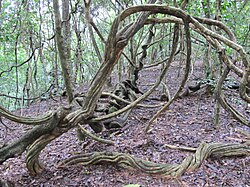
These canopy bridges provide essential pathways for various arboreal (tree-dwelling) animals. Invertebrates, ants, lizards, rodents, sloths, monkeys, and lemurs all utilize these vine networks to navigate the forest. In the eastern tropical forests of Madagascar, for instance, many lemur species achieve much higher mobility thanks to the web of lianas draped among the trees. Interestingly, many lemurs actually prefer trees that are inhabited by lianas because of the presence of their roots.
The Complex Relationship with Host Trees
The relationship between a liana and its host tree is complex and often described as parasitic. While lianas do not derive nutrients directly from the host tree's vascular system, they live on the host and indirectly derive benefits at the host's expense. This interaction can significantly impact the forest ecosystem. Research indicates that lianas can reduce the growth and reproduction of their hosts, increase tree mortality, and prevent new seedlings from establishing themselves. This can ultimately alter forest regeneration and decrease tree population growth rates. For example, forests without lianas have been observed to produce 150% more fruit, and trees hosting lianas have twice the probability of dying.
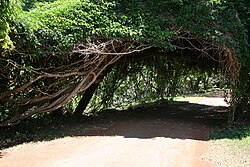
Lianas cause direct physical damage to their hosts through mechanical abrasion (physical scraping) and strangulation. They can also make host trees more vulnerable to damage from wind and ice, increasing the likelihood that a tree will fall. On the other hand, lianas can occasionally provide a benefit by acting as lateral anchors, supporting weaker trees during strong winds by connecting them to sturdier neighbors. However, this anchoring can be a double-edged sword: if one tree falls, the liana connections can create a domino effect, pulling down many other connected trees.
Physical Characteristics and Unique Adaptations
Lianas are uniquely adapted to their climbing lifestyle. Some species attain extraordinary lengths. For instance, a Bauhinia species in Surinam has been recorded growing as long as 600 meters (2,000 ft), and the length of Entada phaseoloides has been accepted at 1.5 km (1 mile). Among monocots (flowering plants that typically have a single embryonic leaf), the longest liana is Calamus manan (also known as Calamus ornatus), reaching 240 meters (787 ft).
One way to distinguish lianas from trees and shrubs is through their stiffness, scientifically measured by the Young's modulus (a measure of a material's elasticity and stiffness). While trees and shrubs generally have flexible young twigs and stiffer older trunks, lianas often exhibit the opposite: they frequently have stiff young growth and more flexible older growth at the base of the stem. To manage these physical stresses, some lianas have evolved flat, ribbon-like stems. This includes certain species of Bauhinia, Entada, and Tetrastigma, as well as Serjania icthyoctonia and Thinonia scandens, the latter of which can even divide into parallel strands.
Key Facts
- Growth Habit: Lianas are woody vines that climb trees to reach sunlight.
- Habitat: Primarily found in tropical moist broadleaf forests, but also in temperate forests.
- Ecological Impact: They act as canopy bridges for animals but can increase tree mortality and reduce fruit production.
- Extreme Length: Some species can reach lengths of up to 1.5 km.
- Physicality: They often possess flexible older stems and stiff young growth, unlike most trees.
Summary of Liana Characteristics
| Feature | Description |
|---|---|
| Classification | A growth habit, not a specific taxonomic group. |
| Primary Goal | Reaching the canopy to access direct sunlight. |
| Host Relationship | Indirectly parasitic; uses trees for support. |
| Animal Benefit | Provides canopy bridges for primates, rodents, and invertebrates. |
| Stem Structure | Often features ribbon-like or highly flexible older stems. |
Common Examples of Liana Taxa
- Acanthaceae: Mendoncia, Thunbergia
- Anacardiaceae: Attilaea, Rhus, Toxicodendron
- Annonaceae: Artabotrys, Fissistigma, Uvaria
- Apocynaceae: Fockea, Odontadenia, Stephanotis, Strophanthus, Trachelospermum
- Arecaceae: Calamus
- Fabaceae: Entada, Wisteria, Mucuna, Pueraria (kudzu)
- Vitaceae: Vitis, Tetrastigma, Cissus
Frequently Asked Questions
Is a liana a type of tree?
No. While lianas are woody and can grow to great sizes, they are classified as a growth habit rather than a specific type of tree. They rely on other trees for vertical support to reach the sunlight.
Do lianas steal nutrients from the trees they climb?
Not directly. Lianas are considered indirectly parasitic. They do not tap into the host's nutrients like some other plants, but they use the host for support and can negatively impact the host's growth, reproduction, and survival.
How long can a liana grow?
Lianas can reach incredible lengths. Some species have been recorded at 600 meters, and one species, Entada phaseoloides, has an accepted length of 1.5 kilometers.
How do lianas help forest animals?
Lianas create a network of "canopy bridges" throughout the forest. This allows animals such as monkeys, lemurs, sloths, and various invertebrates to move through the treetops without having to descend to the ground.
Can lianas cause trees to fall?
Yes. Lianas can cause mechanical damage through abrasion and strangulation. Additionally, while they can sometimes anchor trees together during wind, they can also cause a "domino effect" where the fall of one tree pulls down many others due to their interconnectedness.