Ley de Punto Final: Argentina's Controversial Full Stop Law
Following the end of the military dictatorship known as the Proceso de Reorganización Nacional (1976–1983), Argentina faced the monumental task of transitioning back to democracy. One of the most contentious pieces of legislation from this era was the Ley de Punto Final, commonly known as the Full Stop Law. Passed in 1986, this law sought to draw a definitive line under the investigations and prosecutions of those accused of political violence during the regime.
Key Facts
- Official Name: Law No. 23492.
- Passed: December 24, 1986.
- Purpose: To end the investigation and prosecution of individuals accused of political violence during the dictatorship.
- Exceptions: Cases involving forced disappearance of minors and identity forgery were excluded from the law's protections.
- Legal Status: Repealed by Congress in 2003 and declared unconstitutional by the Supreme Court in 2005.
The Historical Context of the Full Stop Law
The Ley de Punto Final emerged in the wake of the 1985 Trial of the Juntas, where the highest levels of the military hierarchy were prosecuted for crimes committed during the Dirty War—a period of state-sponsored violence against political dissidents. During this era, security and military forces are estimated to have killed or "disappeared" between 15,000 and 30,000 people.
While the Trial of the Juntas resulted in convictions for leaders such as General Jorge Videla, Admiral Emilio Massera, General Roberto Viola, Admiral Armando Lambruschini, and General Orlando Agosti, the military continued to exert significant pressure on the new democratic government.
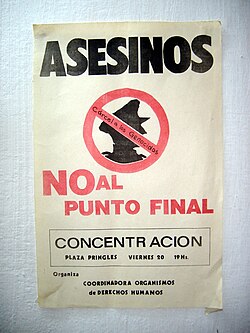
Legislative Passage and Controversy
President Raúl Alfonsín of the Radical administration initially opposed the legislation. However, facing the imminent threat of a coup d'état (the sudden, violent overthrow of a government), Alfonsín accepted the law as a means to stabilize the country and prevent further military unrest.
The law was passed on December 24, 1986, after a brief three-week debate. The legislation was concise, consisting of only seven articles. Despite its brevity, it sparked intense controversy. The voting results reflected a strong legislative majority in favor of the measure:
- Chamber of Deputies: 114 in favor, 17 against, and 2 abstentions.
- Senate: 25 in favor, 10 against.
Complementary Legislation
The Full Stop Law did not act alone. In 1987, the Law of Due Obedience was passed, which further protected the military by exempting subordinates from prosecution if they were acting under orders from their superiors.
The Path to Repeal and Justice
The era of impunity began to end in the early 2000s. The National Congress repealed both the Full Stop Law and the Law of Due Obedience in 2003. This legislative action was solidified on June 14, 2005, when the Supreme Court of Justice ruled that both laws were unconstitutional.
This ruling allowed the government to reopen prosecutions for crimes against humanity. A landmark case followed against Miguel Etchecolatz, the former second-in-command of the Buenos Aires Provincial Police. In September 2006, Etchecolatz was sentenced to life imprisonment for kidnapping, torture, and murder.
Significantly, the tribunal in the Etchecolatz case declared that the state terrorism practiced against political dissidents was a form of genocide, marking the first time this legal classification was applied to these specific assaults in Argentine trials.
Summary of Argentine Amnesty Laws
| Feature | Ley de Punto Final (Full Stop Law) | Law of Due Obedience |
|---|---|---|
| Year Passed | 1986 | 1987 |
| Primary Goal | End investigations/prosecutions of political violence | Exempt subordinates following orders |
| Key Exception | Forced disappearance of minors & identity forgery | N/A |
| Repeal Year | 2003 | 2003 |
| Court Ruling | Unconstitutional (2005) | Unconstitutional (2005) |
Frequently Asked Questions
What was the primary purpose of the Ley de Punto Final?
The law was designed to stop the investigation and prosecution of individuals accused of political violence during the military dictatorship that lasted from 1976 to 1983.
Why did President Raúl Alfonsín support the law despite initial opposition?
President Alfonsín accepted the legislation under the threat of a coup d'état by the military, viewing it as a necessary compromise to maintain the restoration of democracy.
Were there any crimes that the Full Stop Law did not cover?
Yes. Article No. 5 of the law specifically excluded cases involving the forced disappearance of minors and identity forgery from its protections.
When did these amnesty laws lose their legal power?
The National Congress repealed the laws in 2003, and the Supreme Court of Justice officially declared them unconstitutional on June 14, 2005.
What was the significance of the Miguel Etchecolatz trial?
The trial of Miguel Etchecolatz was the first case reopened after the repeal of the amnesty laws. It was historic because the tribunal classified the dictatorship's state terrorism against political dissidents as genocide.