Leonhard Hutter: The Defender of Lutheran Orthodoxy
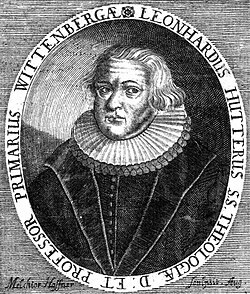
Leonhard Hutter (1563–1616) was a towering figure in German Lutheran theology, renowned for his unwavering commitment to the doctrines of the Reformation. Operating during a period of intense theological volatility, Hutter dedicated his career to safeguarding Lutheran orthodoxy—the adherence to the original teachings of Martin Luther and the established Lutheran confessions—against the rising influence of Calvinism and Jesuit polemics.
Born in Nellingen near Ulm, Hutter's academic journey began in 1581, spanning the prestigious universities of Strasbourg, Leipzig, Heidelberg, and Jena. In 1593, he earned his Doctorate in Theology after a disputation on predestination under the guidance of George Mylius. This early focus on the complexities of divine will and human grace would become a hallmark of his later scholarly battles.
Academic Career and the Battle for Wittenberg
Hutter's professional ascent was rapid. After lecturing at Jena starting in 1594, he was called to the University of Wittenberg in 1596 to serve as a professor of theology. Replacing Samuel Huber, Hutter arrived at the very birthplace of the Reformation with a specific mission: to reverse the trend of Crypto-Calvinism, a movement where individuals publicly adhered to Lutheranism while privately holding Calvinist views.
For twenty years, Hutter served as a pillar of the Wittenberg faculty, eventually being honored with four terms as Rector of the university. His influence extended beyond the classroom, as he sought to crystallize Lutheran dogma into a fixed, objective norm that could withstand external theological attacks.
Major Works and Theological Contributions
Hutter is perhaps best remembered for his Compendium locorum theologicorum (1610), a comprehensive summary of theological places. This work was so highly regarded for its clarity and adherence to tradition that many schools in Saxony adopted it as their official theological textbook.
Defending the Formula of Concord
A central pillar of Hutter's work was the Formula of Concord, a document intended to resolve internal disputes within Lutheranism. Hutter regarded this text as inspired and defended it vigorously in his work Concordia concors (1614), written as a response to Rudolf Hospinian's Concordia discors.
Polemics Against Calvinism
Hutter was a fierce opponent of the Reformed tradition. In Irenicum vere christianum, he countered David Pareus's attempts to reconcile Lutheranism and Calvinism. He also authored Calvinista aulico-politicus (1610) to combat the spread of Calvinism in Brandenburg and Holstein. His opposition was so intense that his writings against Elector John Sigismund of Brandenburg led the Elector to forbid Brandenburgers from attending the University of Wittenberg.
Refining Melanchthon's Legacy
In his work Loci communes theologici, Hutter engaged deeply with the writings of Phillip Melanchthon. He used this text to comment on, correct, and reframe Melanchthon's original Loci communes, providing a historical review of how these doctrines had been received throughout the 16th century.
Key Facts
- Full Name: Leonhard Hutter (Latinized as Hutterus).
- Lifespan: January 19, 1563 – October 23, 1616.
- Primary Role: Professor of Theology and four-time Rector at the University of Wittenberg.
- Key Titles: Known as "Luther redonatus" (Luther restored) and "Malleus Calvinistarum" (Hammer of the Calvinists).
- Core Belief: Viewed dogma as fixed and crystallized, rejecting the idea of a developing theology.
- Major Textbook: Compendium locorum theologicorum.
Summary of Hutter's Theological Impact
| Work | Primary Focus/Target | Theological Goal |
|---|---|---|
| Compendium locorum theologicorum | General Lutheran students | Standardize Lutheran orthodoxy |
| Concordia concors | Rudolf Hospinian | Defend the Formula of Concord |
| Irenicum vere christianum | David Pareus | Oppose Lutheran-Calvinist reconciliation |
| Calvinista aulico-politicus | Calvinism in Holstein/Brandenburg | Combat political-religious conversion |
| Loci communes theologici | Phillip Melanchthon | Refine and correct early Lutheran loci |
Death and Lasting Legacy
Leonhard Hutter died suddenly of a feverish illness on October 23, 1616, at the age of 53. His passing was deeply felt by the theological community. In a funeral sermon, Balthasar Meisner summarized Hutter's importance with the phrase "Lutherus incepit, Hutterus finijt" (Luther began it; Hutter finished it), positioning Hutter as the final architect of the first century of Lutheranism.
Hutter's legacy is that of a systematizer. He is regarded as the prototype of orthodox Lutheran dogmatics, having adhered strictly to the letter and spirit of the Lutheran symbols. By treating dogma as an objective norm, he provided a defensive wall for the church against the competing influences of the 17th century.
Frequently Asked Questions
What was Leonhard Hutter's primary goal at the University of Wittenberg?
Hutter aimed to reverse the trend of Crypto-Calvinism and ensure that the University of Wittenberg remained a bastion of strict Lutheran orthodoxy.
Why was he called the "Hammer of the Calvinists"?
He earned the title Malleus Calvinistarum due to his vehement and rigorous polemical writings against Calvinist theology and its spread within German territories.
What is the significance of the Compendium locorum theologicorum?
It served as a definitive summary of Lutheran theology and was adopted as the official theological textbook in many schools across Saxony.
How did Hutter view the Formula of Concord?
Hutter regarded the Formula of Concord as inspired and viewed it as the essential standard for maintaining confessional unity and doctrinal purity.
What was Hutter's relationship with the works of Phillip Melanchthon?
While respecting Melanchthon, Hutter wrote Loci communes theologici to correct or reframe Melanchthon's doctrines where he believed they needed adjustment to align with orthodox Lutheranism.