The Complete Guide to Leeks: From Ancient History to Modern Kitchens
With its mild, onion-like flavor and versatile texture, the leek is a staple in kitchens around the world. Whether they are being simmered in a creamy soup or sautéed as a side dish, these vegetables offer a unique culinary profile that ranges from crunchy and firm when raw to soft and delicate when cooked. But the leek is much more than just a kitchen ingredient; it is a plant with deep historical roots and significant cultural importance.
Key Facts
- Scientific Name: Allium ampeloprasum
- Plant Type: A biennial vegetable (a plant that completes its life cycle in two years).
- Edible Part: A bundle of leaf sheaths, often referred to as a "stem" or "stalk."
- Nutritional Highlight: An excellent source of Vitamin K and Manganese.
- Cultural Symbol: A national emblem of Wales.
Understanding the Leek: Botanical Profile
The leek is a cultivar—a plant variety produced by selective breeding—of Allium ampeloprasum, also known as the broadleaf wild leek. It belongs to the Allium genus, a large group of plants that includes many familiar kitchen staples such as onions, garlic, shallots, scallions, chives, and the Chinese onion.
Interestingly, three other vegetables—elephant garlic, kurrat, and the Persian leek (or tareh)—are also cultivars of A. ampeloprasum, though they are used differently in various culinary traditions.
Etymology and Origins
The name "leek" has deep linguistic roots, evolving from the Old English word lēac. This term, which meant "onion" in Old English, is also the ancestor of the modern English word for garlic. The word has many cognates across Germanic languages, such as Lauch in German and look in Dutch. While many scientific names were used for leeks in the past, modern taxonomy treats them all as cultivars of A. ampeloprasum.
Growing and Cultivating Leeks
Leeks thrive in soil that is loose and well-drained, sharing similar growing requirements with onions. While they can be seeded directly into the ground, they are most commonly grown in high-density seed-beds before being transplanted into fields. This transplanting typically occurs at 12 weeks, once the young plants have reached the thickness of a pencil.
The ideal temperature for leek growth is approximately 20 °C (68 °F). One of the advantages of leeks is their high cold tolerance compared to other members of the Allium genus, allowing them to be produced year-round in parts of Europe. Once planted, they can remain in the field for an extended harvest period of up to six months.
Managing Pests and Diseases
Like many vegetables, leeks are susceptible to certain pests and diseases. Common insect threats include the leek moth and the thrips species Thrips tabaci. Thrips damage is particularly severe when the plants experience water stress during hot, dry weather, as the insects reproduce rapidly while plant growth slows down. To manage thrips, growers may use chemical pesticides or practice intercropping—planting leeks alongside legumes or other plants to deter pests.
Leeks are also vulnerable to leek rust (Puccinia allii), a fungal disease that can affect crop health.
Common Leek Varieties
Leek cultivars are often grouped together as the "Leek Group" (A. ampeloprasum 'Leek Group'). They are most commonly categorized by their intended harvest time:
- Summer Leeks: These are smaller in size and intended to be harvested during the same season they are planted.
- Overwintering Leeks: These are generally larger and possess a stronger flavor, meant to be harvested in the spring following their planting.
Notable cultivars include 'King Richard' and 'Tadorna Blue'.
Culinary Uses and Preparation
The flavor of a leek is mild and onion-like. The edible portion consists of the white base, the light green sections, and, to a lesser extent, the dark green leaves. While the dark green parts are often discarded due to their tough texture, they are frequently used to add flavor to stocks or can be sautéed.
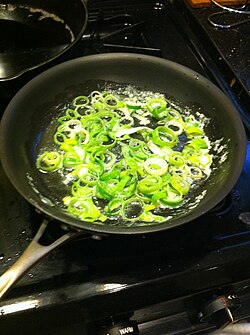
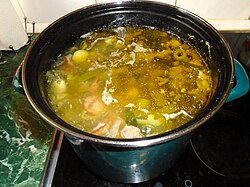
Leeks are typically sliced into pieces 5–10 mm thick. Because of their layered structure, these slices can sometimes fall apart during cooking. Common preparation methods include:
- Boiling: This results in a soft texture and a very mild taste. In France, whole boiled leeks served cold with vinaigrette are known as asperges du pauvre ("poor man's asparagus").
- Frying: This method preserves more of the vegetable's flavor and leaves it with a crunchier texture.
- Raw: Sliced raw leeks are excellent in salads.
Leeks feature prominently in international cuisine. In Turkey, they are often boiled, separated into leaves, and filled with rice, herbs, and meat to create various sarma dishes. In Switzerland, Papet Vaudois—a dish of boiled leeks and potatoes—is an emblematic specialty of the Canton of Vaud. Sephardic Jewish cuisine also features Keftikas de Prasa, or leek patties, which are served during holidays like Rosh HaShana and Passover. In the UK, leeks are essential to dishes like cock-a-leekie soup and vichyssoise.
Nutritional Value
Leeks are a nutrient-dense vegetable. A 100-gram serving is a rich source of Vitamin K and Manganese, and a moderate source of Vitamin B6, folate, Vitamin C, and iron. They are composed of approximately 83% water.
| Nutrient | Quantity | % Daily Value (DV) |
|---|---|---|
| Energy | 255 kJ (61 kcal) | - |
| Carbohydrates | 14.15 g | - |
| Dietary Fiber | 1.8 g | - |
| Protein | 1.5 g | - |
| Vitamin K | - | 39% |
| Manganese | - | 21% |
| Vitamin B6 | - | 14% |
| Vitamin C | - | 13% |
| Iron | - | 12% |
| Folate (B9) | - | 16% |
Historical and Cultural Significance
The consumption of leeks dates back thousands of years. Archaeological evidence and ancient texts show that leeks were a part of the diet in Egypt and Mesopotamia as early as the second millennium BCE. In ancient Rome, leeks were highly regarded and even preferred over garlic and onions. The Emperor Nero was famously known as "Porrophagus" (the Leek Eater) because he consumed them in soup or oil to benefit his voice.
Culturally, the leek is most famously recognized as a national emblem of Wales. It is worn on St. David's Day, a tradition linked to various Welsh myths, including one involving King Cadwaladr of Gwynedd. The leek's importance is reflected in British currency, appearing on one-pound coins, and it is also used as the cap badge for the Welsh Guards in the British Army. Additionally, the leek is considered a symbol of the Oltenia region in Romania.
Frequently Asked Questions
What is the difference between summer and overwintering leeks?
Summer leeks are smaller and are harvested in the same season they are planted. Overwintering leeks are larger, have a stronger flavor, and are intended to be harvested in the spring of the following year.
Can you eat the dark green parts of a leek?
Yes, the dark green parts are edible, but they have a much tougher texture than the white and light green parts. They are often used in stocks for flavor or can be sautéed.
Why is the leek a symbol of Wales?
The leek is a national emblem of Wales and is worn on St. David's Day. This tradition is tied to Welsh history and myths, such as the story of King Cadwaladr using leeks to identify his soldiers in battle.
What are the most common pests for leeks?
The most common insect pests are the leek moth and thrips (Thrips tabaci). Leeks are also susceptible to a fungal disease known as leek rust.
Is a leek a biennial plant?
Yes, the leek is a biennial vegetable, meaning it typically completes its biological life cycle over the course of two years.