Lee Jun-seok: The Rise and Evolution of a South Korean Political Icon
In the rapidly shifting landscape of South Korean politics, few figures have sparked as much debate and movement as Lee Jun-seok. From his early days as a young political voice to his leadership roles in major parties and the eventual founding of the Reform Party, Lee has consistently challenged traditional political norms. Known for his focus on meritocracy and his ability to mobilize younger demographics, his career is a study in political resilience and ideological shifts.

Key Facts
- Current Role: Leader of the Reform Party and Member of the National Assembly (Hwaseong B).
- Political Affiliations: Reform Party (since 2024), formerly People Power Party.
- Education: Bachelor of Arts from Harvard University.
- Key Ideologies: Meritocracy, gender inequality issues, and government restructuring.
- Political Milestone: Served as the Leader of the People Power Party from June 2021 to August 2022.
Early Life and Academic Foundation
Born on March 31, 1985, in the Seongdong District of Seoul, Lee Jun-seok entered the political arena with a strong academic background. He attended Harvard University, where he earned his degree, providing him with a global perspective that would later influence his views on foreign policy and government efficiency. His early interest in political issues was documented in his writings, including his 2012 book, "A Young Man in Politics?".
A Rapid Ascent in National Politics
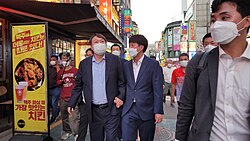
Lee's political career gained significant momentum when he rose to lead the People Power Party (PPP) in June 2021. His leadership was marked by an attempt to modernize the conservative platform, focusing on issues that resonated with the "2030 generation" (voters in their 20s and 30s). During this period, he became a central figure in discussions regarding meritocracy—the belief that advancement should be based on ability rather than social status—and gender equality debates.
Leadership and Controversy
His tenure as PPP leader was not without turbulence. Lee faced significant internal conflicts, including high-profile disagreements with figures such as former Prosecutor General Yoon Suk Yeol. Between 2022 and 2023, his political standing was tested by ethics investigations and a period of suspension from the party. Despite these challenges, Lee remained a prominent voice in the conservative movement.
The Birth of the Reform Party
Following his departure from the People Power Party, Lee sought to create a new political path. On January 20, 2024, he founded the Reform Party. This move was intended to provide a "third way" in South Korean politics, distancing himself from the established major parties. His leadership of the Reform Party was solidified in July 2025, when he assumed office as the party leader.
Legislative Success and Policy Focus
Lee has successfully transitioned into a legislative role, serving as a Member of the National Assembly for the Hwaseong B constituency since May 30, 2024. His policy platform is diverse, covering several critical areas:
- Government Restructuring: Proposing the reduction of government ministries to increase efficiency.
- Transit and Climate Policy: Addressing modern infrastructure and environmental concerns.
- Social Issues: Engaging in debates over gender-based quotas and social fairness.
- Foreign Policy: Advocating for strong alliances, such as the South Korea-US-Japan trilateral cooperation.
Election Performance Summary
Lee's influence is clearly reflected in his various election results, ranging from legislative contests to presidential involvement. The following table summarizes key electoral data associated with his political journey.
| Election Type | Party/Affiliation | Candidate/Context | Result/Percentage |
|---|---|---|---|
| Legislative | Saenuri | Lee Jun-seok | 31.32% |
| Legislative | Bareunmirae | Lee Jun-seok | 27.23% |
| Legislative | Reform | Lee Jun-seok | 42.41% |
| Presidential | Reform | Lee Jun-seok | 8.34% |
Frequently Asked Questions
What is Lee Jun-seok's current political position?
As of 2025, Lee Jun-seok is the leader of the Reform Party and serves as a Member of the National Assembly representing the Hwaseong B constituency.
What are the core pillars of Lee Jun-seok's political ideology?
His platform is built heavily on meritocracy, government efficiency through restructuring, and addressing the specific concerns of younger voters regarding gender and social competition.
Which party did Lee Jun-seok lead previously?
He served as the leader of the People Power Party from June 11, 2021, to August 9, 2022.
How did Lee Jun-seok respond to gender equality debates?
Lee has been a vocal proponent of merit-based systems and has frequently challenged existing gender quota systems, arguing for a focus on individual capability.
What is the Reform Party?
The Reform Party is a political party founded by Lee Jun-seok on January 20, 2024, aimed at providing an alternative to the traditional major political factions in South Korea.