Leaf-Miner Flies: Biology and Impact of the Agromyzidae Family
The Agromyzidae are a diverse family of small flies known primarily for the specialized feeding habits of their larvae. Commonly referred to as leaf-miner flies, these insects play a significant role in both natural ecosystems and agricultural environments. With approximately 2,500 species worldwide, they are found in a vast array of habitats, dictated largely by the availability of their specific host plants.
Most agromyzids are minute, typically ranging from 2 to 3 mm in length, though some species are as small as 1 mm and others can reach up to 6.5 mm. Their life cycle is intricately tied to plant tissue, where the larvae create distinctive tunnels, or "mines," as they feed.
Key Facts
- Species Diversity: Roughly 2,500 species across the globe.
- Feeding Habit: Primarily phytophagous (plant-eating) larvae that mine leaves, stems, or seeds.
- Agricultural Impact: About 10% of species are considered pests, damaging crops and transmitting plant viruses.
- Identification: Often identified by the unique shape of the leaf mines they create.
- Size: Generally small, with most adults measuring between 2 and 3 mm.
Physical Characteristics and Morphology
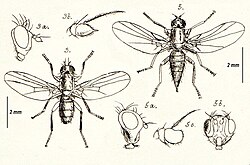
Adult agromyzid flies possess a distinctive head structure that is key to their identification. The frontal vitta—the upper part of the frons above the ptilinal suture—is lightly sclerotized (hardened) and lacks setae (bristles). In contrast, the lower frons and the dorsal area of the head are more heavily sclerotized and setaceous, often creating a visible patch of different color and texture.
Their wings are typically hyaline (transparent), though some tropical species exhibit darker markings. Interestingly, certain species, such as those in the genus Agromyza, are capable of stridulation—producing sound using a "file" on the first abdominal segment and a "scraper" on the hind femur.
Technical Anatomy
From a technical standpoint, these flies feature a rectangular thorax with a well-developed humeral callus and a broad abdomen. Their chaetotaxy (the arrangement of bristles) is highly developed, particularly on the head, where postvertical orbital bristles are always present and divergent. The antennae consist of a very short basal segment, a non-grooved second segment, and a large, usually round third segment with a pubescent arista.
Females are equipped with an elongated telescopic ovipositor, which allows them to deposit eggs precisely into plant tissue. This organ is retracted into the seventh tergite when not in use.
Life Cycle and Biology
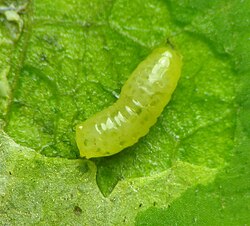
The life cycle of the Agromyzidae begins with an oval, white or yellowish egg. The resulting larva is apodous (legless) and cylindrical, typically reaching 2 to 3 mm in length by its final instar. These larvae are primarily phytophagous, meaning they feed on plants. While most are leaf miners, some species act as stem borers, seed feeders, or gall producers.
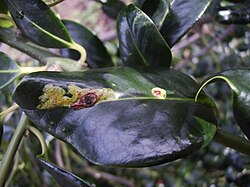
Host specificity varies wildly across the family. Some species are highly specialized; for example, Phytomyza ilicis (the European holly leaf miner) feeds exclusively on holly. Others, particularly in the genera Liriomyza and Phytomyza, are polyphagous, meaning they can attack a wide variety of plant species.
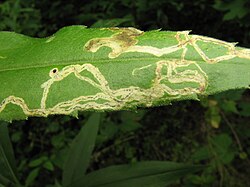
The pupal stage is variable in shape—ranging from barrel-shaped to elongated—and can vary in color from yellowish-white to brown or black. The shape of the mine left behind by the larva is often a diagnostic tool used by entomologists to identify the species and sometimes even the developmental stage (instar) of the larva.
Agricultural and Economic Importance
While many agromyzids are harmless, approximately 10% are significant agricultural pests. They cause direct damage by destroying leaf tissue, which is particularly devastating for young plants. Beyond physical damage, some females can inoculate plants with pathogenic fungi or transmit viruses through their feeding punctures.
Several species are classified as quarantine pests due to their potential for economic destruction, including Liriomyza huidobrensis, Liriomyza sativae, and Liriomyza trifolii. The most economically impactful genera include Agromyza, Melanagromyza, Ophiomyia, Liriomyza, Napomyza, and Phytomyza.
| Genus | Example Species | Common Name / Impact |
|---|---|---|
| Liriomyza | L. trifolii | American serpentine leaf miner |
| Ophiomyia | O. simplex | Asparagus miner |
| Liriomyza | L. brassicae | Serpentine leaf miner |
| Phytomyza | P. ilicis | European holly leaf miner |
Identification and Taxonomy
Identifying Agromyzidae species can be challenging due to their extreme morphological similarity. While traditional methods rely on wing venation and bristle formulas, modern science increasingly utilizes DNA barcoding to ensure accurate species identification.
Frequently Asked Questions
What is a leaf miner?
A leaf miner is an insect larva that lives and feeds between the upper and lower epidermal layers of a leaf, creating visible tunnels or "mines" as it consumes the internal mesophyll tissue.
Why are leaf-miner flies considered pests?
They are considered pests because they can destroy the photosynthetic capacity of leaves, especially in young plants, and can act as vectors for plant viruses and fungi.
How do scientists tell different leaf-miner species apart?
Scientists use a combination of the specific shape of the leaf mine, the arrangement of bristles on the adult fly's head and thorax, and DNA barcoding.
Do all Agromyzidae feed on leaves?
No. While most are leaf miners, some species feed on developing seeds, bore into stems, or live in roots and under bark.
What is stridulation in these flies?
Stridulation is the act of producing sound. Some species, like those in the genus Agromyza, achieve this by rubbing a "file" on their first abdominal segment against a "scraper" on their hind femur.