Law for the Restoration of the Professional Civil Service
Enacted on April 7, 1933, the Law for the Restoration of the Professional Civil Service (German: Gesetz zur Wiederherstellung des Berufsbeamtentums) served as one of the first instruments of systemic racism and antisemitism in Nazi Germany. Coming just two months after Adolf Hitler's rise to power and two weeks after the Enabling Act, this legislation laid the groundwork for the state-sponsored exclusion of "non-Aryans" and political dissidents from public life.
The law's stated goal was to create a "national" and "professional" civil service. In reality, it provided the legal mechanism to purge the government of individuals who did not align with the Nazi Party's racial and political ideologies. This purge targeted tenured civil servants, including teachers, professors, and judges, and eventually expanded to include lawyers, doctors, musicians, and notaries.
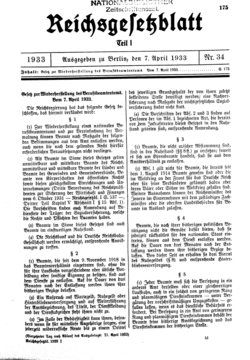
Key Facts
- Date Enacted: April 7, 1933.
- Primary Targets: Individuals of non-Aryan descent (specifically Jewish people) and members of the Communist Party.
- Scope: Applied to Reich, Länder, and municipal government levels, as well as various professional sectors.
- Key Requirement: Civil servants were required to provide an Ariernachweis (proof of Aryan ancestry).
- Historical Significance: The first antisemitic law passed in Germany since the emancipation of Jews in 1871.
The Mechanics of Exclusion
Article 1 and Racial Definitions
Article 1 mandated the retirement of civil servants who were not of Aryan descent. The law defined "non-Aryan" as anyone descended from non-Aryans, specifically those with Jewish parents or grandparents. Even a single non-Aryan grandparent was sufficient for a person to be targeted for dismissal.
Defining "Aryan" proved complex. Early attempts by Albert Gorter included a broad Caucasian definition that encompassed various European and Asiatic groups. However, this was deemed unacceptable by the regime. A later definition by Achim Gercke specified that an Aryan was someone "tribally related to German blood" and descended from a people domiciled in Europe in a closed tribal settlement since recorded history.
Political Purges and Article 4
The law was not solely based on race. Article 4 targeted individuals whose previous political activities suggested they could not guarantee unconditional loyalty to the national state. This was a tool for Gleichschaltung (coordination), ensuring that all state personnel were reliable executors of the Party's will, regardless of their racial origin.
Exceptions and the Hindenburg Amendments
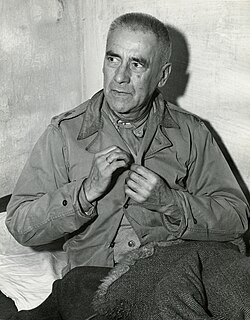
The law was originally drafted by Interior Minister Wilhelm Frick to be an immediate and total purge. However, President Paul von Hindenburg objected, leading to three specific exemptions for civil servants:
- World War I veterans who had served at the front.
- Those who had been in the civil service continuously since August 1, 1914.
- Those who had lost a father or son in combat during the Great War.
While these loopholes provided temporary protection for some Jewish civil servants, they were largely symbolic. Following Hindenburg's death in 1934, these exceptions were completely superseded by the Nuremberg Laws of 1935, which mandated that all remaining Jewish civil servants be given notice by December 31, 1935.
Impact on Society and Professionals
The legislation triggered a wave of forced retirements and resignations. Many prominent intellectuals, such as Albert Einstein, resigned from their positions—such as Einstein's role at the Prussian Academy of Sciences—and emigrated to avoid forced expulsion.
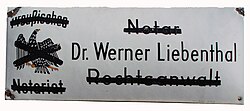
The reach of the law extended beyond government offices. Similar regulations were applied to private professional practices. Notaries, tax consultants, and doctors found their livelihoods stripped away as the state boycotted and closed Jewish-owned offices.
| Feature | Details |
|---|---|
| Primary Objective | Establish a "national" civil service via racial and political purging. |
| Target Groups | Jews, non-Aryans, Communists, and political opponents. |
| Key Requirement | Ariernachweis (Proof of Aryan ancestry). |
| Key Exemptions | WWI veterans and long-term employees (pre-1914). |
| Ultimate Outcome | Total removal of Jewish personnel by late 1935. |
Frequently Asked Questions
Who was primarily targeted by the Law for the Restoration of the Professional Civil Service?
The law primarily targeted individuals of non-Aryan descent, specifically those of Jewish parentage or grandparentage, as well as members of the Communist Party and other political opponents of the Nazi regime.
What was the Ariernachweis?
The Ariernachweis was a formal proof of Aryan ancestry. Civil servants were required to produce this documentation to prove they had no ancestors of the Jewish race to maintain their employment.
Did the law affect people who were not Jewish?
Yes. Under Article 4, any civil servant who could not guarantee their total loyalty to the national state due to their political beliefs could be forced into retirement or dismissed, regardless of their racial background.
How did the law change after the Nuremberg Laws were passed?
The Nuremberg Laws of 1935 closed the loopholes that had previously protected certain Jewish veterans or long-term employees. By December 31, 1935, all remaining Jewish civil servants were required to be removed from their posts.
Which professions were affected beyond government administration?
While initially targeting civil servants, the regime quickly extended similar restrictive laws to lawyers, doctors, tax consultants, musicians, and notaries.