Laughingthrushes and Allies: A Deep Dive into the Leiothrichidae Family
The Leiothrichidae, commonly known as laughingthrushes and their allies, are a diverse family of Old World passerine birds. Once grouped within the broader Old World babbler family (Timaliidae), these birds are now recognized as a distinct lineage comprising 143 species across 17 genera. Found primarily in the tropical regions of Africa, the Middle East, and Asia, they are most abundant and varied across the Indian subcontinent and Southeast Asia.
These small to medium-sized birds are characterized by strong legs and generalized bills similar to those of a thrush. While many species sport predominantly brown plumage with little difference between males and females, the family also includes several brightly colored species. Their physical build—featuring short, rounded wings—makes them weak flyers, and they are generally not strongly migratory.
Key Facts
- Species Count: 143 species divided into 17 genera.
- Primary Habitat: Tropical woodlands, forests, scrublands, and savannas.
- Diet: Primarily insectivorous, though many eat berries and some larger species consume small vertebrates.
- Distribution: Africa, Middle East, South Asia, Southeast Asia, and Eastern Asia.
- Behavior: Highly vocal social birds known for complex communication and cooperative foraging.
Taxonomic Evolution
The classification of Leiothrichidae has undergone significant revision. Originally introduced as a subfamily by William Swainson in 1832, these birds spent much of the 20th century in the Timaliidae family, which served as a "wastebasket taxon" for various Old World insectivores. Early revisions by Jean Théodore Delacour in the 1940s and 50s began organizing the group based on bill shape and plumage.
Modern DNA-DNA hybridization and subsequent molecular phylogenetic studies have refined this further. A landmark 2018 study revealed that the genus Garrulax was polyphyletic (descended from more than one evolutionary ancestor), leading to the resurrection of the genera Pterorhinus and Ianthocincla. Similarly, the genus Turdoides was split, with several species moving to the genus Argya.
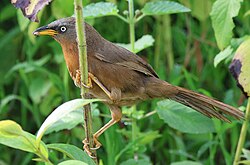
Further refinements include the creation of the genus Montecincla for four species endemic to India's Western Ghats and the movement of crocias to the genus Laniellus. Some debate remains regarding the genus Alcippe (fulvettas); while some place them in Leiothrichidae, others suggest a separate family, Alcippeidae, due to their smaller size and more arboreal nature.
Distribution and Habitat
Leiothrichidae are predominantly woodland and forest birds, though those in the Argya and Turdoides genera are frequently found in savanna and scrub environments. Their highest diversity is concentrated in Southeast Asia and the Himalayas.
While they do not engage in long-distance migration, some species exhibit irregular or altitudinal migration—moving up and down mountain slopes based on the season. For example, the red-billed leiothrix descends from high Himalayan forests in November and returns in late April.
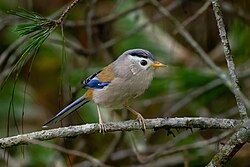
Physical Characteristics
The family exhibits a wide range of sizes. The greater necklaced laughingthrush is the largest, reaching 34 cm in length and weighing up to 170 g. In contrast, the Nepal fulvetta is significantly smaller, measuring only 12.5 cm and weighing between 13 and 18 g.
Plumage varies by environment: forest species can be black, white, or vividly colorful, while scrub and savanna species tend to be drabber. Interestingly, some species use mimicry for survival; the lesser necklaced laughingthrush mimics the plumage of the greater necklaced laughingthrush to facilitate joint foraging.
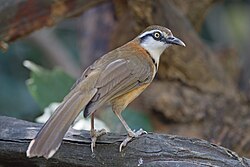
Sexual dimorphism (physical difference between sexes) is generally minimal. While some genera like Leiothrix and Minla show visible differences, others, such as the plain laughingthrush, only show differences under reflectance spectrometry, where males typically possess brighter plumage.
Diet and Social Behavior
Most species are insectivorous, but berries are a critical food source during non-breeding seasons. Larger species may also hunt small lizards.
![Berries form an important part of the diet of Nepal fulvettas in the non-breeding season.[16]](/images/eb/85/eb85524d91980f862972f27f85d7c37d7c690ec763dbee859b307bbc899493ff.jpg)
Social structure is vital for survival. Many species employ sentinels—individuals that watch for predators from high vantage points while the rest of the group forages. Arabian babblers, for instance, are highly adept at identifying specific threats and adjusting their response based on the danger level of the predator.
Vocalizations and Communication
The family is renowned for its complex vocalizations. Many genera, including Actinodura and Trochalopteron, engage in dueting to maintain pair-bonds. In group-living species, calls are used for coordination; the jungle babbler has 15 distinct calls for tasks such as brooding, aggression, and vigilance.
Remarkably, the southern pied babbler has demonstrated the ability to combine different calls to create a new, derived meaning—a trait rarely seen outside of primates. For example, they can combine a recruitment call with a warning call to gather the group to mob a ground-dwelling predator.
Summary of Leiothrichidae Genera
| Genus | Common Name/Group | Approx. Species Count | Notes |
|---|---|---|---|
| Pterorhinus | Laughingthrushes & Babaxes | 23 | Previously part of Garrulax |
| Turdoides | Babblers | 19 | Strongly terrestrial |
| Trochalopteron | Laughingthrushes | 19 | Known for bright markings |
| Argya | Babblers | 16 | Moved from Turdoides |
| Garrulax | Laughingthrushes & Hwamei | 14 | Restricted after 2018 revision |
| Alcippe | Fulvettas | 10 | Smaller and more arboreal |
Frequently Asked Questions
Why were laughingthrushes moved out of the Timaliidae family?
The Timaliidae family was historically a "wastebasket taxon" where many unrelated Old World insectivores were placed. Molecular phylogenetic studies and DNA sequencing revealed that laughingthrushes form a distinct clade, leading to their classification in the family Leiothrichidae.
Do laughingthrushes migrate?
They are not strongly migratory. While most are sedentary, some species perform short or irregular migrations. Several montane species engage in altitudinal migration, moving to lower elevations during winter months.
What is unique about the communication of the southern pied babbler?
The southern pied babbler is one of the few non-primate species identified as being able to combine separate calls to create a new, derived meaning, such as combining a recruitment call with a warning call to organize a mobbing response against predators.
How do the lesser and greater necklaced laughingthrushes interact?
The lesser necklaced laughingthrush mimics the plumage of the greater necklaced laughingthrush. This mimicry allows the two different species to forage closely together in the same flocks.
What do laughingthrushes eat?
Their diet is primarily insectivorous, but they are opportunistic. Many species rely on berries during the non-breeding season, and larger species are known to eat small vertebrates like lizards.