Lattice Theory: Foundations of Order and Algebraic Structures
In the realm of mathematics, lattice theory serves as a critical bridge between order theory and universal algebra. At its core, a lattice is a structure that allows us to find a unique "best" upper and lower bound for any two elements. Whether viewed as a set with a specific ordering or as an algebraic system with binary operations, lattices provide the formal language for describing hierarchies, dependencies, and logical structures across computer science and mathematics.
Defining the Lattice
A lattice can be defined through two equivalent lenses: order-theoretically and algebraically. Depending on the problem being solved, one definition may be more intuitive than the other.
The Order-Theoretic Perspective
From this view, a lattice is a partially ordered set (poset)—a set where some pairs of elements are comparable—that satisfies two conditions: every two-element subset must have a join (the least upper bound) and a meet (the greatest lower bound). These operations are monotone, meaning that if one element increases, its join or meet with another element will also increase or remain the same.
When these operations are restricted to a subset of a lattice, the resulting structure is known as a partial lattice, where the join or meet may be undefined if the result falls outside that subset.
The Algebraic Perspective
Alternatively, a lattice is an algebraic structure consisting of a set and two binary operations, join (&join;) and meet (&meet;), that are commutative, associative, and satisfy the absorption laws. These laws ensure that the two operations are inextricably linked, preventing the structure from collapsing into two unrelated operations.
The connection between these two definitions is seamless: given an algebraic lattice, one can define a partial order by stating that a ≤ b if and only if their meet is a. Conversely, any poset that is both a join-semilattice and a meet-semilattice naturally forms an algebraic lattice.
Bounded and Complete Lattices
Not all lattices are created equal. Some possess additional properties that make them more powerful for mathematical modeling.
Bounded Lattices
A bounded lattice is one that contains a greatest element (top, denoted as ⊤ or 1) and a least element (bottom, denoted as ⊥ or 0). In such a lattice, the bottom element acts as the identity for the join operation, while the top element acts as the identity for the meet operation. Notably, every non-empty finite lattice is automatically bounded.
Complete Lattices
While a standard lattice guarantees joins and meets for pairs of elements, a complete lattice guarantees them for all subsets, regardless of size. This is a more restrictive definition than a bounded lattice, though every complete lattice is necessarily bounded. A related concept is the conditionally complete lattice, where every non-empty subset that has an upper bound must have a join; this is the foundation for the completeness axiom of real numbers.
Key Facts
- Dual Nature: Lattices can be treated as either partially ordered sets or algebraic structures.
- Essential Operations: The two primary operations are the join (least upper bound) and the meet (greatest lower bound).
- Boundedness: A bounded lattice has a defined maximum (⊤) and minimum (⊥).
- Distributivity: A distributive lattice is one where join and meet distribute over each other; these are isomorphic to lattices of sets.
- Modularity: A weaker form of distributivity used in the study of submodules and normal subgroups.
- Boolean Algebra: A complemented distributive lattice is known as a Boolean algebra.
Special Types of Lattices
Distributive and Modular Lattices
A distributive lattice satisfies the law where the join of an element with the meet of two others is equal to the meet of the joins. If a lattice is not distributive, it must contain a sublattice isomorphic to either M3 or N5.
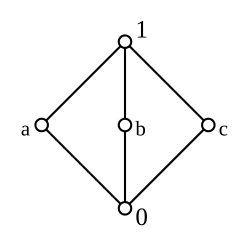
A modular lattice is a slightly more general structure. It satisfies the modular identity: if a ≤ c, then the join of a and the meet of b and c equals the meet of b and the join of a and b. Examples include the lattice of normal subgroups of a group.
Complements and Boolean Algebras
In a bounded lattice, two elements are complements if their join is the top element and their meet is the bottom element. If every element in a bounded lattice has a complement, it is a complemented lattice. When a complemented lattice is also distributive, it becomes a Boolean algebra, where each element has a unique complement.
Morphisms and Sublattices
A lattice homomorphism is a function between two lattices that preserves the join and meet operations. While every homomorphism is monotone (order-preserving), the reverse is not always true.
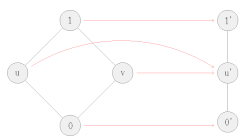
A sublattice is a subset of a lattice that remains a lattice using the same operations. If the subset also contains all elements between any two of its members, it is called a convex sublattice.
Summary of Lattice Classifications
| Lattice Type | Defining Characteristic | Key Property |
|---|---|---|
| Bounded | Has ⊤ and ⊥ elements | Finite lattices are always bounded |
| Complete | Joins/meets for all subsets | More restrictive than bounded |
| Distributive | Join/meet distribute over each other | No M3 or N5 sublattices |
| Modular | Satisfies modular identity | No N5 sublattices |
| Boolean Algebra | Distributive + Complemented | Unique complements for all elements |
Frequently Asked Questions
What is the difference between a join and a meet?
A join is the least upper bound (the smallest element that is greater than or equal to both inputs), while a meet is the greatest lower bound (the largest element that is less than or equal to both inputs).
Can a poset be a lattice without being a total order?
Yes. A total order requires every pair of elements to be comparable. A lattice only requires that every pair has a unique least upper bound and greatest lower bound, even if the elements themselves cannot be compared directly.
What makes a lattice "distributive"?
A lattice is distributive if the join operation distributes over the meet operation (and vice versa), similar to how multiplication distributes over addition in basic arithmetic.
What is a Boolean algebra in the context of lattices?
A Boolean algebra is a specific type of lattice that is both distributive and complemented, meaning every element has a unique opposite that, when combined, results in the top and bottom elements of the lattice.
What are some real-world applications of lattice theory?
Lattice theory is used in various fields, including formal concept analysis, domain theory in programming language semantics, fuzzy set theory, and the study of subgroups in abstract algebra.