La Capital: The Dean of the Argentine Press
In the heart of Rosario, Santa Fe, stands a journalistic institution that has witnessed the evolution of Argentina for over a century and a half. La Capital is not merely a daily newspaper; it is a historical landmark. Founded on November 15, 1867, it holds the prestigious title of Decano de la Prensa Argentina (Dean of the Argentine Press), making it the oldest newspaper in the country still in circulation.
The publication was established by Ovidio Lagos and Eudoro Carrasco. The name "La Capital" was a deliberate political statement by Lagos and his allies, who campaigned to move the federal government's capital to Rosario. Although Congress declared Rosario the capital on three separate occasions, each attempt was ultimately blocked by presidential vetoes.
From its inception, the newspaper positioned itself as a voice for the citizenry. Its enduring motto, "Las columnas de La Capital pertenecen al pueblo" (La Capital's columns belong to the people), underscores a foundational commitment to public opinion and democratic debate.
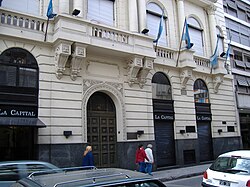
Key Facts
- Founded: November 15, 1867.
- Location: Rosario, Santa Fe, Argentina.
- Ownership: Grupo América.
- Circulation: 40,000 copies.
- Reach: Approximately 2 million readers across Santa Fe and four other provinces.
- Distinction: The oldest circulating newspaper in Argentina.
Evolution of Production and Format
From Afternoon to Morning Editions
Initially launched as an afternoon paper, La Capital served primarily as a forum for political debate and classified advertisements. By 1868, it operated from Santa Fe St. before transitioning into a morning newspaper and moving to Port St. (now Buenos Aires St.) in 1870.
Technological Milestones
The newspaper has consistently modernized its printing capabilities. In 1889, it moved to 763 Sarmiento St. and integrated a French Marinoni reaction printer. The early 20th century brought significant layout changes; in 1903, the paper abandoned large sheet sizes, and by 1906, it introduced a 28-page full-color illustrated supplement.
For 111 years, the publication relied on hot type—a process using Linotype machines to cast lines of text from molten lead and antimony. This remained the standard until 1978, when the paper transitioned to cold type via phototypesetting.
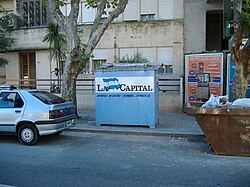
Modern Infrastructure
In mid-1998, La Capital opened a state-of-the-art publishing plant on Santiago St. This facility houses a Goss Urbanite rotating press, a massive piece of machinery weighing 165 tonnes and measuring nearly 36 meters in length. This technological leap allowed the newspaper to adopt a fully color format and a modernized layout.
Regional Impact and Reach
While headquartered in Rosario, the newspaper's influence extends far beyond the city limits. It provides comprehensive coverage of the Greater Rosario metropolitan area, various regional towns, and news spanning four additional provinces beyond Santa Fe. Today, it continues to serve as a vital information source for roughly 2 million readers.
| Attribute | Detail |
|---|---|
| Founder(s) | Ovidio Lagos and Eudoro Carrasco |
| Current Publisher | Orlando Vignatti |
| Format | Tabloid |
| Owner | Grupo América |
| Website | www.lacapital.com.ar |
Frequently Asked Questions
Why is La Capital called the "Dean of the Argentine Press"?
It earned this title because it is the oldest newspaper in Argentina that is still in active circulation, having been founded in 1867.
What is the meaning behind the name "La Capital"?
The name was a political statement by founder Ovidio Lagos, reflecting the effort to move Argentina's federal capital to the city of Rosario.
What was the difference between "hot type" and "cold type" used by the paper?
Hot type involved casting text using molten lead and antimony in Linotype machines. Cold type, adopted in 1978, refers to the phototypesetting method which does not require molten metal.
Who currently owns La Capital?
The newspaper is owned by Grupo América.
How many people does the newspaper reach?
La Capital reaches approximately 2 million readers across the province of Santa Fe and four other Argentine provinces.