Kyrgyzstan 2020 Political Crisis: A Timeline of Unrest and Leadership Change
In October 2020, Kyrgyzstan experienced a period of intense political volatility that culminated in a change of national leadership. What began as a localized protest against electoral integrity rapidly evolved into a nationwide crisis, characterized by the seizure of government buildings, declarations of emergency, and a complex struggle for power among competing political factions.
Key Facts
- Trigger: Allegations of vote-buying and disputes over the 2020 parliamentary election results.
- Epicenter: Bishkek, the capital city, specifically Ala-Too Square and the White House.
- Casualties: One confirmed death and hundreds of injuries (over 768 treated by hospitals).
- Outcome: The resignation of President Sooronbay Jeenbekov and the rise of Sadyr Japarov as acting president.
- Legal Actions: Annulment of parliamentary election results and two separate states of emergency.
The Spark: Election Disputes and Initial Unrest
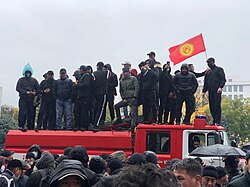
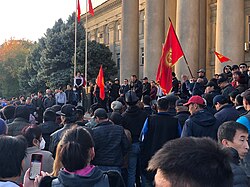
The crisis ignited on 5 October 2020. An initial crowd of 1,000 people gathered in Bishkek to protest the results of the parliamentary elections, citing widespread vote-buying. By evening, the crowd grew to at least 5,000. Tensions escalated when police used tear gas and water cannons to clear Ala-Too Square, leading to clashes where protesters allegedly attacked officers with rocks.
By the morning of 6 October, the situation intensified. Protesters reclaimed Ala-Too Square and seized the White House and Supreme Council buildings. During the occupation, protesters entered the President's offices and set fire to papers thrown from the windows. This surge of unrest resulted in one death and 590 injuries.
Immediate Political Fallout
The chaos forced immediate reactions from the state. Electoral authorities annulled the parliamentary election results, and Gulnara Jurabaeva, a member of the Central Election Commission, indicated that the commission was considering self-dissolution. Meanwhile, President Jeenbekov described the events as a coup d'état (an illegal seizure of power from a government) and expressed a willingness to hand responsibility to strong leaders.
The Struggle for Power
As government buildings fell, the political landscape shifted rapidly. Protesters freed opposition politician Sadyr Japarov and former president Almazbek Atambayev from prison. Under significant pressure, Prime Minister Kubatbek Boronov resigned, and Myktybek Abdyldayev was cited as the new speaker.
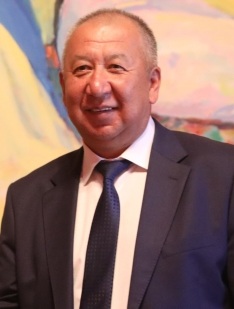
The following days were marked by confusion over legitimacy. On 7 October, Japarov was appointed to replace Boronov, but opposition parties rejected this, nominating Tilek Toktogaziyev instead. While Japarov claimed legitimacy via a parliamentary majority, official government websites still listed Boronov as Prime Minister, as President Jeenbekov had not yet formally confirmed the resignation.
During this period, the Ministry of Healthcare reported that at least 768 people had been treated for injuries. Simultaneously, parliamentarians from the Ata-Meken party initiated impeachment procedures against President Jeenbekov.
Escalation and State of Emergency
On 9 October, President Jeenbekov declared a state of emergency, deploying troops to Bishkek and imposing a 12-hour curfew. This declaration led to violent clashes and reports of gunfire in the capital. It was only after this declaration that Jeenbekov formally accepted Boronov's resignation.
The instability continued into mid-October. On 10 October, special forces raided the compound of former president Atambayev and detained him.
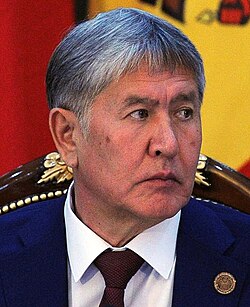
A second state of emergency was declared on 12 October, accompanied by another curfew (10 pm to 5 am) and the deployment of military convoys to maintain control. Jeenbekov stated he would only consider resigning once the political crisis was resolved.
The Transition of Leadership
On 13 October, Kanatbek Isaev was elected Speaker of the Supreme Council. Although Parliament endorsed the second state of emergency, President Jeenbekov formally rejected Japarov's nomination as prime minister.
The deadlock ended on 15 October when President Jeenbekov resigned to stop the unrest. He urged Japarov and other politicians to withdraw their supporters from the capital. Despite the Constitution designating the Speaker of the Supreme Council as the successor, Kanatbek Isaev refused to assume the office. This allowed Sadyr Japarov to declare himself acting president.
![Japarov was sworn-in as the new president, ending the protests. Prior to this, he was arrested for encouraging protesters to topple Jeenbekov.[citation needed]](/images/d7/b0/d7b0bcafc27b7d11a08be0d7d1309f221efcfc56ea7455e05f7d9d3ff05c7db8.jpg)
Summary of the October 2020 Crisis
| Date | Key Event | Primary Outcome |
|---|---|---|
| 5 Oct | Initial Protests | Thousands gather in Bishkek over election fraud. |
| 6 Oct | Seizure of Government Buildings | White House seized; election results annulled. |
| 7 Oct | Leadership Dispute | Conflicting claims for the Prime Minister position. |
| 9 Oct | First State of Emergency | Curfew imposed; troops deployed to Bishkek. |
| 12 Oct | Second State of Emergency | Military convoys enter the capital. |
| 15 Oct | Presidential Resignation | Jeenbekov resigns; Sadyr Japarov becomes acting president. |
Frequently Asked Questions
What caused the 2020 protests in Kyrgyzstan?
The protests were triggered by allegations of vote-buying and disputes regarding the results of the 2020 parliamentary elections.
Who replaced President Jeenbekov?
Sadyr Japarov declared himself acting president after President Jeenbekov resigned on 15 October and the Speaker of the Supreme Council, Kanatbek Isaev, refused to take office.
How many people were injured during the unrest?
According to the Ministry of Healthcare, at least 768 people were treated at hospitals and clinics as of 7 October.
What happened to the parliamentary election results?
Following the seizure of government buildings and widespread protests on 6 October, the electoral authorities annulled the results of the parliamentary elections.
Why was a state of emergency declared?
President Jeenbekov declared states of emergency to deploy troops in Bishkek and impose curfews in an attempt to regain control of the capital during violent clashes.