The Story of Kwangmyŏngsŏng-1: North Korea's First Satellite Attempt
On August 31, 1998, North Korea attempted a milestone in its technological history: the launch of its first experimental satellite, Kwangmyŏngsŏng-1 (meaning "Bright Star 1"). While the mission was framed by the North Korean government as a triumphant success, the international community viewed the event through a much more skeptical lens.
This mission marked the beginning of the Kwangmyŏngsŏng program, representing North Korea's first official attempt to place a man-made object into orbit. However, the discrepancy between domestic claims and international observations would set a precedent for how North Korean space activities are perceived globally.
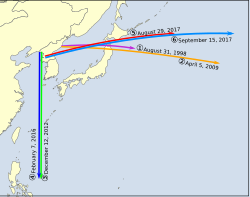
Mission Overview and Technical Details
The Kwangmyŏngsŏng-1 was launched using a Paektusan rocket from the Musudan-ri launch site. The launch took place at 03:07 UTC, following a delay caused by adverse weather conditions that had pushed the window from the previous evening.
The satellite's design was notable for its 72-faced polyhedral shape. This geometry was highly reminiscent of the first Chinese satellite, Dong Fang Hong I. While the exact mass of the satellite remains a subject of debate, scientific estimates range from as little as 6 kg (13 lb) to as much as 170 kg (370 lb).
Symbolism in Naming
The names chosen for the rocket and the satellite carry deep nationalist significance. Paektusan refers to Mount Paektu, the highest mountain on the Korean Peninsula. In North Korean mythology and state propaganda, the mountain is considered a sacred site, linked to the mythical founder of Korea, Tangun, and the guerrilla activities of Kim Il Sung.
Similarly, Kwangmyŏngsŏng (Bright Star) holds hagiographic meaning. According to state narratives, a bright star appeared in the sky at the birth of Kim Jong Il, signaling the arrival of a new leader.
The Launch: Success or Failure?
The launch was a complex event involving various international actors and intelligence agencies. While U.S. intelligence had detected preparations consistent with a missile test, analysts were surprised to see the rocket configured with a third stage, suggesting an intent for orbital launch rather than a standard ballistic missile test.
Technical analysis suggests that while the Paektusan-1's solid propellant third stage achieved a near full-duration burn and successfully spun up the satellite, a critical failure occurred. The third-stage solid motor ruptured, causing the satellite to de-orbit almost immediately after reaching orbital velocity. Consequently, while North Korea claimed the satellite reached a low Earth orbit, no objects were ever tracked in orbit by international monitoring agencies.
Claimed Orbital Parameters
Despite the suspected failure, North Korean media reported that the satellite had successfully completed its 100th orbit. They provided specific orbital parameters—the mathematical description of an object's path around a planet:
- Perigee altitude (closest point): 218.82 km (135.97 mi)
- Apogee altitude (farthest point): 6,978.2 km (4,336.1 mi)
- Orbital period: 165 minutes, 6 seconds
- Inclination: 40.6 degrees
North Korea further claimed the satellite broadcasted specific songs in Morse code via a 27 MHz frequency and collected data regarding space temperature and pressure.
International Reactions and Political Impact
The launch had immediate geopolitical consequences. In North Korea, the timing was politically significant, occurring just before the Supreme People's Assembly amended the constitution to usher in the Kim Jong-il era. The state used the launch to promote the doctrine of Kangsŏngdaeguk (national strength and prosperity).
Globally, the response was divided:
- United States: Initially viewed the launch as a test of intercontinental ballistic missile (ICBM) technology, the U.S. later responded by attempting to defuse tensions through the 1994 Agreed Framework.
- China: Stated it had no prior knowledge of the launch and expressed concern regarding regional tensions.
- Russia: Faced conflicting reports; while one official claimed North Korea had provided a warning, the Russian Ministry of Foreign Affairs stated no such agreement or notification existed.
- South Korea: Issued statements alongside Japan and the U.S. condemning the launch and calling for international deterrence.
Key Facts
- Launch Date: 31 August 1998, 03:07 UTC.
- Rocket Model: Paektusan.
- Satellite Shape: 72-faced polyhedron.
- Estimated Mass: Between 6 kg and 170 kg.
- Official Status: Claimed success by North Korea; considered a failure by international observers.
- Primary Cause of Failure: Rupture of the third-stage solid motor.
Satellite Launch History Summary
| No. | Date | Model | Satellite Name | North Korean Claim |
|---|---|---|---|---|
| 1 | 31 August 1998 | Taepodong-1 | Kwangmyŏngsŏng-1 | Satellite launch |
| 2 | 5 April 2009 | Unha-2 | Kwangmyŏngsŏng-2 | Satellite launch |
| 3 | 12 December 2012 | Unha-3 | Kwangmyŏngsŏng-3 | Satellite launch |
| 4 | 7 February 2016 | Kwangmyŏngsŏng (Unha-3) | Kwangmyŏngsŏng-4 | Satellite launch |
| 5 | 29 August 2017 | Hwasong-12 | N/A | Missile launch |
| 6 | 15 September 2017 | Hwasong-12 | N/A | Missile launch |
| 7 | 4 October 2022 | Hwasong-12 modified | N/A | Missile launch |
Frequently Asked Questions
What was the design of Kwangmyŏngsŏng-1?
The satellite featured a 72-faced polyhedral shape, a design similar to China's first satellite, Dong Fang Hong I.
Why is the launch considered a failure by the international community?
While North Korea claimed success, international observers were unable to track any objects in orbit following the launch, and evidence suggested the third-stage motor ruptured during the attempt.
What does the name "Paektusan" signify?
Paektusan refers to Mount Paektu, which holds immense symbolic value in Korean nationalism and is central to North Korean state mythology.
How did the United States respond to the 1998 launch?
The U.S. initially analyzed the launch as a potential test of long-range missile technology and later worked to manage regional tensions through diplomatic and economic measures related to the 1994 Agreed Framework.
What was the purpose of the Kwangmyŏngsŏng-1's transmitters?
According to North Korean claims, the satellite carried transmitters intended to broadcast specific songs in Morse code and provide data on space conditions like temperature and pressure.