Ktunaxa People: History, Origins, and Cultural Resilience
The Ktunaxa (also known as the Kootenai) are an Indigenous people whose ancestral lands span the rugged landscapes of southeastern British Columbia, Idaho, and Montana. Defined by their relationship with the Kootenay River—spelled "Kootenai" in the United States—the people are generally divided into two groups: the Upper Kutenai and the Lower Kutenai. This division reflects the different sections of the river where their various bands reside.
The Upper Kutenai include the Ɂakisq̓nuk First Nation (Columbia Lake Band), the ʔaq̓am First Nation (St. Mary's First Nation), and the Yaq̓it ʔa·knuqⱡi’it First Nation (Tobacco Plains Band) in British Columbia, as well as the Montana Kootenai. The Lower Kutenai comprise the Lower Kootenay First Nation of British Columbia and the Kootenai Tribe of Idaho.
Key Facts
- Ancient Presence: Archaeological sites in British Columbia contain artifacts dated to 11,500 years before the present (BP).
- Unique Technology: The Ktunaxa are known for the sturgeon-nosed canoe, crafted from specific mountain tree bark.
- Geographic Range: Their territory covers parts of British Columbia, Idaho, and Montana.
- Cultural Identity: Their language is isolated from the neighboring Salish tribes, and their customs share similarities with Plains peoples.
- Political Action: The Kootenai Tribe of Idaho famously declared a symbolic "war" on the U.S. government in 1974 to secure land rights.
Origins and Archaeological Mysteries
The origins of the Ktunaxa are a subject of ongoing scholarly debate. One prominent theory suggests they originally inhabited the prairies but were pushed across the Rockies by famine, disease, or conflict with the Blackfoot people. Some Upper Kootenay maintained a seasonal Plains lifestyle, crossing the mountains for bison hunts, while others established settlements near Fort Macleod, Alberta. However, smallpox epidemics and conflict with the Blackfoot eventually forced these Plains Ktunaxa back into the Kootenay region of British Columbia.
While some oral traditions suggest ancestors arrived from the Great Lakes region of Michigan, scholars have yet to find archaeological evidence to support this. Instead, attention has turned to the Goatfell Complex, a collection of human-made artifacts found near Creston, British Columbia, and extending into Idaho. These artifacts, which include evidence of flint-knapping (the process of shaping stone tools) using quartzite and tourmaline, date back 11,500 BP.
Archaeologist Dr. Wayne Choquette argues that the lack of breaks in the archaeological record suggests the Ktunaxa are the direct descendants of these first inhabitants. Conversely, scholars like Reg Ashwell suggest a later arrival in the 18th century, citing the Ktunaxa's isolated language and their use of teepee-style dwellings, which align more closely with Plains cultures than with the Coastal Salish.
The prevailing scientific theory posits that as the Cordilleran ice sheet retreated at the end of the last ice age, people moved northward from the southwestern United States, following the return of flora and fauna. This movement established the foundation for the Ktunaxa's prehistoric presence as big game hunters.
Early History and Traditional Lifeways
By the late 18th century, the Ktunaxa entered the historical record, appearing on Alexander Mackenzie's map circa 1793. As the climate warmed and glacial lakes drained, the Lower Kootenay integrated fishing into their core diet and culture, while the Upper Kootenay continued their bison hunts.
Early ethnographies from the turn of the 20th century describe a society with a rich ritual calendar and a stable economy. Their spiritual life included vision quests for young men transitioning to adulthood, the ritual use of tobacco, and ceremonial dances such as the Sun Dance, the Grizzly Bear Dance, and the Blue Jay Dance. Social structure was organized around lodges or societies, such as the Crazy Dog, Crazy Owl, and Shamans' Societies, each with specific community and military obligations.
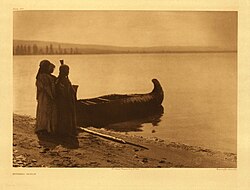
A hallmark of their ingenuity was the sturgeon-nosed canoe. These vessels were crafted by carefully harvesting a single sheet of bark from high-altitude trees using elk-horn chisels or flint knives. The bark was pried from the trunk in a straight incision and wrapped to prevent drying before being shaped into a boat. Interestingly, the inside of the bark became the outside of the canoe.
Contact and Conversion
European contact initially occurred through the fur trade and gold rushes, such as the 1863 discovery at Wild Horse Creek. While the Ktunaxa were initially uninterested in European economic activities due to their own resource abundance, they eventually integrated into local industries as guides and hunters. A Ktunaxa man named Pierre even discovered the richest gold mine in the Kootenays in 1893.
Christianity arrived in waves, first through the "Blackrobes" (Jesuit missionaries) and Christian Iroquois. By the 1830s, the Ktunaxa practiced a syncretic blend of traditional and Christian ceremonies. Father Pierre-Jean de Smet and later Father Nicolas Coccola provided detailed records of this era, though modern historians note that these accounts often reflect the cultural biases of the missionaries.
The 20th Century: Adaptation and Rights
The 20th century was marked by a transition toward European-style agriculture and industry. In British Columbia, the Yaqan Nu'kiy (Creston Band) experienced a period of peaceful coexistence with settlers, though conflicts frequently arose over land use and hay-cutting rights on government land. This tension highlighted the struggle of the Ktunaxa, whose territories were drastically reduced by the reserve system.
Over time, the Yaqan Nu'kiy integrated into forestry, mining, healthcare, and tourism. Despite this shift, they have maintained a strong sense of community and have worked toward self-government. Because they did not sign a treaty defining their territorial rights, they have spent decades in cooperative negotiations with the Canadian government.
Cultural Revitalization
Today, there is a concerted effort to revive the Ktunaxa language and traditions. With only 10 fluent speakers remaining across North America, the Yaqan Nu'kiy have implemented language curricula for students in grades 4 through 12. They are also utilizing video and audio recordings to preserve oral myths and traditional craft techniques for future generations.
The Kootenai Nation War
In a bold political move on September 20, 1974, the Kootenai Tribe of Idaho, led by Chairwoman Amy Trice, declared war on the United States government. Because the tribe had never signed a treaty, they were not legally forbidden from doing so. Their primary action was establishing a toll on U.S. Highway 95, with the proceeds intended to support elderly tribal members.
While the "war" remained non-violent, it successfully drew attention to their lack of land. The U.S. government eventually provided a land grant of 12.5 acres, forming the basis of the Kootenai Reservation. To commemorate the event, the tribe issued "Kootenai Nation War Bonds" in 1976, designed by artist Emilie Touraine.
| Group | Associated Nations/Tribes | Primary Region | Key Economic Focus |
|---|---|---|---|
| Upper Kutenai | Ɂakisq̓nuk, ʔaq̓am, Yaq̓it ʔa·knuqⱡi’it, Montana Kootenai | BC & Montana | Bison hunting, big game |
| Lower Kutenai | Lower Kootenay First Nation, Kootenai Tribe of Idaho | BC & Idaho | Fishing, waterfowl, big game |
Frequently Asked Questions
What is the Goatfell Complex?
The Goatfell Complex is an assemblage of ancient human-made artifacts, including stone tools made from quartzite and tourmaline, found near Creston, BC. Dated to 11,500 BP, it provides evidence of very early human occupation in the Kootenay Rockies.
How was the sturgeon-nosed canoe made?
It was made by cutting a large, straight sheet of bark from a high-altitude tree using an elk-horn chisel or flint knife. The bark was then wrapped to keep it moist and shaped into a canoe, with the tree-side of the bark serving as the exterior.
Why did the Kootenai Tribe declare war on the U.S. in 1974?
The declaration was a political strategy to secure land rights and funding for elderly tribal members. Since the tribe had never signed a treaty with the U.S. government, they used this symbolic act to highlight their lack of a reservation.
What is the current status of the Ktunaxa language?
The language is critically endangered, with only about 10 fluent speakers remaining. However, the Yaqan Nu'kiy have developed educational curricula for grades 4-12 to train a new generation of speakers.
How do the Upper and Lower Kutenai differ?
The division is primarily geographic, based on their location along the Kootenay River. Historically, the Upper Kutenai were more involved in bison hunting on the prairies, while the Lower Kutenai focused more heavily on fishing.