Korean Americans: A Comprehensive History and Demographic Profile
The Korean American community represents a vibrant and growing segment of the United States population, characterized by a rich history of immigration and significant cultural contributions. From early small-scale arrivals to the large-scale migrations following major legislative changes, the journey of Korean Americans is a testament to resilience and adaptation.
As of 2023, the total population of individuals identifying with Korean ancestry or ethnic origin reached 2,023,517, with 1,017,250 of those individuals being born in Korea.
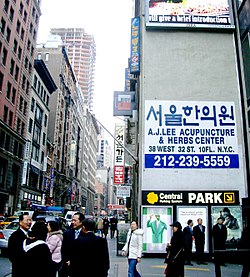
Korean Americans have achieved a high demographic profile in some U.S. cities, including New York City.
Key Facts
- Total Population: Over 2 million people identify as Korean American (2023).
- Primary Languages: English and Korean.
- Religious Affiliation: 61% Protestant, 23% Unaffiliated, 10% Roman Catholic, and 6% Buddhist.
- Largest State Population: California, with 558,338 residents.
- Immigration Phases: Four distinct waves, including post-1965 immigration following the Immigration Act.
Demographic Distribution and Statistics
The Korean American population is widely distributed across the United States, with significant concentrations in major metropolitan areas. California holds the largest number of Korean Americans, followed by New York, Texas, and New Jersey.
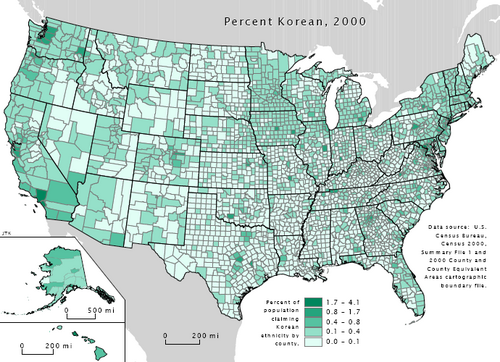
Koreans in the United States, on the census 2000
Population by State
While many states host Korean American communities, the following states show the highest concentrations:
- California: 558,338
- New York: 141,745
- Texas: 115,107
- New Jersey: 113,736
- Virginia: 94,275
- Washington: 92,798
- Illinois: 81,340
- Georgia: 75,525
Historical Population Growth
The community has seen dramatic shifts in size over the last century. Notably, the 1970s saw a massive percentage increase as immigration patterns shifted significantly.
| Year | Population | Percentage Change |
|---|---|---|
| 1910 | 462 | — |
| 1920 | 1,224 | +164.9% |
| 1930 | 1,860 | +52.0% |
| 1940 | 1,711 | −8.0% |
| 1970 | 69,130 | +3940.3% |
| 1980 | 354,593 | +412.9% |
| 1990 | 798,849 | +125.3% |
| 2000 | 1,076,872 | +34.8% |
| 2010 | 1,423,784 | +32.2% |
| 2020 | 1,508,575 | +6.0% |
The History of Korean Immigration
The history of Korean immigration to the United States can be categorized into four distinct phases:
- Small-scale immigration (around 1884): The earliest recorded arrivals.
- Early immigration (1903–1950): A period of foundational settlement.
- Post-Korean War immigration (1950–1964): Migration following the conflict in Korea.
- Post-1965 Immigration Act: A major wave of immigration following changes to U.S. immigration law.
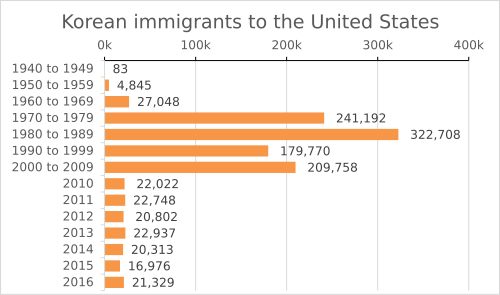
North and South Korean obtaining lawful permanent resident status: fiscal years 1940 to 2016

Dosan Ahn Chang Ho, picking oranges in Southern California

Korean American football player in Chicago, 1918
Cultural and Social Presence
Korean Americans have made profound impacts across various sectors, including media, politics, and culinary arts. Notable figures include television journalists, actors, and world-renowned restaurateurs.

Juju Chang is a Korean American television journalist for ABC News, and currently serves as an anchor of Nightline.

Actor Randall Park, who since 2015 portrayed Eddie Huang's father, Taiwanese-American restaurateur Louis Huang, in ABC's television show Fresh Off the Boat.

David Chang, at the Time 100 gala in Manhattan, is a Korean American restaurateur, author, and television personality.
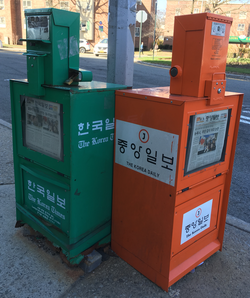
Korean-language newspapers being sold in the United States (2018)
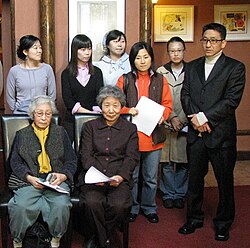
A wide range of Korean Americans
Frequently Asked Questions
What are the main languages spoken by Korean Americans?
The primary languages spoken within the community are English and Korean.
Where are the largest concentrations of Korean Americans located?
The largest populations are found in California, New York, Texas, New Jersey, and Virginia.
What are the most common religions among Korean Americans?
Protestantism is the most common religion at 61%, followed by those who are unaffiliated (23%), Roman Catholics (10%), and Buddhists (6%).
How has the Korean American population changed over time?
The population has grown significantly, particularly after 1970, moving from a few thousand in the early 20th century to over 2 million in 2023.
What were the major phases of Korean immigration to the U.S.?
Immigration occurred in four phases: small-scale arrivals around 1884, early immigration from 1903–1950, post-Korean War migration (1950–1964), and the post-1965 Immigration Act wave.