Kings Plaza: A History of Brooklyn's Premier Enclosed Shopping Center
Located at the intersection of Flatbush Avenue and Avenue U, Kings Plaza stands as a landmark of retail evolution in Southeast Brooklyn. From its origins as an industrial site to its status as the first fully enclosed and air-conditioned mall in New York City, the center has mirrored the shifting economic and social landscapes of the Flatlands and Canarsie neighborhoods.
Key Facts
- Opened: September 1970.
- Distinction: First fully enclosed and air-conditioned mall in New York City.
- Original Anchors: Macy's and Alexander's.
- Current Owner: Macerich (acquired in 2013).
- Notable Firsts: Site of the first Sbarro pizzeria.
Construction and Early Development
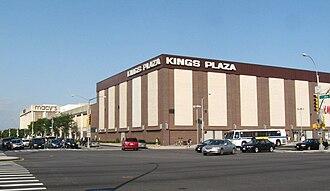
Before the mall's inception, the land served various industrial purposes, including a 1930s Standard Oil petroleum storage facility, an auto garage, and a plastics production plant. In 1965, the Alexander's department store chain sought to expand into Southeast Brooklyn to meet the demands of growing residential developments. This led to a joint venture between Macy's and Alexander's to create a comprehensive shopping destination.
Ground was broken on July 8, 1968, in a ceremony attended by Mayor John Lindsay and Brooklyn Borough President Abe Stark. The project, financed by John Hancock Financial, necessitated significant infrastructure upgrades. Flatbush Avenue was expanded south of Utica Avenue, and a new bus terminal was constructed to support the anticipated influx of shoppers.
The Golden Era and Early Challenges
Kings Plaza opened in September 1970 with 79 stores, including the very first Sbarro. The facility also featured a two-screen cinema and a planned marina on Mill Basin. By 1971, the mall had grown to 125 stores, and by 1973, it hosted Brooklyn's first professional dinner-theater at Cooky's Steak Pub.
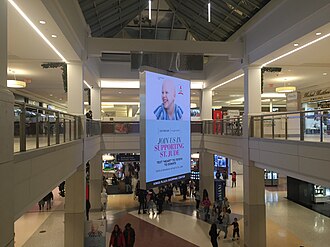
By 1983, the mall was a massive economic engine, with 150 stores generating $12 million annually in city sales tax and seeing 20,000 cars daily. However, this success brought challenges. Local residents initially protested the mall to prevent traffic congestion in residential areas, and later, both shoppers and merchants raised concerns regarding theft, leading to an increase in private security.
A significant point of contention arose in 1983 when owners proposed a 50-cent parking fee. After intense community protests and a brief intervention by the New York City government to study environmental impacts, the fee was officially reinstated in January 1984.
Ownership Shifts and Retail Transitions
The mall's ownership evolved over several decades. Macy's sold half its stake to Alexander's in 1985, and Alexander's became the sole owner in 1998. However, Alexander's filed for bankruptcy in 1992, leaving its anchor space vacant until 1997 when Sears moved in. Management of the property eventually transitioned to Vornado Realty Trust.
In 1999, a $50 million renovation introduced a new glass entrance and interior upgrades. While developers initially planned a massive 100,000-square-foot addition including a multiplex theater and home improvement store, community backlash over traffic forced a downsizing. Consequently, only a Lowe's home improvement store was added, opening on July 23, 2010.
Modern Era and Recent Changes
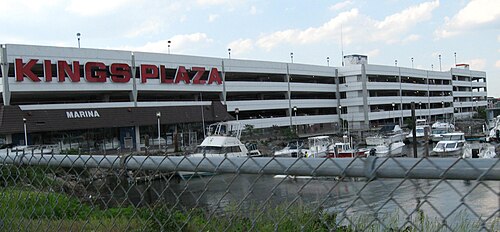
In 2013, Macerich purchased the mall from Vornado Realty Trust, initiating a comprehensive overhaul of the parking garage, exterior facade, signage, and interior decor. The retail mix continued to shift: the Sears location was repurposed for Primark and Zara in 2016, and Burlington and JCPenney opened in 2018. Following JCPenney's 2020 bankruptcy, Target occupied the space in late 2021.
| Period | Key Anchor/Tenant | Status/Change |
|---|---|---|
| 1970s - 1992 | Alexander's | Closed due to bankruptcy |
| 1997 - 2016 | Sears | Replaced by Primark and Zara |
| 2018 - 2020 | JCPenney | Closed due to bankruptcy |
| 2021 - Present | Target | Current occupant of former JCPenney space |
Incidents and Security
The mall has faced several high-profile security incidents. In December 2013, a violent flashmob organized via social media led to vandalism and the temporary implementation of a "no teens" rule. In September 2018, a seven-alarm fire broke out in the parking garage, injuring 21 people (including 18 firefighters) and leading to arson charges. Most recently, in January 2022, a 14-year-old boy was shot inside the premises.
Frequently Asked Questions
What was unique about Kings Plaza when it first opened?
Kings Plaza was the first shopping mall in New York City to be fully enclosed and air-conditioned.
Who currently owns and manages Kings Plaza?
The mall is currently owned by Macerich, which acquired the property at the end of 2013.
Which major retailers have recently occupied the mall?
Recent major tenants include Target, Primark, Zara, and Burlington, following the departures of Sears and JCPenney.
What caused the downsizing of the 2002 expansion plan?
The expansion was downsized to a single Lowe's store due to community backlash and fears regarding increased traffic congestion in the surrounding area.
What was the site used for before the mall was built?
The site previously housed a Standard Oil petroleum storage facility from the 1930s, as well as a plastics producer and an auto garage.