The Sacred Legacy of Jongmyo Shrine: A Journey Through Korea's Royal Ancestral History
In the heart of Seoul's Jongno District lies a site of profound spiritual and historical significance: Jongmyo Shrine. As a Confucian royal ancestral shrine, this complex served as the sacred space where the kings and queens of the Joseon Dynasty (1392–1897) were honored through solemn memorial services. Today, it stands as a living link to the 14th century, recognized by UNESCO as the oldest preserved royal Confucian shrine in the world.
The shrine is more than just a collection of historic buildings; it is a site where ancient traditions continue to breathe. While similar shrines existed during Korea's Three Kingdoms period, none have survived to the present day like Jongmyo, making it a unique testament to the enduring legacy of Korean royal ritual.
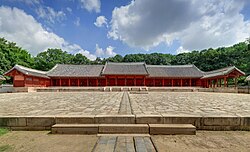
Key Facts
- Location: 157 Jongno, Jongno District, Seoul, South Korea.
- Established: Originally built in 1394 by King Taejo.
- UNESCO Status: Designated as a World Heritage Site in 1995.
- Primary Function: A Confucian shrine for memorial services for deceased Joseon royalty.
- Architectural Highlight: The Jeongjeon hall is the longest traditional building in Korea.
- Cultural Heritage: Home to the Jongmyo Daejae ritual and Jongmyo Jeryeak music.
A History of Resilience and Expansion
The history of Jongmyo is one of both grand construction and survival against adversity. The main buildings were first established in October 1394 when King Taejo, the founder of the Joseon Dynasty, moved the capital to Hanseong (modern-day Seoul). However, the shrine faced a major catastrophe during the Japanese invasions of Korea (1592–1598), when fire destroyed the original structures. Remarkably, the original spirit tablets—the sacred items representing the souls of the deceased—were saved by being hidden in a commoner's home. The complex was rebuilt in the early 1600s and has remained intact ever since.
As the dynasty grew, so did the shrine. The complex underwent continuous expansion to accommodate the increasing number of royal spirit tablets. This growth moved from west to east, eventually resulting in a total of 19 myoshil (temple rooms or niches). One of the most significant expansions was the construction of Yeongnyeongjeon (the Hall of Eternal Comfort), ordered by King Sejong to house the tablets of kings whose ancestors were considered "old" by the standards of the current reigning monarch or those whose reigns were short-lived.
The Sacred Tablets and Enshrinement
The ritual of enshrinement follows a strict tradition: a king's tablet is placed in the shrine three years after his death, marking the end of the official mourning period. Within the 19 niches of the shrine, there are currently 19 tablets of kings and 30 tablets of queens. Each niche is designed with a sense of profound simplicity and plainness, accompanied by a panel detailing the accomplishments of the deceased ruler. Even in modern times, the tradition continues; the most recent enshrinements occurred in 1973 and 1991 for Crown Prince Euimin and Crown Princess Bangja.
Architectural Design and Layout
The layout of Jongmyo follows traditional Confucian principles. Historically, the shrine's placement was designed to complement the royal palaces: if viewed from the king's throne room at Gyeongbokgung Palace, Jongmyo would have been situated to the king's left. This arrangement mirrors Chinese practices, where the Sajik Shrine (dedicated to the gods of earth and grain) would be placed to the right.
The complex is characterized by its massive scale and ritualistic pathways:
- Jeongjeon (Main Hall): The longest traditional building in Korea, housing the tablets of kings renowned for their great accomplishments.
- Yeongnyeongjeon (Hall of Eternal Comfort): Dedicated to ancestors of older lineages or those with shorter reigns.
- Woldae Courtyard: A vast ceremonial space in front of the main hall, measuring 150 meters in length and 100 meters in width.
- Ritual Gates: The south entrance was reserved for spirits, the east gate for the king, and the west gate for ritual performers.
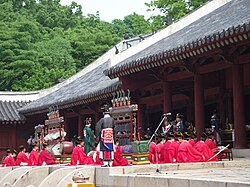
Living Traditions: Rituals and Music
Jongmyo is not merely a museum; it is a venue for active spiritual practice. The most significant event is the Jongmyo Daejae, an ancestor-worship ceremony performed by descendants of the imperial family to honor the spirits of their ancestors. This ritual has been designated as Intangible Cultural Heritage and is performed annually on the first Sunday in May.
Accompanying these rituals is Jongmyo Jeryeak, the traditional court music of the Joseon Dynasty. This music, which includes accompanying dances, has its roots in Chinese court music brought to Korea during the Goryeo period. In the 15th century, King Sejong composed new music for these rituals, blending traditional Korean styles (hyangak) with imported styles (dangak). Today, the Jeonju Lee Royal Family Association performs these rites, supported by professional musicians and dancers, to invite ancestral spirits to descend and witness the achievements of their descendants.
Summary of Jongmyo Shrine
| Feature | Details |
|---|---|
| Official Name | Jongmyo Shrine (종묘) |
| Type | Confucian Royal Ancestral Shrine |
| Total Area | 200,545 m² |
| UNESCO Designation | 1995 (Criteria iv) |
| Main Buildings | Jeongjeon and Yeongnyeongjeon |
| Governing Body | Jongmyo Management Office, Cultural Heritage Administration |
Frequently Asked Questions
What is the difference between Jeongjeon and Yeongnyeongjeon?
Jeongjeon is the main hall used to house the tablets of kings known for their significant accomplishments. Yeongnyeongjeon is a secondary hall used for kings whose ancestors were considered "old" by the standards of the reigning king or for those who had short reigns.
Why is Jongmyo Shrine a UNESCO World Heritage Site?
It was designated in 1995 because it is the oldest preserved royal Confucian shrine, maintaining ritual traditions and architectural styles that have remained consistent since the 14th century.
What is Jongmyo Jeryeak?
Jongmyo Jeryeak is the traditional court music and dance performed during the royal shrine rituals. It is an Intangible Cultural Heritage that combines ancient musical styles to honor ancestral spirits.
How many royal tablets are kept in the shrine?
The shrine houses a total of 19 tablets of kings and 30 tablets of queens across its various niches.
When can I see the Jongmyo Daejae ritual performed?
The reconstructed Jongmyo Daejae ritual is performed every year on the first Sunday in May.