John Warnock: The Visionary Behind PostScript, Illustrator, and PDF
John Warnock was a pioneering force in the world of computer science, best known as the creative engine behind some of the most influential software products in history. From the invention of the Portable Document Format (PDF) to the creation of Adobe Illustrator, Warnock's career was defined by a passion for the invention process and a unique ability to solve complex problems that others found insurmountable.
Early Academic Contributions and the Warnock Algorithm
Warnock's journey into high-level computation began in the 1960s. His master's thesis in 1964 provided a proof of a theorem solving the Jacobson radical for row-finite matrices, a problem originally posed by mathematician Nathan Jacobson in 1956.
By 1969, while completing his doctoral thesis at the University of Utah, Warnock developed the Warnock algorithm. This breakthrough addressed the challenge of hidden surface determination—the process of deciding which surfaces of a 3D object are visible and which are obscured from a specific viewpoint. The algorithm utilizes recursive subdivision, breaking a scene into smaller parts until they are simple enough to compute. This innovation allowed computers to render solid objects rather than simple line drawings, a feat highlighted on the cover of Scientific American in 1970.
The Birth of Adobe and the PostScript Revolution
While working at Evans & Sutherland in 1976, Warnock began developing the concepts that would lead to the PostScript language. He later joined the Palo Alto Research Center (Xerox PARC) in 1978, where he worked alongside Charles Geschke. The duo sought to commercialize the InterPress graphics language—a system for controlling printing across various computers and printers—but were unable to convince Xerox management to pursue the vision.
In 1982, Warnock and Geschke left Xerox to found Adobe, naming the company after Adobe Creek, which flowed behind their homes. They recruited a small team of computer scientists and electronics designers from PARC to build a new technology from the ground up: PostScript.
Launched in 1985 for Apple's LaserWriter, PostScript enabled the printing of high-resolution text and images directly from a computer. This breakthrough effectively launched the era of desktop publishing, fundamentally changing how media was produced and consumed.
Expanding the Creative Toolkit: Illustrator and PDF
Warnock's contributions continued to evolve to meet the needs of designers. In late 1986, he invented Adobe Illustrator. Designed partly to automate the manual tasks performed by his wife, Marva, a graphic designer, Illustrator used lines and Bézier curves (mathematical curves used in computer graphics) to create graphics that could be scaled infinitely without losing quality. The software was released to the public in early 1987.
In 1991, Warnock envisioned a system called "Camelot," which led to the creation of the Portable Document Format (PDF). His goal was to create a universal file format that could capture documents from any application and allow them to be viewed and printed on any machine. Warnock also foresaw the utility of text searching within these electronic archives, though the PDF format took some time to gain widespread industry adoption.
Key Facts
- Co-founded Adobe: Established the company in 1982 with Charles Geschke.
- Major Inventions: Created PostScript, Adobe Illustrator, and the PDF file format.
- Academic Milestone: Developed the Warnock algorithm for hidden surface determination in 1969.
- Industry Impact: PostScript made high-resolution desktop publishing possible.
- Intellectual Property: Held twenty patents throughout his career.
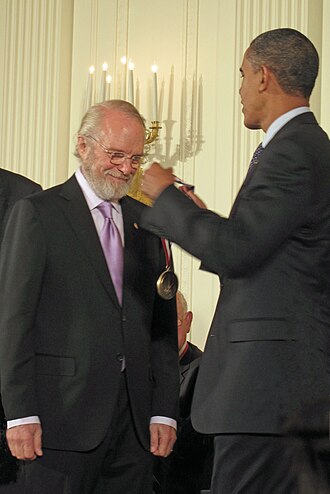
- Recognition: Received the National Medal of Technology and Innovation in 2009.
Career and Legacy Summary
| Innovation/Role | Year/Period | Primary Impact |
|---|---|---|
| Warnock Algorithm | 1969 | Enabled rendering of solid 3D objects in computer graphics. |
| Adobe Systems | 1982 | Founded the company to revolutionize digital printing. |
| PostScript | 1985 | Enabled high-resolution printing and desktop publishing. |
| Adobe Illustrator | 1987 | Introduced infinitely scalable vector graphics. |
| PDF (Camelot) | 1991 | Created a universal, machine-independent document format. |
Professional Affiliations and Personal Interests
Beyond Adobe, Warnock served on the boards of directors for several organizations, including Netscape Communications, Salon Media Group, and the Octavo Corporation. He was also deeply involved in the arts and sciences, serving as a trustee for the American Film Institute, the Sundance Institute, and the Folger Shakespeare Library, and as chairman of the Tech Museum of Innovation in San Jose.
Outside of his professional achievements, Warnock was a man of diverse interests. He enjoyed photography, painting, skiing, and hiking. He was also a collector of historical Native American objects and rare scientific books.
Frequently Asked Questions
What is the Warnock algorithm?
The Warnock algorithm is a method for hidden surface determination in computer graphics. It uses recursive subdivision to break a complex scene into smaller, simpler areas that are easier to compute, allowing computers to render solid 3D objects.
How did PostScript change the printing industry?
PostScript allowed computers to communicate high-resolution text and images to printers regardless of the hardware. This made high-quality printing accessible to individuals and businesses, effectively creating the desktop publishing industry.
Why was Adobe Illustrator created?
John Warnock developed Adobe Illustrator to automate many of the manual graphic design tasks performed by his wife, Marva. It introduced the use of Bézier curves to create scalable graphics.
What was the original goal of the PDF?
Originally outlined under the project name "Camelot," the PDF was designed to capture documents from any application so they could be sent, viewed, and printed on any machine while maintaining their original formatting.
Where did the name "Adobe" come from?
The company was named after Adobe Creek, a stream that ran behind the homes of co-founders John Warnock and Charles Geschke.