John Addington Symonds: Pioneer of Gay History and Victorian Literature
John Addington Symonds was a complex figure of the Victorian era—a man of deep contradictions who balanced a public persona of good fellowship with a private life of melancholic introspection. While he was recognized by contemporaries like Robert Louis Stevenson as a brilliant conversationalist and a lover of the arts, Symonds's most enduring legacy lies in his courageous, though often clandestine, exploration of male-male love.
His work bridged the gap between classical scholarship and the emerging understanding of human sexuality, making him a foundational figure in what is now recognized as gay history.
Key Facts
- Pioneering Terminology: Symonds used the word "homosexual" in A Problem in Greek Ethics before it was widely credited to C. G. Chaddock in 1892.
- Academic Roots: He studied classics under Benjamin Jowett at Balliol College, Oxford.
- Literary Firsts: He authored the earliest known self-conscious gay autobiography between 1889 and 1893.
- Translation Work: He restored original male pronouns to Michelangelo's sonnets to Tommaso Cavalieri in 1878.
- Lost Works: His English text of Soldier Love was lost, with the first English edition appearing only in 2007 via a German translation.
The Literary Style and Persona of Symonds
Symonds was described by Robert Louis Stevenson as "the best of talkers," possessing a serenading manner when discussing wine, music, and the arts. However, this outward charm masked a melancholic nature, a trait evident in his gnomic poetry (poetry consisting of short, pithy statements of truth) and the sonnets of Animi Figura (1882).
Critics often note that Symonds excelled in passages and extracts rather than long-form philosophical arguments. His writing was characterized by "purple patches"—sections of rich, ornate description. He found his greatest success in translation, where he could apply his characteristic sympathy and vivid color to existing subjects.
Contributions to Gay History and Homoerotic Literature
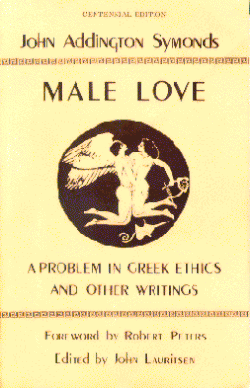
In 1873, Symonds wrote A Problem in Greek Ethics, an exhaustive eulogy of "Greek love," which he defined as a passionate attachment between a man and a youth that was recognized by society and not merely licentious. Inspired by his correspondence with Walt Whitman, the work remained unpublished for a decade and was initially distributed only in limited private editions due to the strict taboos of the time.
Symonds's influence extended into his translations and poetry. In 1878, he corrected previous translations of Michelangelo's sonnets to Tommaso Cavalieri by restoring the male pronouns. He also wrote homoerotic poems such as Eudiades and "The Meeting of David and Jonathan," the latter of which used biblical imagery to depict a soul-knitting kiss between two men.
Despite the risks, Symonds found an ally in his mentor, Benjamin Jowett. Although Jowett disagreed with Symonds's views on sexuality, he supported him when Symonds was falsely accused of corrupting choirboys.
Legacy, Loss, and Rediscovery
The preservation of Symonds's legacy was fraught with difficulty. After his death, his papers were left to Brown, who published an expurgated biography in 1895. This version was further stripped of homoerotic content by Edmund Gosse. In a devastating blow to Symonds's granddaughter, Gosse burned nearly all of Symonds's papers in 1926, sparing only the memoirs.
Despite these losses, Symonds's influence persisted through his social circle. His daughter, Madge Vaughan, was a close friend of Virginia Woolf, and his life served as partial inspiration for Henry James's short story "The Author of Beltraffio" (1884).
Recent years have seen a revival of his lost works. In 2016, "The Song of the Swimmer" (written in 1867) was published in the Times Literary Supplement. Furthermore, in 2007, Andrew Dakyns published Soldier Love and Related Matter, the only surviving version of a work whose original English text had been lost.
| Work | Year | Significance |
|---|---|---|
| A Problem in Greek Ethics | 1873 | Early study of "Greek love"; early use of the term "homosexual." |
| The Meeting of David and Jonathan | 1878 | Poem featuring direct references to male-male love. |
| Animi Figura | 1882 | Collection of sonnets reflecting his melancholic nature. |
| Private Memoirs | 1889–1893 | The first known self-conscious gay autobiography. |
| Soldier Love | 2007 (Pub) | First English publication (via German translation) of a lost text. |
Frequently Asked Questions
Did John Addington Symonds coin the word "homosexual"?
While the Oxford English Dictionary credits C. G. Chaddock with introducing the term in 1892, Symonds had already used the word in his earlier work, A Problem in Greek Ethics.
What happened to Symonds's original papers?
Most of his papers were burned in 1926 by Edmund Gosse, who only preserved the author's memoirs, much to the dismay of Symonds's granddaughter.
How did Symonds approach the topic of homosexuality in the Victorian era?
Because of the era's taboos, he often used oblique references—such as calling pederasty "that unmentionable custom" in letters—while using classical Greek contexts to justify and define male-male love in his essays.
Who were some of Symonds's notable literary connections?
He corresponded with Walt Whitman, was mentored by Benjamin Jowett, and his life influenced Henry James. Additionally, his daughter Madge Vaughan was a close friend of Virginia Woolf.
What is the significance of his translation of Michelangelo's sonnets?
Symonds restored the original male pronouns to the sonnets addressed to Tommaso Cavalieri, correcting previous editors who had changed them to female pronouns to hide the homoerotic nature of the poems.