Jimmy Carter: The Presidency and Legacy of the 39th U.S. President
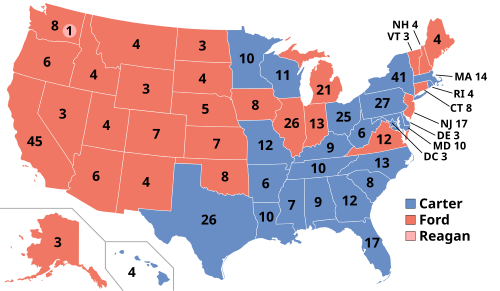
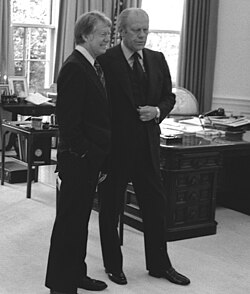
Jimmy Carter served as the 39th President of the United States from January 20, 1977, to January 20, 1981. A member of the Democratic Party, Carter entered the White House following the 1976 election, succeeding Gerald Ford. His presidency was defined by a steadfast commitment to human rights, a complex struggle with domestic economic instability, and pivotal diplomatic achievements that reshaped global relations.
Accompanied by Vice President Walter Mondale, Carter sought to bring a new moral dimension to the American presidency, emphasizing ethics and transparency in government.
Key Facts

- Term: January 20, 1977 – January 20, 1981.
- Major Diplomatic Win: Brokered the Camp David Accords between Egypt and Israel.
- Foreign Policy Focus: Integrated human rights into the core of U.S. international relations.
- Economic Challenges: Faced significant inflation and the 1979 energy crisis.
- Key Treaties: Signed the SALT II arms limitation treaty and the Torrijos-Carter Treaties.
The Carter Administration and Governance
President Carter assembled a diverse cabinet to manage the nation's affairs, including Cyrus Vance and later Edmund Muskie as Secretary of State, and Harold Brown as Secretary of Defense. His administration was marked by a desire to reform the federal budget and improve the relationship between the executive branch and Congress.
Throughout his term, Carter focused on several domestic initiatives, including environmental protection through the EPA and the creation of the Love Canal Superfund. He also pushed for welfare and tax reform, though these often met with legislative resistance.
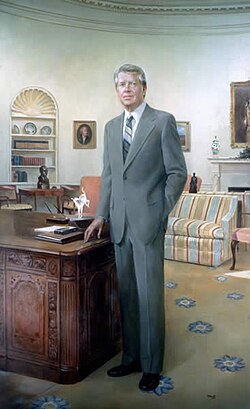
Cabinet Overview
The administration's leadership was characterized by a mix of experienced diplomats and new faces. Notable figures included National Security Advisor Zbigniew Brzezinski and Ambassador to the UN Andrew Young.

Domestic Challenges and the Economy
Carter's domestic tenure was heavily impacted by economic volatility. The U.S. faced rising inflation and a series of budget deficits. One of the most pressing issues was energy security, leading to the National Energy Act and a struggle to manage the 1979 energy crisis.
| Fiscal Year | Receipts (Billions) | Outlays (Billions) | Deficit (Billions) | GDP (Billions) | Debt as % of GDP |
|---|---|---|---|---|---|
| 1977 | 355.6 | 409.2 | -53.7 | 2,024.3 | 27.1 |
| 1978 | 399.6 | 458.7 | -59.2 | 2,273.5 | 26.7 |
| 1979 | 463.3 | 504.0 | -40.7 | 2,565.6 | 25.0 |
| 1980 | 517.1 | 590.9 | -73.8 | 2,791.9 | 25.5 |
| 1981 | 599.3 | 678.2 | -79.0 | 3,133.2 | 25.2 |
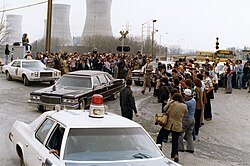
Beyond economics, the administration dealt with the 1979 Three Mile Island nuclear accident, a significant event that raised national concerns over nuclear safety.
Foreign Policy and Global Diplomacy
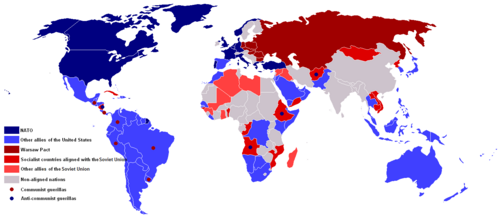
Carter's foreign policy was a blend of Cold War pragmatism and a moral imperative to promote human rights. He made 12 international trips to 25 different countries to strengthen ties and advocate for democratic values.
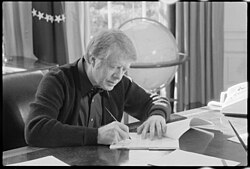
![Carter made 12 international trips to 25 different countries during his presidency.[151]](/images/8a/34/8a34bdb117b780433b89ec481089441ec7ed31b3a2162fa93f365baf4da29929.png)
The Middle East and the Camp David Accords
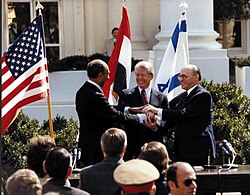
Perhaps the most enduring achievement of the Carter presidency was the Camp David Accords. In 1978, Carter hosted Egyptian President Anwar Sadat and Israeli Prime Minister Menachem Begin, leading to a historic peace treaty signed in March 1979.

Cold War and International Treaties
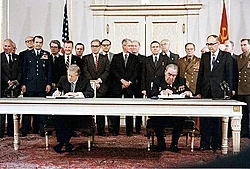
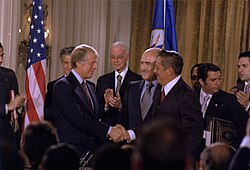
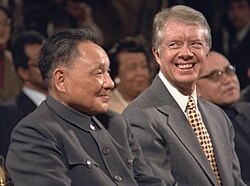
In an effort to reduce nuclear tensions with the Soviet Union, Carter and General Secretary Leonid Brezhnev signed the Strategic Arms Limitation Talks (SALT II) treaty in 1979. Additionally, Carter normalized relations with China and signed the Torrijos-Carter Treaties, which facilitated the return of the Panama Canal to Panama.
Crisis in Iran and Latin America
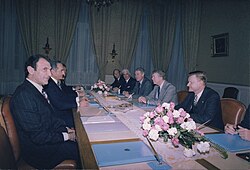
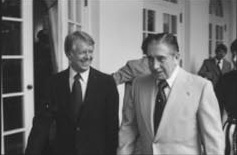
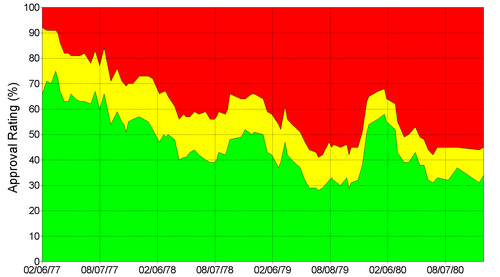
The latter part of Carter's term was overshadowed by the Iranian Revolution and the subsequent hostage crisis, which severely impacted his domestic approval ratings. He also navigated complex relationships in Latin America, including meetings with Chilean dictator Augusto Pinochet.
The 1980 Election and Transition
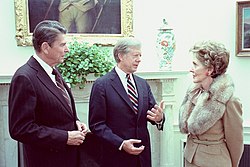
The combination of the Iranian hostage crisis and economic stagflation led to a decline in public support. In the 1980 presidential election, Republican Ronald Reagan defeated President Carter.
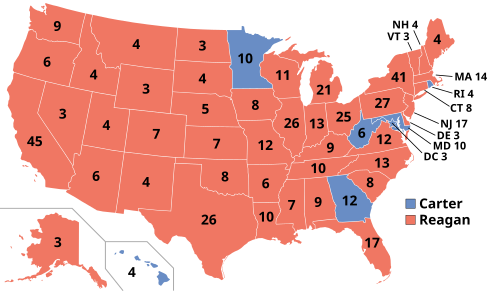
The transition of power took place in November 1980, marking the end of Carter's single term in office.
Frequently Asked Questions
What was Jimmy Carter's most significant foreign policy achievement?
His most significant achievement was brokering the Camp David Accords in 1978, which led to the first peace treaty between Egypt and Israel.
How did the 1979 energy crisis affect the Carter presidency?
The energy crisis caused economic instability and led Carter to implement the National Energy Act and deliver a famous address to the nation regarding energy and national goals.
What was the SALT II treaty?
The Strategic Arms Limitation Talks (SALT II) was a treaty signed between the U.S. and the Soviet Union in 1979 to limit the number of strategic nuclear weapons.
Why did Jimmy Carter lose the 1980 election?
Carter's re-election bid was hindered by high inflation, the 1979 energy crisis, and the Iranian hostage crisis, leading to his defeat by Ronald Reagan.
What role did human rights play in Carter's administration?
Carter made human rights a central pillar of U.S. foreign policy, using it as a benchmark for diplomatic relations and international aid.