Jazz at Lincoln Center: A Global Hub for Jazz Education and Performance
Located in the heart of New York City, Jazz at Lincoln Center (JALC) is more than just a performance venue; it is a comprehensive organization dedicated to the totality of jazz music. Founded in 1987 and established in its permanent home in October 2004, JALC serves as a sanctuary for the art form, focusing on education, curation, archiving, and ceremonial celebration. Under the long-term artistic leadership of Wynton Marsalis, the organization advocates for jazz and arts education on a global scale.
The center reaches approximately 3 million people annually through a diverse array of offerings, including high-capacity concerts, international tours, and musical instruction. Its influence extends digitally via the JAZZ LIVE platform and a robust YouTube channel that streams live performances and educational content to a worldwide audience.
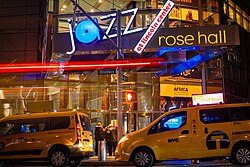
Key Facts
- Founded: 1987; permanent facility opened in 2004.
- Location: Deutsche Bank Center (formerly Time Warner Center), New York City.
- Artistic Director: Wynton Marsalis (since 1987).
- Annual Reach: Approximately 3 million people.
- Primary Venues: Rose Theater, The Appel Room, and Dizzy's Club.
- Educational Reach: Free tuition academies for middle and high school students in NYC.
The Journey to Permanence: A History of Advocacy
The path to establishing a permanent jazz presence at Lincoln Center was not without struggle. In the mid-1980s, the Lincoln Center sought to attract younger audiences and fill its halls during the summer. However, early proposals to introduce jazz were met with resistance; a 1986 report suggested that no "compelling case" existed for adding jazz, partly due to fears that jazz audiences would be too rowdy.
Determined to prove the genre's viability, Alina Bloomgarden, then director of visitor services, collaborated with trumpeter Wynton Marsalis to launch the Classical Jazz concert series in August 1987. This inaugural series highlighted women in jazz, featuring artists such as Betty Carter, Sasha Dalton, and Marian McPartland. The success of these concerts demonstrated both the commercial appeal and the cultural merit of jazz during a period of significant social upheaval and the rise of electronic music.
By 1996, the organization's success led to its elevation to full constituency status, placing it alongside prestigious institutions like the New York Philharmonic and the Metropolitan Opera. This growth is reflected in its budget, which rose from $4 million in 1996 to over $50 million by 2016.
Frederick P. Rose Hall: Engineering the Sound of Jazz
The center's physical home, the $131 million Frederick P. Rose Hall, was designed by architect Rafael Viñoly. Opened in 2004 on the fifth floor of the Deutsche Bank Center, it was the first facility of its kind globally to be entirely devoted to jazz performance, education, and broadcasting.
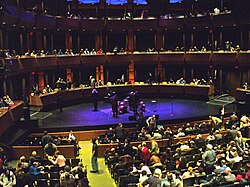
The facility was specifically engineered to capture the warmth and clarity of swing and blues-oriented jazz. It houses three distinct venues, each tailored to a different experience:
Rose Theater
The largest venue, with 1,233 seats, utilizes a "floating box-in-box construction" and rubber isolation pads to block outside noise. Its moveable seating towers allow it to switch between "concert mode" (where seats surround the musicians for better acoustics) and "theater mode" (providing a platform for opera, ballet, or modern dance).
The Appel Room
An intimate space with 583 seats, the Appel Room is famous for its 50-foot glass wall overlooking Central Park. To manage acoustics, the room uses ceiling-hung panels and catwalks to diffuse and absorb sound, ensuring a high-quality listening experience despite the glass architecture.
Dizzy's Club
Named after the legendary Dizzy Gillespie, this 140-seat club is designed to mimic the "golden" sound and intimacy of early New York City jazz clubs, fostering direct interaction between the artists and the audience while offering views of Columbus Circle.
Education and Global Outreach
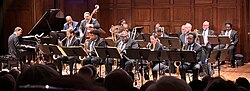
JALC views education as a cornerstone of its mission. The organization provides jazz curriculums to high schools through the Essentially Ellington program and sends professional musicians into schools via the Let Freedom Swing initiative. In New York City, the center operates Middle School, High School, and Summer Jazz Academies, all of which offer free tuition to students.
The organization also maintains its own record label, Blue Engine Records, established in 2015 to release albums by the Jazz at Lincoln Center Orchestra.
The Nesuhi Ertegun Jazz Hall of Fame
To preserve the legacy of the genre, JALC hosts the Nesuhi Ertegun Jazz Hall of Fame. Inductees are selected by an international panel of 60 musicians, scholars, and educators from 17 countries. The Hall recognizes the most definitive artists in jazz history, from pioneers like Louis Armstrong and Duke Ellington to modern innovators.
| Venue | Capacity | Primary Focus |
|---|---|---|
| Rose Theater | 1,233 | Large-scale concerts, opera, and dance |
| The Appel Room | 483 | Intimate performances with Central Park views |
| Dizzy's Club | 140 | Small ensembles and club-style interaction |
Critical Reception
Despite its success, JALC has faced criticism. Some critics, including pianist Matthew Shipp, have argued that the center "institutionalized" jazz, potentially stifling the spirit of experimentation and diversity that defines the genre. Conversely, supporters argue that Wynton Marsalis brought artistic seriousness and market viability back to a genre that had previously lost its way.
Frequently Asked Questions
Who is the artistic director of Jazz at Lincoln Center?
Wynton Marsalis has served as the artistic director since 1987. However, he announced in January 2026 that he will step down in July 2027, remaining as an advisor through June 2028.
Where is Jazz at Lincoln Center located?
It is located within the Deutsche Bank Center (formerly Time Warner Center) at Broadway and 60th Street in New York City, near Columbus Circle.
What educational programs does JALC offer?
JALC offers the Essentially Ellington high school curriculum, the Let Freedom Swing school visits, and free-tuition academies for middle and high school students in New York City.
How can I watch performances if I am not in New York?
Many concerts and educational programs are streamed live or archived on the organization's official YouTube channel and through the JAZZ LIVE platform.
What is the Nesuhi Ertegun Jazz Hall of Fame?
It is a prestigious honor recognizing the most definitive artists in jazz history, with inductees chosen by an international panel of experts from 17 different countries.