Jaws: The Story Behind Peter Benchley's Legendary Thriller
Few novels have left as indelible a mark on popular culture as Jaws. Written by American author Peter Benchley and published in 1974, the story of a massive great white shark terrorizing a Long Island resort town became a global phenomenon. While many recognize the title from the iconic film, the journey from a freelance writer's idea to a worldwide bestseller is a fascinating tale of marketing, suspense, and an evolving relationship with the natural world.
Key Facts
- Author: Peter Benchley, a freelance journalist at the time of writing.
- Publication: First released in hardcover by Doubleday in February 1974.
- Commercial Success: Sold an estimated 20 million copies worldwide.
- Film Legacy: Adapted by Steven Spielberg in 1975, becoming the first "summer blockbuster."
- Scientific Impact: The novel contributed to a widespread fear of sharks, leading Benchley to later become a conservationist.
The Origins of a Monster
Peter Benchley's fascination with the ocean began in childhood, fishing in Nantucket with his father, Nathaniel Benchley. For years, he harbored an idea for a story about a shark that refused to leave a populated area. This interest was galvanized in 1964 when Benchley read about Frank Mundus, a shark fisherman from Montauk, New York, who had captured a great white shark weighing 4,550 pounds (2,060 kg).

In 1971, while struggling as a freelance writer, Benchley pitched the idea to Thomas Congdon, an editor at Doubleday. While Congdon was uninterested in Benchley's non-fiction proposals, he saw potential in the shark thriller. Benchley received a total advance of $7,500 (approximately $59,624 in 2025) to complete the manuscript.
Writing and Development
The process of writing Jaws was far from seamless. Benchley spent a year and a half completing the draft, working from a makeshift office in New Jersey during the winter and a converted turkey coop in Connecticut during the summer. He conducted extensive research, drawing from works by Jacques Cousteau and Peter Matthiessen, as well as the documentary Blue Water White Death.
The novel's development also involved significant editorial shaping. Thomas Congdon pushed Benchley to move away from a comic tone and requested specific changes to the plot and character dynamics to heighten the tension. The final manuscript was delivered in January 1973.
Publication and Cultural Impact
Despite Benchley's own doubts about the success of a "novel about a fish," a sophisticated marketing campaign by Doubleday and Bantam Books propelled the book to the top of the charts. The hardcover edition remained on the bestseller list for 44 weeks, while the paperback edition sold millions of copies starting in 1975.
Beyond the plot, the novel mirrored 1970s cultural anxieties. It touched upon themes of distrust in local government, financial instability in small towns, and the fragility of marriage—reflecting an era marked by high unemployment and political scandals.
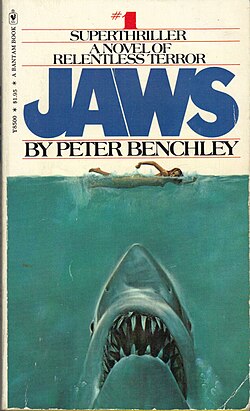
Book Summary and Specifications
| Detail | Information |
|---|---|
| Genre | Thriller |
| Hardcover Publisher | Doubleday |
| Paperback Publisher | Bantam |
| Publication Date | February 1974 |
| Hardcover Length | 311 pages |
| Estimated Global Sales | 20 million copies |
From Page to Screen
Producers Richard D. Zanuck and David Brown purchased the film rights before the book was even published. They hired Steven Spielberg to direct the adaptation, which was released in June 1975. Spielberg streamlined the story, removing the novel's subplots to focus on the three protagonists and the shark.
The film was a historic success, becoming the highest-grossing movie of its time. While Benchley was satisfied with the adaptation, he had little interest in the three sequels that followed, eventually opting for one-time payments of $70,000 per sequel rather than ongoing royalties.
A Legacy of Conservation
In later years, Peter Benchley expressed regret over the negative perception of sharks caused by his work. He realized that great white sharks are not anthropophagus (man-eating) by choice, but rather attack humans by accident, mistaking them for normal prey. This realization transformed him into an ardent ocean conservationist, spending the latter part of his life advocating for the protection of the species he once made famous as a monster.
Frequently Asked Questions
What inspired Peter Benchley to write Jaws?
Benchley was inspired by his childhood fishing trips and a 1964 news story about Frank Mundus, a fisherman who caught a massive great white shark off the coast of Montauk, New York.
How does the novel differ from the movie?
The novel includes several subplots and cultural themes—such as political distrust and marital strife—that Steven Spielberg omitted from the film to focus more tightly on the shark and the three main characters.
Was the novel a critical success?
While it was a massive commercial success, critical reviews were mixed. Many critics praised the suspense but found the prose and characterizations to be amateurish.
How did Peter Benchley feel about sharks later in life?
Benchley became a dedicated ocean conservationist, stating that he could not write the book today in good conscience because he learned that shark attacks on humans are typically accidental.
Who provided the iconic artwork for the paperback?
The iconic paperback cover was created by Roger Kastel, and this artwork was later reused for the famous Jaws film posters.