J.G.M. Ramsey: Historian, Physician, and Controversial Figure of Early Tennessee
James G.M. Ramsey was a man of immense contradictions: a learned physician and historian who championed the cause of slavery, and a wealthy banker whose fortunes were obliterated by the American Civil War. As a central figure in 19th-century Knoxville, Ramsey left an indelible mark on the region's early infrastructure and its recorded history.
Early Life and Education
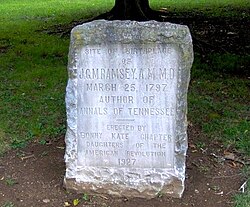
Born in 1797 in a temporary cabin at the site of the future Ramsey House, J.G.M. Ramsey was the fourth son of Francis Alexander and Peggy Ramsey, both of Scots-Irish descent. His father, Francis, had arrived in the region in 1783 with little more than a horse and surveying tools, settling near Big Limestone Creek in what is now Greene County, Tennessee.
Growing up in a household that hosted influential figures like John Sevier, Willie Blount, and Knoxville founders James White and Charles McClung, Ramsey was exposed to the political and social elite of the frontier. He received early instruction from private tutors and attended Ebenezer Academy in West Knoxville before graduating from Washington College (formerly Martin Academy) in March 1816. He later pursued medical studies at the University of Pennsylvania and began practicing medicine in Knoxville after marrying Margaret Crozier in 1821.
Business Ventures and Regional Development
Following his father's death in 1820, Ramsey entered the financial sector as president of the Knoxville Branch of the Bank of Tennessee. He established a grand plantation named Mecklenburg—after his mother's home county in North Carolina—located at the confluence of the French Broad and Holston rivers. This estate featured a massive mansion, a ferry across the Holston River, and a distinguished 4,000-volume library containing critical early Tennessee documents.
Ramsey was a visionary regarding transportation. As early as 1825, he proposed a railroad connecting Knoxville to the Atlantic Coast to help local farmers reach markets in Charleston. He negotiated hundreds of thousands of dollars in bonds to fund the region's first railroads and advocated for Tennessee River improvements to ensure year-round access to the Mississippi River. In 1828, he welcomed the Atlas, the first steamboat to reach Knoxville, at his Mecklenburg dock.
Financial Decline and Legal Conflict
By the 1850s, Ramsey served as a director for the East Tennessee and Georgia Railroad, which brought rail access to Knoxville in 1855. However, his reputation suffered a blow in 1858 when the Bank of East Tennessee collapsed due to overspeculation. The bank prioritized paying large depositors over smaller ones, sparking regional outrage. This led to a civil lawsuit against Ramsey, brought by his long-time rival, the Methodist minister and newspaper editor William "Parson" Brownlow.
The Annals of Tennessee
Ramsey's most enduring legacy is The Annals of Tennessee. He began collecting historical documents in the 1830s and started writing the work in 1840. The project was challenging due to contradictory sources and gaps in information, which were eventually filled with the help of historian Lyman Draper, who visited Ramsey in 1844.
Published in 1853, the Annals covered the state's history up to 1800. While praised by contemporaries like George Bancroft and Benson John Lossing, it was derided by others. Modern historians view the work as an invaluable resource because many of the original documents Ramsey used were destroyed during the Civil War. However, critics note that Ramsey focused heavily on biographies and battles while neglecting the social and economic factors of early settlement.
Political Ideology and the Secession Crisis
Ramsey was a staunch advocate for a Deep South-style economy, opposing the industrialization of Knoxville. He believed the South was morally superior to the North and was radically pro-slavery, even suggesting the reopening of the Atlantic slave trade. In 1860, he owned eight slaves.
During the secession crisis following Abraham Lincoln's 1860 election, Ramsey grew frustrated with East Tennessee's pro-Union sentiment. He dismissed the local population as "ignorant" and accused Parson Brownlow of brainwashing the public. Ramsey went as far as urging Governor Isham Harris to dissolve Tennessee's ties to the Union by proclamation, bypassing a public referendum.
The Civil War and Its Aftermath
During the American Civil War, Ramsey served as a Confederate treasury agent. His eldest son, John Crozier Ramsey, served as the Confederate States District Attorney for Knox County and arrested Parson Brownlow for treason in 1861. Ramsey personally wrote to Jefferson Davis demanding that Brownlow be court-martialed.
The war brought personal and financial ruin to the Ramsey family. His son Arthur was killed in battle, two daughters died, and two other sons were captured. When Union forces occupied Knoxville in 1863, the family fled. The Mecklenburg estate and its 4,000-volume library were burned, and Brownlow seized Ramsey's Knoxville townhouse. Ramsey spent the remainder of the war as a fugitive, moving between various regional cities.
Final Years and Legacy
After the war, Ramsey lived in Charlotte, North Carolina, at a residence he called "Exile's Retreat." Although Governor Brownlow refused to pardon him, Ramsey received a presidential pardon from Andrew Johnson in November 1865. He returned to Knoxville in 1872, resumed his medical practice, and recovered some property through lawsuits.
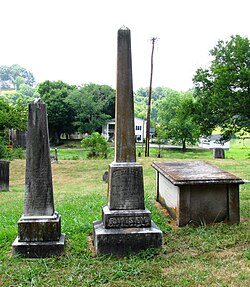
His final years were marked by physical hardship; letters from 1875 reveal he had become a "cripple" after an accident with an unruly horse left him with a crushed limb. J.G.M. Ramsey died in 1884. His funeral procession was reported as the largest in Knoxville's history, and he was buried near his father at the Lebanon in the Forks Cemetery.
Key Facts
- Major Work: Authored The Annals of Tennessee (1853), a primary historical record of the state's early years.
- Professional Roles: Practiced as a physician, served as a bank president, and acted as a Confederate treasury agent.
- Infrastructure: Championed the first railroads in East Tennessee and improvements to the Tennessee River.
- Personal Loss: Lost his estate, "Mecklenburg," and its 4,000-volume library to arson during the Civil War.
- Political Stance: A radical pro-slavery advocate and strong supporter of Southern secession.
| Category | Details |
|---|---|
| Birth/Death | 1797 – 1884 |
| Education | Washington College; University of Pennsylvania (Medicine) |
| Key Estate | Mecklenburg (at the confluence of French Broad and Holston rivers) |
| Political Affiliation | Confederate / Pro-Secession |
| Notable Rival | William "Parson" Brownlow |
Frequently Asked Questions
What was the significance of The Annals of Tennessee?
The book is considered an invaluable account of early Tennessee history because it was based on documents that were later destroyed during the Civil War, though it is criticized for ignoring social and economic contexts.
What was the "Mecklenburg" estate?
Mecklenburg was Ramsey's large plantation located east of Knoxville. It featured a mansion, a ferry, and a massive 4,000-volume library before it was burned during the Union occupation of Knoxville.
Why did J.G.M. Ramsey clash with Parson Brownlow?
Their conflict was both political and personal. Ramsey was a pro-slavery secessionist, while Brownlow was a pro-Unionist. They also clashed over the collapse of the Bank of East Tennessee, which led to a civil judgment against Ramsey.
How did the Civil War affect Ramsey's family?
The war was devastating: his son Arthur was killed, two daughters died, two sons were captured, and the family lost their homes and library, forcing them into exile in North Carolina.
How did Ramsey return to Knoxville after the war?
Despite Governor Brownlow's refusal to pardon him, Ramsey obtained a presidential pardon from Andrew Johnson in 1865, allowing him to return to Knoxville in 1872.