Italian Rock: A Comprehensive History of a Diverse Musical Evolution
Italian rock is a vibrant and eclectic form of rock music produced primarily in Italy. While the genre took root in the early 1960s as rock and roll spread from the United States, its beginnings were modest, consisting largely of cover versions and interpretative renditions of existing American hits. However, this foundation soon evolved into a sophisticated movement that blended international trends with Italy's own rich cultural and classical heritage.
Key Facts
- Origins: Emerged in the early 1960s via US rock and roll covers.
- Prog-Rock Peak: The 1960s and 70s saw a surge in classically influenced progressive rock.
- Genre Diversity: Evolution spans from psychedelic and punk to hardcore, thrash metal, and post-rock.
- Global Reach: Gianna Nannini was the first Italian rocker to achieve significant popular success across Europe and Mexico.
- Modern Influence: Italy has become a major international center for post-rock and contemporary alternative styles.
The Formative Years: 1960s and 1970s
The transition from covers to original compositions began with artists like Piero Ciampi, a singer-songwriter whose style drew inspiration from French chansonniers (lyric-driven songwriters). As the psychedelic rock boom swept through the US and UK, Italian bands such as Le Orme and Mario Schifano began experimenting with similar sounds.
By 1968, the global student uprisings and counterculture movements deeply influenced Italian youth. Combining their education in classical music—specifically composers like Bach—with modern rock, a wave of progressive rock bands emerged. These artists moved beyond simple song structures to create complex, orchestral compositions.
The Progressive and Experimental Wave
The Italian progressive scene was vast, featuring influential groups such as Banco del Mutuo Soccorso, PFM (Premiata Forneria Marconi), Goblin, and New Trolls. Some bands pushed the boundaries further by fusing rock with jazz, fusion, and world music, notably Area, Perigeo, and Osanna.
Among the most discussed works of this era is Il Balletto Di Bronzo's YS, an album that remains polarizing among critics. Another landmark was Area's Arbeit macht frei, which combined agit-prop (agitation propaganda) lyrics with raw electronics and Middle-Eastern scales. Area was led by Demetrio Stratos, a vocalist renowned for his experimental work with the human voice, as heard in Cantare la Voce.
Simultaneously, the early 1970s saw the rise of iconic singer-songwriters including Lucio Battisti, Fabrizio De André, and Franco Battiato.
The Birth of Italian Punk
As the 1970s closed, the musical landscape shifted toward raw energy. The pioneers Skiantos released Monotono in 1978, effectively launching the Italian punk scene. This era also saw the emergence of Gaznevada and The Confusional Quartet, who blended punk with new wave and varieta (a traditional Italian variety show style).
The 1980s: New Wave and Heavy Metal
The 1980s marked a period of intensity, with Italy developing some of the most vibrant new wave, hardcore, and thrash metal scenes in Europe. Toward the end of the decade, the sound grew even more extreme with the rise of heavy metal.
Key artists and bands from this era included Litfiba, Vasco Rossi, CCCP Fedeli alla linea, and extreme metal acts like Necrodeath and White Skull.
1990s and the Modern Era
In the 1990s, Italian alternative and avant-garde rock gained critical international acclaim. Many bands adopted a sonic model influenced by the likes of Sonic Youth and Fugazi, focusing on "neo-existentialism" and the psychological struggles of youth. Interestingly, Italy—long known for its melodic traditions—became a global hub for post-rock.
While many artists remained critical favorites, Gianna Nannini broke through as a true international pop-rock icon, finding massive success in Germany, Switzerland, Austria, Benelux, and Mexico. She was followed by other global stars such as Zucchero, Eros Ramazzotti, and Jovanotti.
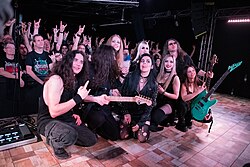
The contemporary scene continues to expand, encompassing a wide array of genres from the symphonic metal of Rhapsody of Fire and Lacuna Coil to the global phenomenon of Måneskin.
Summary of Italian Rock Evolution
| Era | Dominant Styles | Notable Artists/Bands |
|---|---|---|
| 1960s | Rock and Roll Covers, Psychedelic | Le Orme, Mario Schifano |
| 1970s | Progressive Rock, Jazz Fusion, Punk | PFM, Area, Banco del Mutuo Soccorso, Skiantos |
| 1980s | New Wave, Hardcore, Thrash Metal | Litfiba, Vasco Rossi, Necrodeath |
| 1990s+ | Alternative, Post-Rock, Symphonic Metal | Gianna Nannini, Lacuna Coil, Måneskin |
Frequently Asked Questions
How did Italian rock begin?
It began in the early 1960s, primarily through the adoption of American rock and roll, with early Italian artists performing cover versions of existing US songs.
What makes Italian progressive rock unique?
Italian progressive rock was heavily influenced by the musicians' familiarity with classical composers like Bach, leading to a sophisticated blend of rock and classical structures.
Who was the first Italian rocker to achieve major international success?
Gianna Nannini was the first Italian rocker to achieve significant popular success outside of Italy, particularly in Central Europe and Mexico.
Which bands defined the Italian punk scene?
The band Skiantos is credited with kickstarting the scene with their 1978 release Monotono, followed by groups like Gaznevada and The Confusional Quartet.
What characterized the Italian rock scene in the 1990s?
The 1990s were characterized by a move toward avant-garde and alternative rock, a focus on neo-existentialist themes, and the emergence of Italy as a center for post-rock.