Irish Time History and the Time (Ireland) Act 1916
For centuries, the concept of time was localized. Before the standardization of clocks, cities and regions relied on their own solar positions to determine the hour. In Ireland, this led to a distinct legal time that differed from that of Great Britain, creating a gap that eventually became a logistical hurdle for a modernizing world.
The Era of Local Mean Time
Prior to 1880, legal time across the United Kingdom of Great Britain and Ireland was defined as local mean time—the average solar time at a specific location. This standard was upheld by the 1858 court case of Curtis v. March.
The Statutes (Definition of Time) Act 1880 sought to bring more structure to this system. It established Dublin Mean Time (the local mean time at Dunsink Observatory outside Dublin) as the legal time for Ireland. At the time, Dublin Mean Time lagged behind Greenwich Mean Time (GMT)—the legal time for Great Britain—by approximately 25 minutes and 21 seconds.
The Time (Ireland) Act 1916
Following the Easter Rising, the time discrepancy between Ireland and Britain became an inconvenience, particularly for telegraphic communication. To resolve this, the Parliament of the United Kingdom passed the Time (Ireland) Act 1916 (6 & 7 Geo. 5 . c. 45). This Act of Parliament aimed to assimilate Irish time with that of Great Britain.
The transition occurred at 2:00 am Dublin Mean Time on Sunday, 1 October 1916. This change coincided with the shift from summer time (daylight saving time)—which had been introduced in May 1916 as a temporary efficiency measure for World War I—back to winter time.
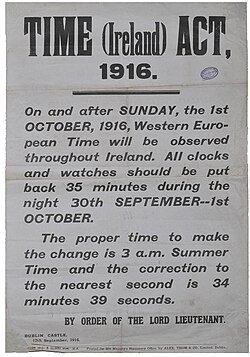
The Act was not without political controversy. John Dillon opposed the first reading, arguing that the lack of consultation with the Irish Parliamentary Party served as a reminder that Ireland was being treated as a "strange country." T. M. Healy also opposed the second reading, critically noting that while the Daylight Saving Bill increased daylight, this specific Bill "adds to the length of your darkness."
Post-Independence and the Irish Free State
After the Irish Free State gained independence in 1922, the government generally mirrored the time developments of the United Kingdom to prevent time differences from emerging along the border with Northern Ireland.
- 1923 & 1924: Summer time was provided on a one-off basis via specific Acts.
- 1925: The Summer Time Act 1925 established an ongoing default summer time period, adjustable by ministerial order.
During World War II (known in Ireland as the Emergency), the UK introduced "double summer time" in 1940. Because Ireland did not adopt this measure, Northern Ireland remained one hour ahead of the Republic of Ireland until the UK returned to GMT in the autumn of 1947.
Modern Standardization and the EEC
In 1968, Ireland conducted an experiment in preparation for its 1973 accession to the European Economic Community (EEC). The country observed standard time (GMT+01:00) year-round, eliminating the winter time change. This aligned Ireland with six other EEC countries, though Italy differed during the summer by using Central European Summer Time (CEST). This experiment ended in 1971.
A legal quirk from the 1968 legislation remains: "standard time" legally refers to summer time. The Standard Time (Amendment) Act 1971 subsequently defined "winter time" as the period when GMT is observed, leaving the definition of "standard time" unchanged.
Since the 1980s, the dates for switching between winter and summer time have been synchronized across the European Union.
Key Facts
- Dublin Mean Time: Formerly 25 minutes and 21 seconds behind GMT.
- The 1916 Act: Synchronized Irish and British time on October 1, 1916.
- The Emergency: A time gap existed between the Republic and Northern Ireland (1940–1947) due to the UK's double summer time.
- EEC Experiment: Ireland tried year-round GMT+01:00 from 1968 to 1971.
- Legal Definition: In Irish law, "standard time" refers to summer time.
| Year | Legislation/Event | Primary Effect |
|---|---|---|
| 1880 | Statutes (Definition of Time) Act | Defined Dublin Mean Time as legal time for Ireland. |
| 1916 | Time (Ireland) Act | Assimilated Irish time to British time (GMT). |
| 1925 | Summer Time Act | Established ongoing summer time framework. |
| 1968 | Standard Time Experiment | Observed GMT+01:00 year-round until 1971. |
| 1971 | Standard Time (Amendment) Act | Defined "winter time" as GMT. |
Frequently Asked Questions
Why was the Time (Ireland) Act 1916 passed?
The Act was passed primarily because the time difference between Ireland and Great Britain had become inconvenient for telegraphic communication.
What was Dublin Mean Time?
Dublin Mean Time was the local mean time at Dunsink Observatory, which served as the legal time for Ireland until 1916 and was approximately 25 minutes and 21 seconds behind Greenwich Mean Time.
Did Ireland and Northern Ireland ever have different times?
Yes. Between 1940 and 1947, Northern Ireland was one hour ahead of the Republic of Ireland because the UK implemented double summer time during World War II, while the Republic did not.
What is the legal meaning of "standard time" in Ireland?
Due to legislation from 1968, "standard time" legally refers to summer time, while the period in winter when GMT is observed is defined as "winter time."
How is the switch between summer and winter time managed today?
Since the 1980s, the dates for switching between winter and summer time in Ireland have been synchronized with the rest of the European Union.