iPhone Evolution: From the 2007 Original to the iPhone 17 Pro
Since its debut on June 29, 2007, the iPhone has fundamentally reshaped the global telecommunications landscape. Developed by Apple, this line of smartphones has grown from a single revolutionary device into a massive ecosystem of 52 different models, selling over 3 billion units as of July 2025.
The iPhone's journey is marked by constant iteration in hardware, software, and connectivity, moving from the early days of the 30-pin dock connector to the modern ubiquity of USB-C and high-performance silicon.

Key Facts
- Total Units Sold: Over 3 billion (as of July 2025).
- Total Models: 52 distinct models produced to date.
- Operating System: iOS.
- Current Flagship: iPhone 17 Pro (featuring the Apple A19 Pro chip).
- Manufacturing Partners: Foxconn, Pegatron, Wistron, and Tata Group.
- Connectivity Evolution: Transitioned from 30-pin dock → Lightning → USB-C.
The Hardware Journey
The physical evolution of the iPhone reflects broader trends in mobile technology. Early models focused on establishing the touch interface, while later generations prioritized display size, camera capabilities, and processing power.
Connectivity and Audio
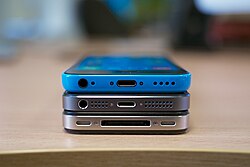
One of the most visible changes has been the device's ports. The original models utilized a 30-pin dock connector until the iPhone 5. This was replaced by the Lightning port, which served as the standard from the iPhone 5 through the iPhone 14. Starting with the iPhone 15, Apple transitioned to the USB-C port for universal compatibility.
Audio has seen similar shifts. The 3.5 mm headphone jack, a staple for years, was removed starting with the iPhone 7, which also introduced stereo speakers.
Processing Power and Storage
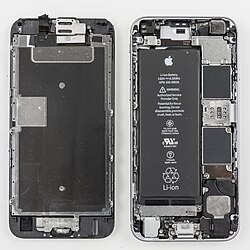
Apple's custom System-on-a-Chip (SoC) architecture has driven the device's performance. The latest generation features the Apple A19 and A19 Pro chips. Storage capacities have expanded significantly to accommodate high-resolution media, with current models offering options from 128 GB up to 2 TB of flash memory.
Camera Innovation
The iPhone has evolved from a simple camera phone into a professional-grade tool. Modern iterations, such as the iPhone 13 Pro and subsequent models, feature advanced multi-lens arrays to support a wide range of photographic and videographic needs.

Model Lineup and Lifecycle
Apple has diversified its offerings to target different market segments, introducing "Plus," "Pro," "Max," and "SE" (Special Edition) variants. The most recent additions include the iPhone 17 series and the iPhone Air, released in September 2025, followed by the iPhone 17e in March 2026.

The support lifecycle for these devices varies. While early models like the original iPhone had a support lifespan of under three years, more recent devices often receive updates for six or seven years, extending the utility of the hardware.
| Era | Notable Models | Key Hardware/OS Shift |
|---|---|---|
| Early Years (2007-2009) | iPhone, 3G, 3GS | Introduction of iPhone OS; 3G connectivity |
| Refinement (2010-2013) | iPhone 4, 4s, 5, 5s, 5c | Retina display; Lightning port; 64-bit architecture |
| Expansion (2014-2017) | iPhone 6, 6s, 7, 8, X | Larger screens; Removal of headphone jack; FaceID |
| Modern Era (2018-Present) | iPhone 11 through 17 Pro | 5G connectivity; USB-C; A-series Pro chips |
Software and Ecosystem
The iPhone runs on iOS, a closed-source operating system that integrates deeply with Apple's other services. The App Store allows third-party developers to distribute software, while services like iCloud, Apple Pay, and Apple One provide a seamless experience across devices.
Frequently Asked Questions
When was the first iPhone released?
The original iPhone was released on June 29, 2007.
Which iPhone models use USB-C?
The USB-C port was introduced with the iPhone 15 and is used in all subsequent models, including the iPhone 16 and 17 series.
What is the latest processor used in the iPhone?
The latest flagship models, such as the iPhone 17 Pro, utilize the Apple A19 Pro chip.
How many iPhones have been sold globally?
As of July 2025, more than 3 billion iPhone units have been sold.
What happened to the 3.5 mm headphone jack?
The 3.5 mm headphone jack was discontinued starting with the release of the iPhone 7.