Internal Conflict in Peru: The Legacy of the Shining Path and MRTA
The internal conflict in Peru represents one of the most violent chapters in the nation's modern history. Primarily characterized as an armed struggle between the Government of Peru and the Maoist guerrilla organization known as the Shining Path (PCP-SL), the conflict spanned decades, leaving a profound impact on the country's social and political fabric. While the most intense phase occurred between 1980 and 2000, remnants of this insurgency persist today, intertwined with the complexities of the global war on drugs.
Key Facts
- Primary Belligerents: The Peruvian Government versus the Shining Path (PCP-SL) and the Túpac Amaru Revolutionary Movement (MRTA).
- Human Cost: Estimated 50,000 to 70,000 killed or missing, with approximately 600,000 people displaced.
- Main Phase: 1980 to 2000, ending largely with the capture of key leaders.
- Current Status: Ongoing low-intensity insurgency concentrated in the VRAEM region.
- Key Figures: Abimael Guzmán (Shining Path founder) and Alberto Fujimori (President during the 1990s).
The First Phase: Total War (1980–2000)
The conflict began on May 17, 1980, when the Shining Path launched its insurgency. Guided by a Maoist ideology, the group sought to overthrow the Peruvian state through a protracted people's war. The early years under the administration of Fernando Belaúnde were marked by escalating violence and government responses that sometimes resulted in massacres of civilians.
By 1982, a second insurgent group, the Túpac Amaru Revolutionary Movement (MRTA), emerged. Unlike the Maoist Shining Path, the MRTA followed a Marxist-Leninist ideology and acted as a rival to the PCP-SL, though both fought the state.
The tide turned during the administration of Alberto Fujimori in the 1990s. A combination of intelligence operations and military action led to the capture of the Shining Path's leader, Abimael Guzmán, in 1992. This blow, followed by the capture of Óscar Ramírez in 1999, effectively ended the first phase of the conflict and led to the dissolution of the MRTA by 1997.
Following the violence, the Truth and Reconciliation Commission was established to document the atrocities committed by both the state and the insurgent groups, providing a formal record of the human rights violations that occurred.
The Second Phase: VRAEM and Narcoterrorism (2001–Present)
Although the main insurgency collapsed, the conflict entered a second phase characterized by fragmented factions. The VRAEM (Valley of the Apurímac, Ene, and Mantaro Rivers) became the stronghold for these remnants. In this region, the insurgency shifted from a purely political goal to a symbiotic relationship with drug trafficking.
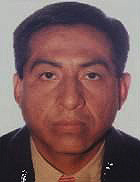
Various factions emerged, including the CBMR (2001) and the CRH (2004–2012). The Peruvian government launched several counter-offensives to dismantle these cells. A significant victory occurred in 2012 with the capture of "Comrade Artemio," who had led a major faction in the jungle.
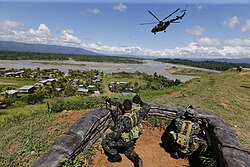
Despite these successes, the VRAEM remains a volatile zone. Security forces continue to supervise counter-terrorism bases to prevent the regrouping of militants and the influence of foreign entities, including reported links to FARC dissidents and Hezbollah.
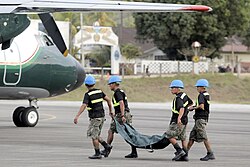
The violence has persisted in sporadic bursts. In February 2014, attacks targeted natural gas work camps in the Cusco region. More recently, in May 2021, remnants of the Shining Path carried out a massacre of civilians in San Miguel del Ene, killing between 16 and 18 residents.
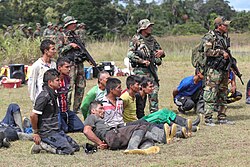
Recent operations, such as "Operation Armageddon," have focused on arresting FARC dissidents and other collaborators who provide tactical support to the remaining Peruvian insurgents.
The political landscape remains complex, with the emergence of alliances like the MPCP (established in 2018) and the FUDARP alliance, which utilized specific political fronts to maintain influence.

Conflict Summary Table
| Period | Primary Groups | Key Outcome | Estimated Casualties |
|---|---|---|---|
| 1980–2000 | Shining Path, MRTA | Government victory; capture of Abimael Guzmán | 50,000–70,000 killed/missing |
| 2001–Present | CBMR, CRH, MPCP, FARC dissidents | Ongoing insurgency in VRAEM; focus on drug trafficking | Ongoing (lower intensity) |
Frequently Asked Questions
What was the primary goal of the Shining Path?
The Shining Path sought to overthrow the Peruvian government and establish a new state based on Maoist communist ideology through a violent, protracted people's war.
How did the MRTA differ from the Shining Path?
While both were insurgent groups, the MRTA followed a Marxist-Leninist ideology and was a rival to the Maoist Shining Path, often clashing with them as well as the government.
What is the VRAEM and why is it significant?
The VRAEM (Valley of the Apurímac, Ene, and Mantaro Rivers) is a remote jungle region that serves as the current stronghold for Shining Path remnants due to its geography and its role as a center for coca production.
Who was Abimael Guzmán?
Abimael Guzmán was the founder and ideological leader of the Shining Path. His capture in 1992 is widely considered the turning point that led to the decline of the insurgency's first phase.
What was the role of the Truth and Reconciliation Commission?
The Commission was tasked with investigating the human rights abuses committed by both the state security forces and the insurgent groups to provide closure and a historical record for the victims.