Understanding the Interim Register of Marine and Nonmarine Genera (IRMNG)
In the vast effort to catalog every living organism on Earth, scientists rely on Biodiversity Informatics—the application of information technology to manage and analyze biodiversity data. One of the most critical tools in this field is the Interim Register of Marine and Nonmarine Genera (IRMNG). This comprehensive taxonomic database serves as a centralized hub for genus-level names and higher taxonomic ranks across all domains of life.
By organizing scientific names into a single, internally consistent taxonomic hierarchy (the ranked system used to classify organisms), IRMNG provides a vital foundation for researchers, biologists, and global biodiversity initiatives.
Key Facts
- Primary Focus: Published genus names and higher taxonomic ranks for all domains of life.
- Scope: Covers zoology from 1758 and botany from 1753 to the present.
- Scale: Contained over 508,000 genus names as of July 2024.
- Governance: Adheres to the international codes of nomenclature for zoology, botany, prokaryotes, and viruses.
- Hosting: Currently managed by the Flanders Marine Institute (VLIZ) in Belgium.
- Accessibility: Available via online queries and bulk data dumps in Darwin Core Archive (DwC-A) format.
What is the IRMNG?
The IRMNG is a specialized database designed to track scientific names of genera—the rank above species and below family—and higher ranks for most plants, animals, and other kingdoms. While its primary mission is the comprehensive coverage of genus names, it also maintains a subset of species names to support its hierarchy.
As of July 2024, the database holds 508,851 genus name instances. These are categorized by their taxonomic status:
- Accepted: 240,625 names currently recognized as valid.
- Unaccepted: 123,117 names no longer in use.
- Uncertain: 121,917 names that have not yet been assessed.
- Other: 23,192 names, including nomen dubium (names of doubtful application), nomen nudum (names published without a description), and taxon inquirendum (taxa requiring further investigation).
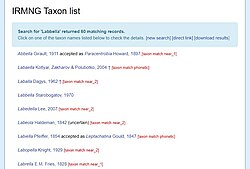
Users can access this information through a web interface that allows for flexible searching, including "fuzzy" searches to find names despite minor spelling variations.
Data Governance and Standards
To ensure scientific accuracy, IRMNG follows the strict rules set by the governing bodies of biological nomenclature. Depending on the organism, the database adheres to:
- ICZN: The International Code of Zoological Nomenclature (animals, zoological protists, and animal-related trace fossils).
- ICN (or ICNafp): The International Code of Nomenclature for algae, fungi, and plants.
- ICNP: The International Code of Nomenclature of Prokaryotes (Bacteria and Archaea).
- ICTV: The International Committee on Taxonomy of Viruses.
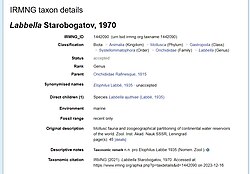
The database integrates data from various specialized sources, such as the Nomenclator Zoologicus for animals and the Index Nominum Genericorum for plants. This data is reorganized into a common structure, allowing the system to generate individual taxon pages for specific groups.
The Distinction Between Zoological and Botanical Subgenera
A unique aspect of IRMNG is how it handles subgenera. In zoology, the "principle of coordination" means that a subgenus name is automatically considered a genus name if it is published as such. Therefore, IRMNG includes zoological subgenera, marking them as "unaccepted" unless they are currently used as the accepted genus name.
Botanical nomenclature (ICN) does not have this provision. Consequently, botanical subgenera are only included in IRMNG if they have been explicitly re-ranked to the level of a genus by a researcher.
Global Distribution of Genera
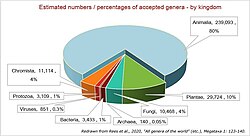
The IRMNG provides a window into the estimated diversity of life across different kingdoms. Based on May 2023 data and the methodology established by Rees et al. (2020), the following estimates represent accepted genera (including a notional 50% of those marked as "uncertain").
| Kingdom | Accepted Genus Names | Estimated Total (incl. 50% Uncertain) |
|---|---|---|
| Animalia | 189,287 | 241,578 |
| Plantae | 25,394 | 32,313 |
| Fungi | 10,702 | 10,881 |
| Chromista | 9,912 | 11,102 |
| Protozoa | 999 | 2,081 |
| Bacteria | 3,337 | 3,393 |
| Archaea | 140 | 140 |
| Viruses | 851 | 851 |
History and Integration
The IRMNG was founded in 2006 by Australian biologist and data manager Tony Rees. For his contributions to biodiversity data, Rees was awarded the 2014 Ebbe Nielsen Prize by the Global Biodiversity Information Facility (GBIF). Initially hosted at the CSIRO Division of Marine and Atmospheric Research in Australia, the database transitioned to the Flanders Marine Institute (VLIZ) in Belgium between 2014 and 2016.
Today, IRMNG is a cornerstone for several global projects. Its data helps populate the taxonomic hierarchies of the Catalogue of Life (specifically for protists and plant algae), the Encyclopedia of Life (EOL), and the Open Tree of Life. It also provides essential data to the Global Biodiversity Information Facility (GBIF) and the Atlas of Living Australia.
Frequently Asked Questions
What is the primary purpose of the IRMNG?
The IRMNG aims to provide a complete, internally consistent record of published genus names and higher taxonomic ranks for all domains of life, serving as a resource for biodiversity informatics and general taxonomic research.
How does IRMNG handle species names?
While the database contains over 1.7 million species names (with 1.3 million listed as accepted), this is a secondary activity. The species-level data is not maintained as comprehensively or as currently as the genus-level data.
Who currently manages and hosts the database?
The database is owned and hosted by the Flanders Marine Institute (VLIZ) in Ostend, Belgium, which also hosts the World Register of Marine Species (WoRMS).
In what format can the IRMNG data be downloaded?
Data downloads, available down to the taxonomic rank of genus, are provided in the Darwin Core Archive (DwC-A) format, which is a standard for sharing biodiversity data.
Why are some zoological subgenera listed as "unaccepted" names?
Due to the "principle of coordination" in zoological nomenclature, subgenera are treated as available generic names. They are marked as "unaccepted" in IRMNG unless they are currently being used as the accepted name for a genus.