India's Strategic Engagement with East and Southeast Asia
India has fundamentally reshaped its foreign policy to deepen ties with its eastern neighbors through the Look East and subsequent Act East policies. This strategic shift focuses on enhancing economic integration, ensuring maritime security, and fostering diplomatic cooperation across East and Southeast Asia to balance regional power dynamics and secure vital trade routes.
Key Facts
- Trade Security: Over 50% of India's trade passes through the critical Malacca Strait.
- Strategic Infrastructure: India is developing the Kaladan Multi-Modal Transit Transport Project and the India–Myanmar–Thailand Trilateral Highway.
- Diplomatic Ties: India is a summit-level partner of ASEAN and a member of BIMSTEC and the Mekong-Ganga Cooperation.
- Economic Growth: Trade between India and China has historically seen rapid growth, targeting $60 billion by 2010.
- Military Presence: The Far Eastern Naval Command has been established off Port Blair in the Andaman and Nicobar Islands.
Relations with Southeast Asia and Burma
India's approach to Burma (Myanmar) shifted in 1993 from supporting pro-democracy movements to engaging with the military junta. This pivot allowed India to secure lucrative state contracts for highways, pipelines, and port upgrades. A primary driver of this engagement is the competition with China over Burma's oil and natural gas reserves, as India seeks to reduce its energy dependence on the Middle East.
While China remains Burma's primary military supplier and has harnessed significant natural gas in the A-1 Shwe field of Rakhine State, India has focused on training Burmese military personnel to combat drug trafficking and separatist militants affecting Northeast India.
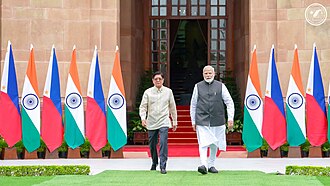
Beyond Burma, India has cultivated strong commercial and military ties with the Philippines, Singapore, Vietnam, and Cambodia. Free trade agreements (FTAs) have been established with Sri Lanka and Thailand, including an Early Harvest Scheme with the latter. India also maintains a Comprehensive Economic Cooperation Agreement with Malaysia and continues negotiations with Japan, South Korea, and other ASEAN member states.
Strategic Partnerships in East Asia
India has strengthened its bonds with Japan, South Korea, and Taiwan, rooted in shared interests in democracy and human rights. Japan and South Korea are among the largest sources of foreign direct investment in India. While India officially adheres to the One China policy—recognizing the People's Republic of China's sovereignty over the mainland—it has simultaneously increased its practical engagement with Taiwan.
Maritime security is a cornerstone of these relations. To protect its trade interests in the Malacca Strait, India has conducted joint naval exercises such as SIMBEX with Singapore (since 1993) and collaborations with Vietnam (since 2000) and Indonesia (since 2002). India also played a key role in the 2004 tsunami relief regional core group alongside the US, Japan, and Australia.
The Complex Dynamic with China
India and China exist as strategic rivals, yet have pursued periods of rapprochement. High-level talks began in 1993, and the Nathu La pass was reopened for trade in 2006. In November 2006, Prime Minister Manmohan Singh and President Hu Jintao issued a 10-point joint declaration to resolve conflicts.
Despite economic growth, several friction points persist:
- China's close military and political ties with Pakistan.
- Disputes over the sovereignty of Arunachal Pradesh and the integration of Sikkim.
- India's provision of asylum to the 14th Dalai Lama.
Chinese state media has occasionally criticized the Look East policy, suggesting it stems from a "fear of China" or a failure of India's Cold War-era diplomacy.
Multilateralism and Regional Connectivity
To expand its influence beyond South Asia without the obstruction of Pakistan or China, India has championed organizations like BIMSTEC (Bay of Bengal Initiative for Multi-Sectoral Technical and Economic Cooperation) and the Mekong-Ganga Cooperation.
India's integration into ASEAN has progressed steadily: becoming a sectoral dialogue partner in 1992, gaining advisory status in 1995, and reaching summit-level partnership in 2002. This integration was often supported by regional partners like Japan, Singapore, and Indonesia, who viewed India as a necessary balance to China's dominance in forums like ASEAN+3.
Infrastructure and Connectivity Summary
| Project/Forum | Type | Primary Objective |
|---|---|---|
| Kaladan Multi-Modal Project | Infrastructure | Trade and transit via Myanmar |
| India–Myanmar–Thailand Highway | Infrastructure | Trilateral road connectivity |
| ASEAN | Multilateral | Regional economic and security integration |
| Stilwell Road | Infrastructure | Proposed link between Assam (India) and Yunnan (China) |
| Asian Highway/Trans-Asian Railway | Infrastructure | Broad regional transport networks |
Tourism and People-to-People Ties
While not the primary goal of the Act East policy, outbound tourism has flourished as a complementary result. Rising middle-class disposable income and simplified visa regimes have led to a surge in Indian visitors to Thailand, Singapore, Malaysia, Vietnam, and Indonesia.
Japan has also seen an increase in Indian tourists, particularly among higher-income segments, supported by expanded flight connectivity and streamlined visa procedures. This growth in travel reflects the broader success of regional integration and cultural exchange.
Frequently Asked Questions
What is the primary goal of India's Look East/Act East policy?
The policy aims to enhance economic, strategic, and cultural ties with East and Southeast Asian nations to ensure maritime security, balance regional power (specifically China), and foster economic growth.
Why is the Malacca Strait important to India?
The Malacca Strait is a critical maritime chokepoint through which more than 50% of India's trade passes, making its security vital for India's economic stability.
How does India balance its relationship with China and Taiwan?
India officially supports the "One China" policy, recognizing the People's Republic of China's sovereignty over the mainland, while simultaneously increasing its strategic and economic engagement with Taiwan.
Which multilateral organizations does India use to expand its influence?
India utilizes ASEAN, BIMSTEC, and the Mekong-Ganga Cooperation to build regional partnerships and avoid the diplomatic stalemates often found in the South Asian Association for Regional Cooperation (SAARC).
What are the main obstacles in India-China relations?
Key tensions include border disputes over Arunachal Pradesh, China's relationship with Pakistan, and India's asylum of the 14th Dalai Lama.