India Defence Expenditure: Budgetary Trends and Strategic Allocations
Maintaining national security requires a sophisticated balance of financial planning and strategic investment. Over the last decade, India's defence expenditure has evolved to meet growing security challenges, reflecting a consistent trend of growth in both absolute terms and strategic focus. From the allocation of funds for personnel to the modernization of hardware, the Union Budget serves as the primary roadmap for the country's military capabilities.
Key Facts
- Current Budget: The 2025-26 Budget Estimate (BE) stands at ₹6.81 lakh crore (US$71 billion).
- GDP Impact: Defence spending accounts for 1.9% of the projected Gross Domestic Product (GDP) for 2025-26.
- Global Standing: As of 2022-23, India's defence allocation made it the fourth highest spender globally, following the US, China, and Russia.
- Growth Trend: The 2025-26 budget reflects a 9.5% increase over the previous year.
- Primary Focus: Recent allocations emphasize domestic procurement, modernization, and the fulfillment of salary and pension obligations.
Historical Budgetary Growth (2017–2025)
India's defence spending has seen steady increments since 2017. In the 2017-18 fiscal year, the Minister of Finance allocated ₹359,000 crore (US$52 billion in 2023 values), a 7% increase from the prior year. This upward trajectory continued through 2018-19 with an allocation of ₹404,365 crore, marking a 5.66% rise.
The 2019-20 period was unique due to the general election. The National Democratic Alliance (NDA) government initially presented an interim budget of ₹431,011 crore. While the budget remained unchanged after the re-election, actual expenditures rose to ₹448,820 crore, representing a 10% increase over the previous budget.
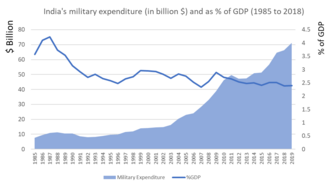
Between 2020 and 2023, spending continued to climb, reaching ₹525,166 crore in 2022-23. By the 2024-25 cycle, the budget grew to ₹621,940 crore (US$65 billion), representing 1.89% of the projected GDP.
Detailed Expenditure Breakdown (2025-26)
The 2025-26 Budget Estimate (BE) provides a clear view of how funds are distributed across different operational needs. A significant portion of the budget is dedicated to Salaries and Pensions, ensuring the welfare of service members. However, there is a notable surge in Capital Outlay—funds used for the acquisition of new assets and infrastructure—which is projected to increase by 13% to ₹192,388 crore (US$20 billion).
Spending by Major Head
The following table summarizes the financial transition from actual spending in 2023-24 to the estimates for 2025-26.
| Major Head | Actuals (2023-24) | RE (2024-25) | BE (2025-26) | % Change (24-25 v 25-26) |
|---|---|---|---|---|
| Salaries | ₹172,496 cr (US$18B) | ₹172,760 cr (US$18B) | ₹177,923 cr (US$18B) | 3% |
| Capital Outlay | ₹164,559 cr (US$17B) | ₹170,485 cr (US$18B) | ₹192,388 cr (US$20B) | 13% |
| Pensions | ₹142,093 cr (US$15B) | ₹157,681 cr (US$16B) | ₹160,795 cr (US$17B) | 2% |
| Maintenance | ₹87,722 cr (US$9.1B) | ₹86,191 cr (US$9.0B) | ₹90,923 cr (US$9.4B) | 5% |
| Other Expenses | ₹42,634 cr (US$4.4B) | ₹53,943 cr (US$5.6B) | ₹59,181 cr (US$6.1B) | 10% |
| Total | ₹609,504 cr (US$63B) | ₹641,060 cr (US$67B) | ₹681,210 cr (US$71B) | 6% |
Service-Specific Revenue Allocations
The distribution of revenue across the armed forces shows the Army as the primary recipient of funding. For the 2025-26 BE, the allocations are as follows:
- Army Revenue: ₹351,345 crore (US$36 billion), a 5% increase.
- Navy Revenue: ₹52,290 crore (US$5.4 billion), an 8% increase.
- Air Force Revenue: ₹71,254 crore (US$7.4 billion), an 8% increase.
- Capital Outlay: ₹168,565 crore (US$18 billion), a 14% increase.
Defence Spending as a Percentage of GDP
Analyzing defence spending as a percentage of the Gross Domestic Product (GDP)—the total value of goods and services produced within a country—provides insight into the economic priority given to military spending. Data from the World Bank and other sources show a fluctuating trend. For instance, spending peaked at 2.89% in 2009 and 2.88% in 2020, while it has settled at 1.9% for the 2025-26 projection.
Capital Acquisition and Historical Performance
Capital acquisition refers to the procurement of long-term assets like aircraft, ships, and tanks. Historical data from the Institute for Defence Studies and Analyses for 2013-2014 reveals varying levels of spending efficiency. During that period, the Air Force showed the highest efficiency with only a 2.78% variance in under/over spending, while the Army experienced a more significant variance of 18.95%.
Frequently Asked Questions
What is the total defence budget for India in 2025-26?
The Budget Estimate (BE) for the 2025-26 fiscal year is ₹6.81 lakh crore, which is approximately US$71 billion.
How does India's defence spending compare globally?
As of the 2022-23 allocation, India's defence spending ranked as the fourth highest in the world, trailing only the United States, China, and Russia.
What percentage of India's GDP is allocated to defence in 2025-26?
The defence budget for 2025-26 accounts for 1.9% of the country's projected Gross Domestic Product (GDP).
Which area of defence spending saw the highest growth for 2025-26?
Capital Outlay saw the most significant increase, growing by 13% to reach ₹192,388 crore (US$20 billion).
What are the primary focuses of the current defence budget?
The current budget focuses heavily on domestic procurement, military modernization, and the payment of salaries and pensions for service personnel.