Immunization Economics: Positive Externalities and Social Optimums
When we think about vaccinations, we often focus on the personal health benefits. However, from an economic perspective, immunizations are a classic example of a positive consumer externality. This occurs when the consumption of a good provides a benefit to a third party who is not involved in the market transaction. In the case of vaccines, the benefit extends beyond the individual to the rest of society through herd immunity—the indirect protection from an infectious disease that happens when a population is immune either through vaccination or immunity acquired through previous infection.
The Gap Between Private and Social Benefit
In a standard market, individuals make decisions based on their private marginal benefit (the personal value they derive from one additional unit of a good). However, because vaccines protect others, there is also a social marginal benefit, which includes both the private benefit and the external benefit to the community. When individuals ignore the external benefit, a market failure occurs, leading to an undervaluing of the vaccine and a resulting under-consumption.
For example, consider an individual who values their own immunity at $100, but the vaccine costs $150. Based on private benefit alone, the individual will decline the shot. However, if the community values that person's immunity at an additional $70 due to herd immunity, the total social marginal benefit is $170. Because the private benefit ($100) is lower than the social benefit ($170), the market fails to reach the level of immunization that would be best for society.
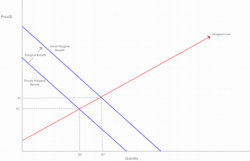
Defining the Socially Optimal Outcome
The socially optimal outcome is the quantity of immunizations where the cost of the vaccine equals the total social marginal benefit. Because private benefits are almost always lower than social benefits, vaccines are typically under-consumed without intervention. Interestingly, the "optimal" level of immunization does not always mean the total eradication of a disease.
Eradication vs. Management
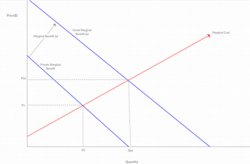
The goal of immunization varies depending on the severity of the illness and the cost of the vaccine. In some cases, the social marginal benefit is so high that society is willing to pay whatever is necessary to achieve total eradication. A primary example is smallpox, where the risk was so great that the social optimum was the complete elimination of the virus.
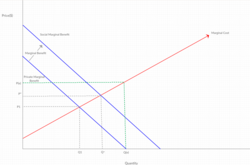
In other cases, the social optimum results in a level of immunization that allows the disease to persist at a low level. For instance, measles still sees occasional outbreaks in the United States because the social optimum—balancing cost and benefit—leaves room for a small presence of the disease, even if it occasionally leads to deaths.
Internalizing the Externality
To correct market failure, society must "internalize the externality." This means ensuring that the person receiving the vaccine is compensated for the benefit they provide to others. This is most commonly achieved through subsidies—financial assistance provided by the government to lower the cost for the consumer.
Government and Non-Profit Intervention
In the United States, immunization programs were originally managed at state and local levels, leading to inconsistent subsidy levels and uneven immunization rates. The Vaccination Assistance Act of 1962 helped standardize these efforts, moving the country closer to a socially optimal outcome on a national scale.
Beyond government action, non-profit organizations play a critical role in developing regions. In areas where individuals cannot afford vaccines at any price, these organizations provide free immunizations, moving communities from a state of severe under-immunization toward the social optimum.
Challenges to Achieving Optimums
Achieving a social optimum is not without hurdles. Cultural movements and vaccine controversies can shift the private marginal benefit curve. If an individual perceives the health risks of a vaccine to be higher than the risks of the antigen itself, their private benefit drops. This widening gap between private and social benefits makes it increasingly difficult for governments to reach the social optimum through subsidies alone.
Key Facts
- Positive Externality: Immunizations benefit not just the recipient but society at large via herd immunity.
- Market Failure: Under-consumption occurs because individuals base decisions on private marginal benefit rather than social marginal benefit.
- Social Optimum: The ideal quantity of vaccines where social benefit equals cost; this does not always equal total eradication.
- Internalization: Subsidies (like those from the Vaccination Assistance Act of 1962) help align private incentives with social benefits.
- Eradication Example: Smallpox was eradicated because its social marginal benefit was exceptionally high.
| Term | Definition | Impact on Consumption |
|---|---|---|
| Private Marginal Benefit | Value to the individual receiving the vaccine | Leads to under-consumption |
| Social Marginal Benefit | Private benefit + benefit to society (herd immunity) | Defines the socially optimal quantity |
| Subsidies | Payments to lower the cost of the vaccine | Increases consumption toward social optimum |
Frequently Asked Questions
Why don't we eradicate every disease for which a vaccine exists?
Total eradication is not always the end goal because it depends on the balance between the cost of immunization and the social marginal benefit. For some diseases, the social optimum is a level that manages the disease rather than eliminating it entirely.
What is the difference between private and social marginal benefit?
Private marginal benefit is the personal health protection an individual gains. Social marginal benefit includes that personal protection plus the added protection provided to the rest of the community through herd immunity.
How do subsidies help solve the problem of under-immunization?
Subsidies lower the price for the individual, effectively paying them for the positive externality they provide to society. This encourages more people to get vaccinated, moving the quantity closer to the socially optimal level.
How do vaccine controversies affect the economics of immunization?
When people believe a vaccine is riskier than the disease it prevents, their private marginal benefit decreases. This shifts the demand curve, making it harder for governments to reach the social optimum even with subsidies.
What role do non-profits play in immunization economics?
Non-profits provide free vaccines in developing regions where individuals cannot afford them. This allows these communities to bypass the private marginal benefit barrier and move toward a socially optimal level of protection.