Icterids: The Diverse Family of New World Blackbirds
The Icteridae, commonly known as New World blackbirds, are a vibrant family of small to medium-sized passerine birds found throughout the Americas. Comprising 108 species across 30 genera, these birds are recognized for their striking plumage—often dominated by black and accented with brilliant yellows, oranges, or reds—and their remarkable adaptability in both form and function.
From the elegant orioles to the loud grackles, the icterids exhibit a level of diversity in size and behavior that is nearly unmatched among songbirds. Their name is derived from the Ancient Greek íkteros, meaning "jaundiced ones," a nod to the bright yellow feathers seen in many of its members.
Key Facts
- Species Count: 108 species divided into 30 genera.
- Distribution: Primarily tropical, with high densities in Colombia and southern Mexico, though some inhabit temperate regions.
- Unique Adaptation: "Gaping," a skull configuration that allows them to force open bills to find hidden food.
- Extreme Dimorphism: Some species show massive size differences between sexes; for example, male great-tailed grackles are 60% heavier than females.
- Diverse Diet: Includes nectar, seeds, fruit, and insects.
Classification and Relationships
Despite their common names, New World blackbirds are only distantly related to the Old World blackbirds (which are thrushes) or Old World orioles. They belong to the superfamily Emberizoidea and are classified as nine-primaried oscines, meaning they possess nine primary feathers.
Recent phylogenetic research has clarified their lineage. A 2019 analysis identified the Icteridae as the sister group to the Icteriidae (which contains only the yellow-breasted chat). Together, these two families form a clade that is sister to the Parulidae, the New World warblers.
Physical Characteristics and Adaptations
Icterids are noted for their extreme sexual dimorphism, where males are typically larger and more colorful than females. The size variation within the family is staggering: the orchard oriole female averages just 15 cm in length and 18 g in weight, while the male Amazonian oropendola can reach 52 cm and weigh approximately 550 g.
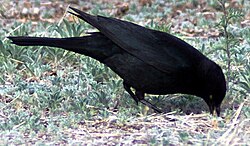
One of the most fascinating morphological traits of the family is gaping. Unlike most birds that open their bills passively, icterids can open their bills with force. This allows them to pry apart bark or open the skins of fruits to reach the soft interior.
Dietary Specializations
The family has evolved various bill shapes to exploit different food sources:
- Oropendolas and Caciques: Long bills used for gaping into fruit.
- Cowbirds and Bobolinks: Short, stubby bills designed for crushing seeds.
- Jamaican Blackbirds: Specialized bills for prying through tree bark and epiphytes (plants that grow on other plants), filling a niche similar to woodcreepers.
- Orioles: Adapted for drinking nectar.
Behavior and Ecology
Icterids inhabit a wide array of environments, including savannas, forests, swamps, and scrublands. While many tropical species remain stationary, temperate species—such as the red-winged blackbird—are migratory, traveling between North America and Central America.
Nesting and Social Structure
Nesting habits vary wildly. Some species, like orioles and oropendolas, build intricate pendulous woven nests. Many are colonial, with some colonies reaching up to 100,000 birds. A notable behavioral trait in some cowbirds is brood parasitism, where the female lays her eggs in the nests of other bird species, leaving the host to raise the offspring.
Conservation and Human Impact
The relationship between icterids and humans is complex. Some species are viewed as agricultural pests; in the United States, red-winged blackbirds are considered significant pests for crops like rice. In 1994, control costs in California reached $30 per acre.
Conversely, several species are facing extinction due to habitat loss. Threatened birds include the St Lucia oriole, the yellow-shouldered blackbird, and the Jamaican blackbird. The tricolored blackbird of California is also at risk due to the destruction of its nesting habitats.
| Category | Details |
|---|---|
| Total Species | 108 |
| Total Genera | 30 |
| Smallest Species | Orchard Oriole (Female: ~15 cm / 18 g) |
| Largest Species | Amazonian Oropendola (Male: ~52 cm / 550 g) |
| Primary Habitats | Scrub, swamp, forest, and savanna |
| Key Groups | Orioles, Meadowlarks, Grackles, Cowbirds, Oropendolas, Caciques |
Frequently Asked Questions
Are New World blackbirds related to European blackbirds?
No. Despite the similar names, New World blackbirds (Icteridae) are only distantly related to the Old World common blackbird, which is actually a member of the thrush family.
What is "gaping" in icterids?
Gaping is a specialized skull configuration that allows these birds to open their bills with strong force rather than passively, enabling them to pry open gaps to find hidden food.
Which icterid species is the largest?
The Amazonian oropendola is the largest, with males measuring up to 52 cm in length and weighing about 550 g.
What is brood parasitism?
Brood parasitism is a reproductive strategy used by some cowbirds, where the female lays her eggs in the nests of other bird species, forcing the host parents to raise the cowbird chicks.
Why are some icterids considered pests?
Certain species, such as the red-winged blackbird, feed on agricultural crops like rice in large numbers, leading to significant economic losses for farmers.