ICI: The Rise and Fall of a British Chemical Giant
For over eight decades, Imperial Chemical Industries (ICI) stood as a titan of British industry. Formed from a strategic merger of the UK's leading chemical firms, ICI evolved from a producer of basic explosives and fertilizers into a global powerhouse of innovation, shaping the modern world through the invention of plastics and advanced pharmaceuticals.
From its headquarters in London, ICI navigated the complexities of two world wars and the volatile shifts of the global market, eventually transitioning from bulk commodity chemicals to high-margin speciality products before its final acquisition in 2008.
Key Facts
- Founded: 1926 via the merger of Brunner Mond, Nobel Explosives, United Alkali Company, and British Dyestuffs Corporation.
- Major Innovations: Developed Perspex, polyethylene, Terylene, and Dulux paints.
- Peak Reach: Became Britain's largest exporter during the early 1970s.
- Strategic Pivot: De-merged its pharmaceutical arm as Zeneca in 1993.
- Final Fate: Acquired by AkzoNobel in 2008 for £8 billion.
The Foundation and Early Growth (1926–1944)
ICI was established in December 1926 to create a British entity capable of competing with global giants like DuPont and IG Farben. By 1928, the company had established its head office at Millbank, London. In its first year alone, the company recorded a turnover of £27 million.
The early years were marked by rapid scientific breakthroughs. ICI was instrumental in developing phthalocyanine (a dyestuff) in 1929, the acrylic plastic Perspex in 1932, and polyethylene in 1937. They also co-developed Dulux paints with DuPont and created the polyester fiber Terylene in 1941.
During World War II, the company's role shifted toward national defense. Its subsidiary, ICI Nobel, produced essential munitions, while the parent company contributed to the secret British nuclear weapons program, known as Tube Alloys.
Postwar Innovation and Expansion (1945–1990)
Following the war, ICI expanded its reach into pharmaceuticals and agrochemicals. In 1957, the company formalized this growth by creating ICI Pharmaceuticals. The company also became a leader in crop protection, developing the herbicide paraquat in 1962 and various insecticides throughout the 1960s and 70s.
The company's leadership saw various eras of growth and contraction. Under Chairman Jack Callard (1971–1975), ICI became the UK's largest exporter and expanded into the US market by acquiring Atlas Chemical Industries Inc. Later, under the leadership of John Harvey-Jones (1982–1987), the company acquired the Beatrice Chemical Division and Glidden Coatings & Resins.
ICI also ventured into mining, establishing the Boulby Mine in North Yorkshire via its subsidiary Cleveland Potash Ltd, which began full production in 1976.
Strategic Reorganization and Decline (1991–2007)
The 1990s brought significant instability. In 1991, ICI faced a hostile takeover attempt by Hanson. Although the bid—which would have been the largest in British history—eventually failed, it signaled to investors that the company was vulnerable.
To survive, ICI began a massive restructuring to move away from commodity chemicals (basic, high-volume chemicals) toward speciality chemicals (higher-value, low-volume products). This included:
- The 1993 de-merger of its bio-science and pharmaceutical businesses into a new company, Zeneca.
- The sale of its nylon business to DuPont in 1992.
- The £1 billion sale of ICI Australia in 1997.
- The $8 billion acquisition of Unilever's speciality chemicals businesses in 1997.
The Final Chapter: Acquisition by AkzoNobel
By 2008, the era of ICI as an independent entity ended. On January 2, 2008, the company was acquired by the Dutch firm AkzoNobel for £8 billion. As part of the deal, ICI's adhesives business was sold to Henkel, and AkzoNobel sold Crown Paints to satisfy competition regulators.
Operational Legacy
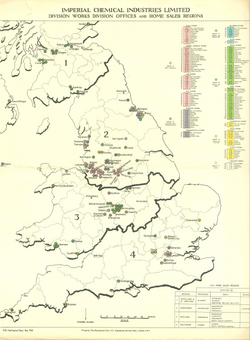
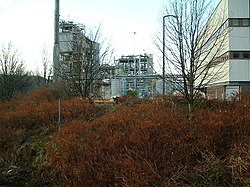
ICI maintained a vast network of industrial sites. In the UK, key locations included Blackley and Huddersfield for dyestuffs and insecticides, Buxton for limestone quarrying, and specialized paint plants in Stowmarket, Prudhoe, and Birmingham.
| Metric | Value |
|---|---|
| Revenue | £4.85 billion |
| Operating Income | £502 million |
| Net Income | £295 million |
| Number of Employees | 29,130 |
| Final Parent Company | AkzoNobel |
Frequently Asked Questions
What was ICI?
Imperial Chemical Industries (ICI) was a major British chemical company founded in 1926. It was a leader in the production of plastics, paints, pharmaceuticals, and general chemicals for over 80 years.
What are some of ICI's most famous inventions?
ICI is credited with the development of several world-changing materials, including the plastic Perspex, the polymer polyethylene, and the synthetic fiber Terylene.
Why did ICI split from Zeneca?
In 1993, ICI de-merged its pharmaceutical and bio-science businesses into Zeneca to allow both companies to focus on their respective strengths: ICI on speciality chemicals and Zeneca on healthcare.
Who eventually bought ICI?
ICI was acquired by the Dutch company AkzoNobel in 2008 for £8 billion, after which its remaining operations were integrated into AkzoNobel's organization.
What happened to the ICI plants in Huddersfield?
The Huddersfield sites transitioned through several owners following the Zeneca split and the AkzoNobel takeover, with portions eventually being owned by companies such as Syngenta, Avecia, Arch, and Lubrizol.