ice hockey rulesprofessional hockey leagueshockey equipmentIIHFNHL

Ice Hockey: A Comprehensive Overview of the World's Premier Winter Sport

Ice Hockey: A Comprehensive Overview of the World's Premier Winter Sport Ice hockey is a high-speed, contact team sport played on an ice surface. Characterized by its intense physicality ...

Ice Hockey: A Comprehensive Overview of the World's Premier Winter Sport

Ice hockey is a high-speed, contact team sport played on an ice surface. Characterized by its intense physicality and rapid pace, the game involves players using sticks to maneuver a puck toward an opponent's net. While often played in professional arenas, the sport also maintains a strong recreational presence on frozen lakes and ponds.
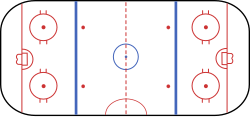
rectangle with markers for goal nets, faceoff positions, and lines for rules purposes
Traditional layout of an ice hockey rink surface.

The sport's modern structure is governed globally by the International Ice Hockey Federation (IIHF). Since its first recorded play in Montreal, Quebec, in 1875, ice hockey has evolved from a regional pastime into a massive international phenomenon, featured prominently in both the Summer and Winter Olympic Games.

Key Facts

  • First Played: 1875 in Montreal, Quebec, Canada.
  • Governing Body: International Ice Hockey Federation (IIHF).
  • Standard Team Composition: 3 forwards, 2 defencemen, and 1 goaltender.
  • Olympic Status: Men's competition has been part of the Olympics since 1920; Women's since 1998.
  • Contact Levels: Full contact for men; limited contact for women.

Game Mechanics and Rules

A standard game is played on a hockey rink, which varies slightly depending on the league. For example, the National Hockey League (NHL) utilizes specific dimensions and markings that differ from traditional layouts.
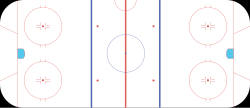
An NHL ice hockey rink. It includes a trapezoid behind the goal line and a blue painted area in front of the goal. The blue lines are also closer together than they are on a traditional rink.

Teams manage their energy and strategy through line changes, where an entire group of players is substituted at once to maintain high intensity throughout the match.
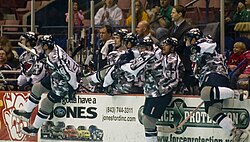
Players from the South Carolina Stingrays perform a line change. A line change is a substitution of an entire line at once.

Periods and Overtime

Games are divided into periods. If a game remains tied at the conclusion of regulation time, leagues often employ sudden death overtime. If the score remains tied after extra periods, some tournaments utilize a shootout to determine the winner.
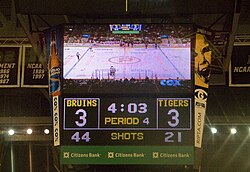
Scoreboard for a hockey game during the fourth period. If a game is tied at the end of the third period, several leagues and tournaments have teams play additional sudden death overtime periods.
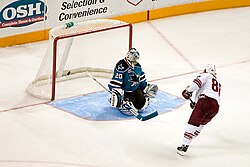
Several leagues and tournaments have implemented the shootout as a means to determine a winner, if the game remains tied after an extra overtime period.

Penalties and Officiating

To maintain fairness, officials monitor the game for rule infractions. When a player commits a foul, they are sent to the penalty box, forcing their team to play shorthanded for a set duration.
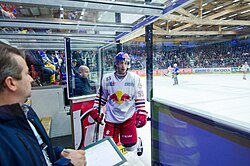
An ice hockey player enters the penalty box. Players may be sent to the penalty box for rule infractions, forcing their team to play with one less player for a specified time.

Referees may also call a delayed penalty, a situation where play continues until the offending team regains control of the puck or a goal is scored. In certain instances, a referee may award a penalty shot if an infraction prevents a clear scoring opportunity.
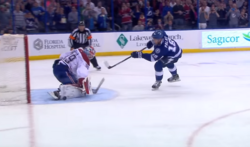
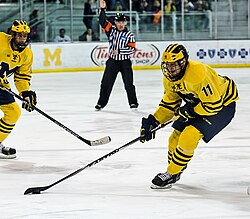
A skater taking a penalty shot, with a referee in the background. A referee may award a player with a penalty shot if they assess an infraction stopped the player from a clear scoring opportunity.
A referee calls a delayed penalty, which sees play continue until a goal is scored, or the opposing team regains control of the puck.

Professional officiating often utilizes a four-official system to ensure comprehensive coverage of the ice. Referees are typically distinguished from lineswomen by wearing orange armbands.
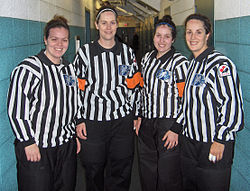
Officials working under a four-official system. Orange armbands are worn by the referees to distinguish them from the lineswomen.

Physicality and Safety

Ice hockey is a physical sport. In men's professional leagues, body checking—the act of using the body to impede an opponent—is a standard defensive and offensive tactic.
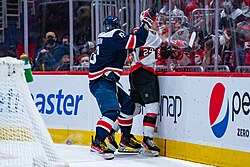
A player checks an opposing skater into the board that surrounds the ice.
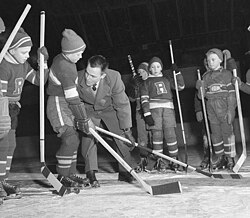
Youths being taught how to properly deliver a check in ice hockey.

Because players move at high speeds and engage in heavy contact, the risk of injury is present. Protective gear is essential for all participants.
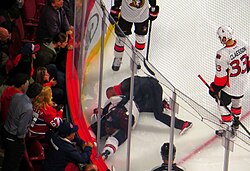
An injured skater being attended to after hitting the endboards. Because ice hockey is a full-contact sport, and involves players moving at high speeds, injuries can occur during play.

Essential Equipment

Players rely on specialized gear to protect against impacts from sticks, pucks, and other players. Standard equipment includes:

  • Protective Padding: Helmets (often with visors or cages), shoulder pads, elbow pads, shin pads, and hockey pants.
  • Skating Gear: Ice hockey skates.
  • Hand and Neck Protection: Gloves and neck guards (depending on league regulations).
  • Other Essentials: Hockey sticks, pucks, mouthguards, and jock/jill protection.
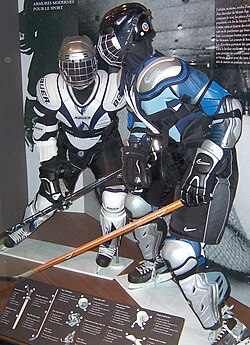
Models with the protective equipment worn by ice hockey skaters, such as a helmet, shoulder pads, elbow pads, gloves, hockey pants, and shin guards.

Goaltenders require even more specialized equipment to defend the net, often sacrificing mobility for maximum protection.
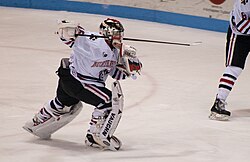
A goalie heads to the bench in order to allow for an extra attacker.

The Evolution of Women's Ice Hockey

Women's ice hockey has seen explosive growth. Between 1995 and 2005, participation increased by 400 percent. While men's hockey is full-contact, women's hockey is categorized as limited contact.
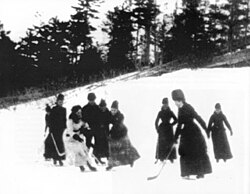
Women playing ice hockey, c. 1888. The daughter of Lord Stanley of Preston, Lady Isobel Gathorne-Hardy, is visible in white.

The history of international women's competition began with the 1987 World Women's Hockey Tournament in Toronto. The first IIHF-sanctioned Women's World Championship took place in 1990 in Ottawa. Today, the Professional Women's Hockey League (PWHL) stands as a premier level of club competition.
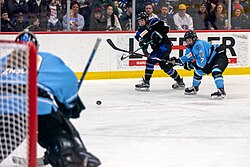
Members of the Buffalo Beauts and the Minnesota Whitecaps during the 2019 Isobel Cup championship game for the NWHL, later known as the Premier Hockey Federation.

Women's ice hockey has also been a staple of the Winter Olympics since 1998, showcasing elite talent on the global stage.
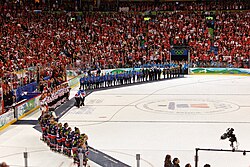
Medal ceremony for the women's ice hockey tournament at the 2010 Winter Olympics.

Professional Leagues and Global Presence

Ice hockey is played professionally across the globe, with varying levels of attendance and regional dominance. The National Hockey League (NHL) remains the most prominent league in terms of attendance and scale.

Comparison of Major Professional Leagues
League Country/Region Average Attendance (Approx.)
National Hockey League (NHL) USA & Canada 17,448
Professional Women's Hockey League USA & Canada 9,304
Kontinental Hockey League (KHL) Eurasia 7,870
Deutsche Eishockey Liga (DEL) Germany 7,563
National League (NL) Switzerland 7,367
Swedish Hockey League (SHL) Sweden 7,047

Beyond North America and Europe, leagues exist in various forms, including junior leagues like the Western Hockey League (WHL) and developmental leagues such as the American Hockey League (AHL).
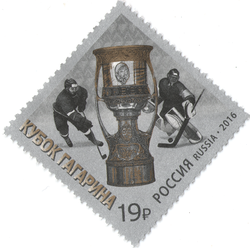
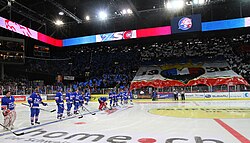
A Russian stamp commemorating the Gagarin Cup, which is presented to the KHL's playoff champion. The KHL is the largest ice hockey league in Eurasia.
Players from the ZSC Lions line up prior to a game. The club plays in the Swiss National League A.
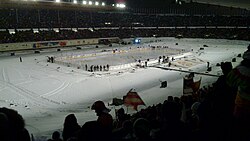
Finnish clubs Jokerit and HIFK during a 2011 outside game at the Helsinki Olympic Stadium.
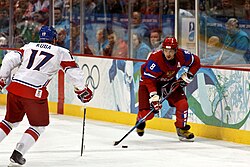
Alexander Ovechkin of the Russian men's hockey team moves the puck as Czech Republic's Filip Kuba defends against him, during the 2010 Olympics.
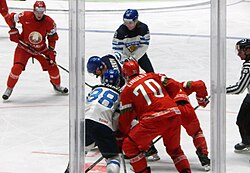
Skaters from the Finnish and Belarusian men's ice hockey teams shortly after a face-off during the 2016 IIHF World Championship. The IIHF is an annual national team tournament.
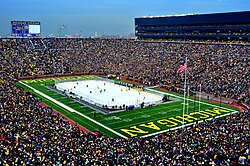
The Big Chill at the Big House was a collegiate ice hockey game played at Michigan Stadium in 2010. The game set the attendance record for ice hockey games.
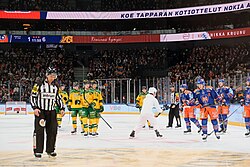
The match between rival teams Ilves (yellow and green) and Tappara (blue and orange) on December 3, 2021, at Nokia Arena in Tampere, Finland.

From the massive crowds at collegiate games to the community spirit of pond hockey, the sport's reach is vast.
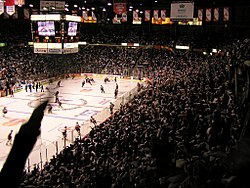

Pre-game warmups prior to a Memorial Cup game. The tourney serves as the championship for the major junior Canadian Hockey League.
Pictogram used to identify ice hockey at the Winter Olympic Games
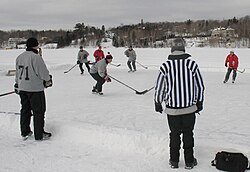
A game of pond hockey being played in Lac-Beauport, Quebec

While the sport is highly regulated, it is not without its controversies; fighting, though prohibited by many official rules, remains a known element in certain North American contexts.
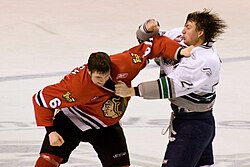
Fighting is prohibited by the rules but is common in North America.

Fans also engage with the sport through various activities, from attending high-stakes championship games to participating in fan exhibits.
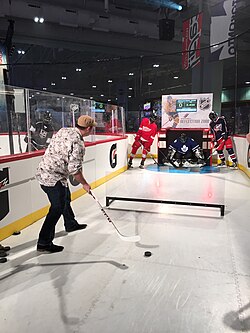
An NHL fan exhibit, where guests attempt to deflect the puck in order to score.

Frequently Asked Questions

What is the difference between ice hockey and field hockey?

Ice hockey is played on ice using skates and a puck, whereas field hockey is played on grass or synthetic turf using a ball.

How many players are on the ice during a standard game?

A standard team lineup consists of 3 forwards, 2 defencemen, and 1 goaltender.

What happens if a game is tied after overtime?

Many leagues and tournaments use a shootout to determine a winner if the score remains tied after extra overtime periods.

Is ice hockey a contact sport?

Yes, it is a contact sport. In men's leagues, it is full-contact, while women's hockey is categorized as limited contact.

Who governs international ice hockey?

The International Ice Hockey Federation (IIHF) is the highest governing body for the sport.

References

  1. Cox, M. H.; Miles, D. S.; Verde, T. J.; Rhodes, E. C. (1995). "Applied Physiology of Ice Hockey" (PDF). Sports Med. 19 (3): 184–201. doi:10.2165/00007256-199519030-00004. ISSN 0112-1642. PMID 7784758. S2CID 26998630. Archived (PDF) from the original on January 9, 2023. Retrieved January 9, 2023.
  2. Dillman, Charles J.; Stockholm, Alan J.; Greer, Nancy (1984). "Movement of ice hockey players". Isbs – Conference Proceedings Archive. ISBS.
  3. "Scots skate on thin ice with hockey claim". The Scotsman. January 31, 2009. Retrieved December 31, 2024.
  4. "Historians dispute proposed Nova Scotia law claiming 'birthplace' of ice hockey". www.bbc.com. March 4, 2026. Retrieved March 5, 2026.
  5. "National Sports of Canada Act, S.C. 1994, c. 16". Government of Canada, Justice Laws. December 31, 2002. Archived from the original on November 6, 2021.