Hydrophobicity and the Science of Superhydrophobic Surfaces
The interaction between water and various surfaces is a fundamental aspect of chemistry and physics, governing everything from how rain cleans a leaf to the design of advanced industrial coatings. At the heart of this interaction is hydrophobicity—the physical property of a molecule or surface that repels water. This phenomenon is not merely a matter of chemical composition but is deeply rooted in thermodynamics, entropy, and surface geometry.
The Chemistry of Hydrophobic Interactions
For small nonpolar solutes, hydrophobicity is primarily an entropic effect. When a nonpolar molecule enters liquid water, it disrupts the dynamic hydrogen bonds between water molecules. To compensate, water molecules arrange themselves into a highly ordered, cage-like structure known as a clathrate. Because this structure is more ordered than free water, it results in a lower entropic state.
To minimize this loss of entropy, nonpolar molecules tend to clump together. This reduces the total surface area exposed to water, thereby increasing the overall entropy of the system. This process is visualized as phase separation, where hydrophilic (water-attracting) and hydrophobic (water-repelling) phases separate to minimize their interfacial area.
As the size of the nonpolar solute increases, the mechanism shifts. For solutes larger than approximately 1 nm, the water network can no longer form a complete clathrate cage. This leads to the inevitable disruption of hydrogen bonds, creating a high enthalpic cost. At this scale, the hydration free energy shifts from scaling with the solute's volume to depending on its exposed surface area.
Quantifying Hydrophobicity: The DIT and V4S Index
To define hydrophobicity at a molecular level, scientists use the Defect Interaction Threshold (DIT). This is the energetic cost of creating a hydrogen-bond defect in pure water, estimated at approximately −6 kJ/mol (about 30% of a typical hydrogen bond's energy). A system is considered hydrophobic if it cannot compensate for missing hydrogen bonds with energy as favorable as the DIT.
This molecular threshold aligns with the classical 90° contact angle threshold. Furthermore, the V4S index—a structural indicator—is used to analyze the four tetrahedral interaction sites of water molecules to determine regimes of filling, partial filling, and drying in nanoconfined environments.
Superhydrophobicity and the Lotus Effect
While many surfaces are hydrophobic, superhydrophobic surfaces exhibit extreme water repellency, with water droplets maintaining a contact angle exceeding 150°. A prime example is the lotus plant leaf, which utilizes the lotus effect. This is primarily a physical property driven by interfacial tension and surface structure rather than chemical composition alone.
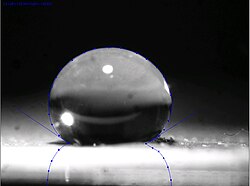
The Theory of Wetting and Contact Angles
In 1805, Thomas Young established the foundation for measuring how a liquid interacts with a solid. He defined the contact angle (θ) as the angle formed where the liquid, gas, and solid intersect at the three-phase boundary.
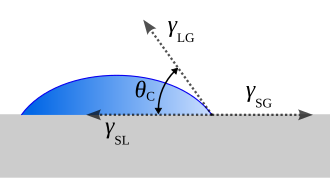
Young's equation describes this relationship using interfacial tensions: γ SG = γ SL + γ LG cos θ, where γ represents the tension between the solid-gas (SG), solid-liquid (SL), and liquid-gas (LG) interfaces. This angle is typically measured using a contact angle goniometer.
Wenzel vs. Cassie–Baxter States
When a surface is microstructured (rough), the behavior of the droplet changes based on how it interacts with those structures. There are two primary states:
- Wenzel State: The liquid is in intimate contact with the surface asperities (roughness). Microstructuring amplifies the surface's natural tendency: hydrophobic surfaces become more hydrophobic, and hydrophilic surfaces become more hydrophilic.
- Cassie–Baxter State: The liquid rests on the tops of the microstructures, trapping air beneath the droplet. This state allows the liquid to be significantly more mobile.
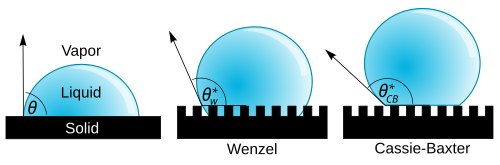
The transition between these states depends on free energy minimization. Generally, the state that predicts the smaller new contact angle is more likely to exist. Recent criteria suggest the Cassie–Baxter state persists if contact line forces overcome the droplet's weight and the microstructures are tall enough to prevent the liquid from touching the base.
Dynamic Measures of Hydrophobicity
While the contact angle measures static hydrophobicity, dynamic behavior is measured via contact angle hysteresis and slide angle.
Contact angle hysteresis is the difference between the advancing contact angle (the angle just before the droplet boundary moves outward) and the receding contact angle (the angle just before the boundary moves inward). High hysteresis indicates surface heterogeneity or roughness that impedes motion.
The slide angle is the tilt angle at which a droplet begins to slide off a surface. Droplets in the Cassie–Baxter state typically exhibit lower slide angles and lower hysteresis than those in the Wenzel state, making them much easier to move.
Key Facts
- Superhydrophobicity is defined by a water contact angle greater than 150°.
- Small nonpolar solutes drive hydrophobicity through entropy by forcing water into clathrate-like cages.
- Large nonpolar solutes (>1 nm) drive hydrophobicity through enthalpy due to the disruption of hydrogen bonds.
- The Defect Interaction Threshold (DIT) is approximately −6 kJ/mol.
- The Wenzel state involves full wetting of surface roughness, while the Cassie–Baxter state involves air trapping.
- Contact angle hysteresis is the difference between advancing and receding contact angles, indicating surface heterogeneity.
| Feature | Wenzel State | Cassie–Baxter State |
|---|---|---|
| Liquid Interaction | Intimate contact with asperities | Rests on top of asperities |
| Air Trapping | No air trapped | Air trapped beneath droplet |
| Mobility | Lower mobility | Higher mobility |
| Slide Angle | Higher | Lower |
| Hysteresis | Higher | Lower |
Frequently Asked Questions
What is the difference between the Wenzel and Cassie-Baxter states?
In the Wenzel state, the liquid completely penetrates the rough features of a surface, amplifying its natural hydrophobicity or hydrophilicity. In the Cassie-Baxter state, the liquid sits on top of the surface features, trapping air underneath, which significantly increases droplet mobility.
How does the size of a solute affect its hydrophobic behavior?
Small solutes (under 1 nm) create a hydrophobic effect primarily through entropy by inducing a clathrate-like structure in water. Larger solutes disrupt hydrogen bonds more severely, making the process governed by enthalpy and the surface area of the solute.
What is the lotus effect?
The lotus effect refers to the superhydrophobicity found in nature, such as on lotus leaves, where a combination of surface roughness and interfacial tension results in water contact angles exceeding 150°, causing water to bead and roll off easily.
What does contact angle hysteresis tell us about a surface?
Contact angle hysteresis—the difference between the advancing and receding contact angles—characterizes surface heterogeneity and roughness. A higher hysteresis generally means the surface has more domains that impede the motion of the liquid's contact line.
What is the Defect Interaction Threshold (DIT)?
The DIT is a molecular measure of hydrophobicity, estimated at −6 kJ/mol. It represents the energy cost of creating a hydrogen-bond defect in water; if a system cannot compensate for this cost, it is considered hydrophobic.